Governing coding agent sprawl with Unity Gateway
Securely deploy, manage, and scale AI coding tools across your organization with centralized governance, observability, and cost controls
by Aarushi Shah, Ankit Mathur, Bilal, Kevin Stumpf, Rohit Agrawal, Harish Gaur and Ana Nieto
- Securely govern coding agents with centralized audit and MCP controls
- Unify costs across tools with single budgets and transparent billing
- Get full visibility into adoption, usage, and effectiveness with built-in observability
Software development has entered a new era. The best engineering teams are now shifting development from human-driven to agent-driven. All organizations should be aggressively looking to deploy these new 10x engineers as broadly as possible but they are concerned about governing and monitoring adoption. For coding agents to be successful, they need access to sensitive company data such as engineering tickets, design documents, and customer issues, and organizations fear the security risks and runaway costs of ungoverned and unmonitored adoption.
Today, we’re introducing the Coding Agent Support in Unity Gateway. Our goal is to deliver coding tool freedom for developers and unified governance for admins.
AI Coding Agent Sprawl
Opus 4.6, Composer 2, GPT-5.4, Kimi-2.5, Gemini 3 Pro -- new models are released every week that reshape the frontier of cost and quality. Coding tools themselves are also constantly evolving, and software developers want choice, For example, within Databricks, our software developers flexibly mix usage between Cursor, Codex, Claude Code, and others -- often using multiple tools at the same time! Adopting multiple coding tools is a business necessity, which then introduces key challenges for administrators trying to move fast to support developer productivity with multiple tools.
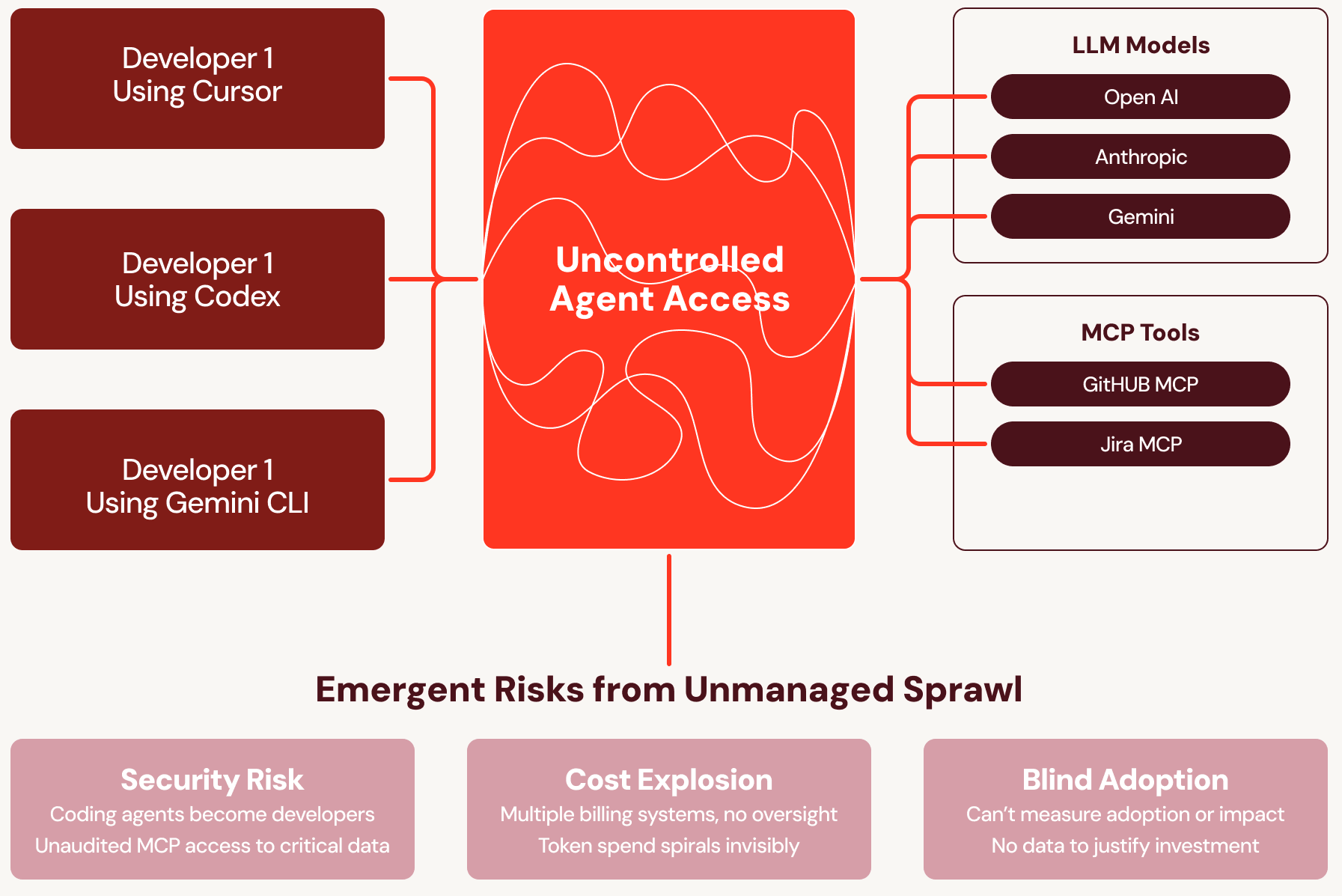
Security, data privacy, and cost reviews for new tools can slow teams down. In addition, these AI coding tools require much stronger due diligence for several reasons:
- Security Risk: MCPs can give agents access to sensitive data
MCP tools are most useful when they have access to critical data within your organization, so it’s easy to accidentally make them the most privileged developer in your organization. How do organizations audit and govern agent’s access to data? - Cost Explosion: Agent costs are exploding
With AI usage growing, agent costs are becoming a top R&D cost driver. Access to AI and flexibility of tools needs to be balanced with reasonable cost guardrails. How can admins ensure effective cost controls across multiple tools? - Visibility Gap: Executives lack visibility into tool adoption
With the expanding capabilities of these tools, organizations are racing to adopt AI. To scale AI across an organization, measurement is critical to identify the key blockers. How can executives easily see who is using AI if everyone’s using a different tool?
So, how can organizations move fast to enable AI productivity while ensuring data privacy and cost visibility?
Introducing Coding Agent Support in Unity Gateway
To simplify this, we are introducing the coding agent support in Unity Gateway, a unified governance hub for popular coding tools like Codex, Cursor, and Gemini CLI. Our gateway unifies access controls, usage statistics, operational observability, cost management, guardrails, and inference capacity into a single platform, giving you centralized control over your AI agents.
- Pillar 1: Centralized Security and Audit: All agent data access can be centrally governed with all audit logs in Unity Catalog with MCP servers managed in Databricks and centralized tracing with MLflow.
- Pillar 2: Single Bill and Cost Limits: Admins can set cost limits that apply across whichever tools developers want to use. With capacity from Foundation Model API, which offers first-party inference for all popular models, admins get one all-in bill from Databricks.
- Pillar 3: Full Observability in the Data Lakehouse: Critical data like lines of code written per user, cost per month per user, and more are all automatically ingested into your Data Lakehouse, alongside the rest of your critical data.
Security and Compliance for Coding Agent, MCP and LLM Interactions
AI Gateway unifies security governance across coding agents, LLM interactions and MCP integrations. Your development workflows run on the same trusted platform as your analytics and AI, with centralized controls
- Data privacy: We ensure your private data stays within the Databricks security perimeter.
- Audit-ready logging: Automatically capture traces in Unity Catalog for compliance and security reviews.
- Single identity across all services: Developers authenticate once with Databricks credentials for all tools—GitHub, Atlassian, and others—with no separate logins per service. This securely connects agents to critical data sources while enforcing consistent governance.
By unifying all integrations, including coding agents and MCP tools, organizations can centralize logging, enforce policies, and monitor usage across the entire ecosystem, ensuring consistent security and compliance.
Simplify cost management and billing
Databricks’ Foundation Model API provides inference for OpenAI, Anthropic, and Gemini models, and the best open source coding models like Qwen in a single platform. The Gateway also lets you bring external capacity in, expanding governance to all your tokens, regardless of where they flow.
This means your coding tools can connect to the same capacity as your other agents, and costs are centralized into a single bill and observability platform! Foundation Model API offers day one launches for every frontier LLM model, so developers can use the newest, best models that are coming out immediately.
With our centralized Gateway, admins can stop switching tabs between admin consoles to control rate limits and budgets for every single coding tool. Instead, organizations can give developers a single budget across all coding tools to burn down on their agent of choice!
Unified Observability for AI Coding Tools
By treating AI coding tool usage data as a first-class citizen in Unity Catalog alongside your enterprise datasets, you gain a unified, governed framework for deep operational intelligence. This ensures all coding activity is auditable, secure, and ready for automated workflows.
With our OpenTelemetry ingestion, coding tool metrics and traces are automatically centralized to Unity Catalog-managed Delta tables.
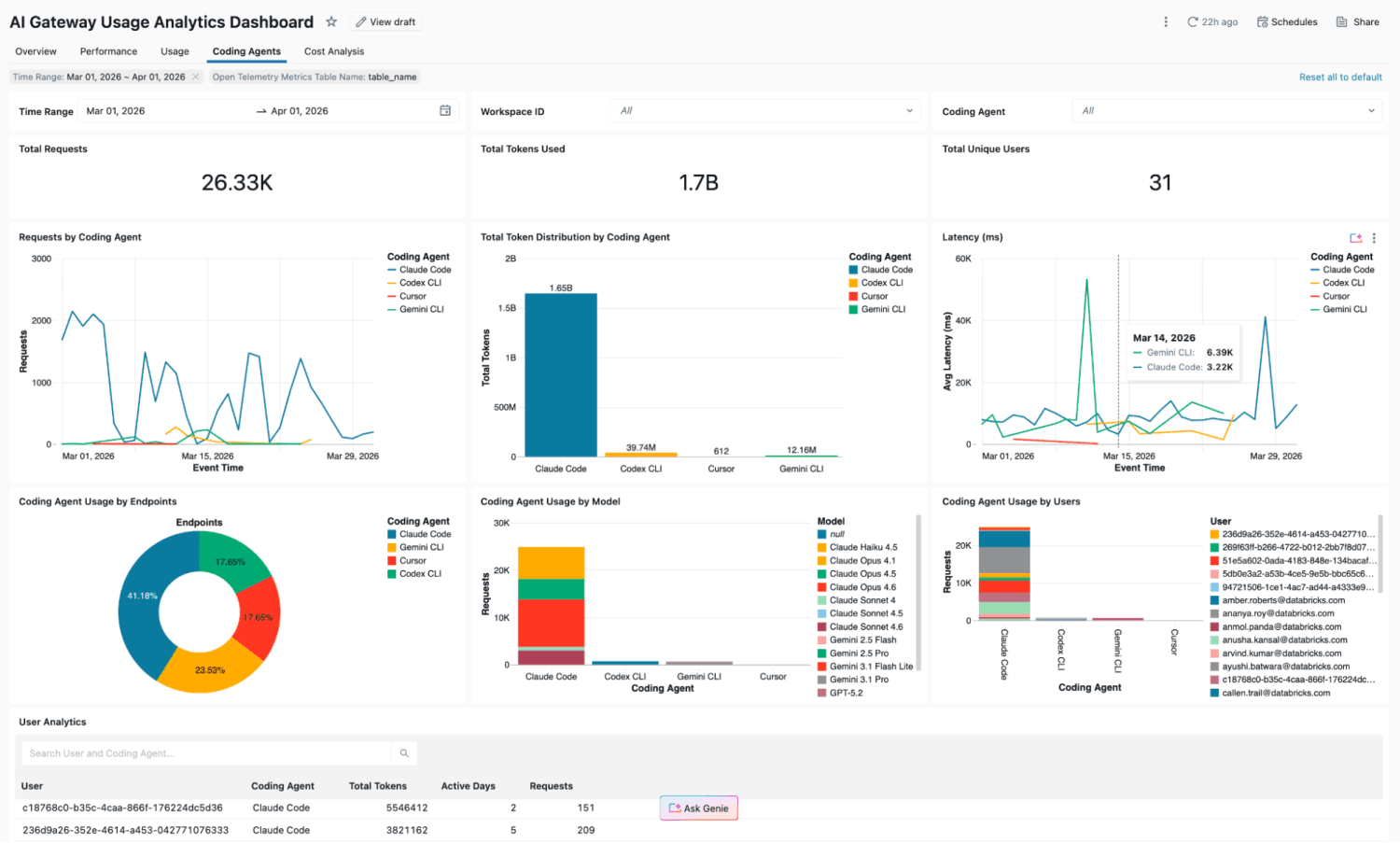
With all the data landing in the Lakehouse, enterprises are finding creative ways to combine usage data with their business’ ontology.
- Track adoption per org: Join AI Gateway metrics with Workday to map GenAI adoption by department, region, or seniority, helping identify where to target enablement.
- Quantify Developer Velocity: Measure the tangible impact of AI assistance on output.
Example: "A 20% increase in token usage per developer drove a 15% reduction in pull request cycle time, directly linking AI tool usage to increased developer velocity."
- Proactive Capacity Planning: Monitor users hitting rate limits to data-justify securing additional capacity or dedicated throughput before productivity is throttled.
What Our Customers Are Saying
We have been working to get visibility into our coding tool usage across teams. We need a centralized way to monitor spending, manage token budgets, and catch anomalies before they become costly problems. We look forward to leveraging AI Gateway’s monitoring capabilities to give us the control and transparency we need to scale AI responsibly. - George Torres, Senior Director of AI Engineering, First American
As we broaden adoption of AI coding tools to support hundreds of developers across regions, we are counting on AI Gateway to provide native support for experimental features and advanced tooling including web search and large-context models. We need a unified platform that seamlessly enables beta capabilities and provides real-time usage dashboards, so we can scale AI development with confidence while maintaining rigorous governance and compliance across our healthcare analytics organization. - Iyibo Jack, Chief Product Officer, Milliman MedInsight
Get Started
Starting today, the AI Gateway for coding tools is available for all Databricks customers. Cursor, Gemini CLI and Codex CLI support are ready for immediate use.
Check out the documentation to get started.
Frequently Asked Questions
How do I govern Claude Code, Codex, Cursor, and other coding agents?
Databricks Unity Gateway provides centralized governance for AI coding agents, including Claude Code, Codex, Cursor, and Gemini CLI. Through the Unity Gateway CLI, organizations can centrally configure model access, MCP servers, skills, and governance settings across supported coding tools. Admins can enforce security policies, monitor usage and costs, and set spending limits in one place, while developers retain the flexibility to use their preferred coding agents.
How can an AI gateway securely govern enterprise coding agents?
An AI gateway like Databricks Unity Gateway provides centralized security controls for coding agents, AI models, and MCP tools. Organizations can enforce identity-aware access policies, manage permissions for approved models and tools, and maintain audit logs and traces of AI activity. This helps security and IT teams consistently govern coding agents without managing separate security configurations for every tool.
How do I prevent coding agents from accessing sensitive data?
Databricks Unity Gateway helps organizations restrict coding agent access to sensitive data through centrally managed MCP integrations, identity-aware permissions, and security policies. Admins can control which models and MCP tools developers can access, enforce applicable guardrails, and audit interactions through centralized logs and traces. This reduces the risk of overprivileged agents accessing unauthorized systems or data.
How can I track AI coding agent usage across my company?
Databricks Unity Gateway provides centralized visibility into coding agent adoption, usage, and performance across supported tools like Claude Code, Codex, and Cursor. Its usage dashboard and Unity Catalog system tables let organizations track active users, coding sessions, model requests, token consumption, and estimated spend. Teams can also combine usage data with business systems to analyze adoption by department or team, identify high-cost workflows, and plan inference capacity.
How can I track AI coding spend by developer?
Databricks Unity Gateway tracks AI model usage and costs by developer, model, and coding agent through centralized usage records and dashboards. Organizations can monitor token consumption, analyze estimated session costs, and attribute spending to individual users or teams across supported coding tools. This provides a consolidated view of AI coding spend without relying on separate provider dashboards.
How should I set budgets for AI coding agents?
Databricks Unity Gateway lets administrators set shared and per-user budgets across supported AI coding agents, including Claude Code, Codex, and Cursor. Teams can configure spending thresholds, alerts, and hard limits to prevent unexpected costs while allowing developers to choose their preferred tools and models. Admins can manage budgets centrally rather than configuring separate limits in each coding tool.
How can I reduce AI coding agent costs without limiting developer choice?
Databricks Unity Gateway helps organizations optimize coding agent costs through centralized budgets, usage visibility, and Smart Routing. Smart Routing selects models based on task requirements, cost, and performance, helping teams avoid using expensive frontier models for every request. Developers can continue using their preferred coding agents while organizations manage spending and model access through a unified control plane.
Get the latest posts in your inbox
Subscribe to our blog and get the latest posts delivered to your inbox.