Managing AI Coding Costs at Scale
by Patrick Wendell, Akshat Bhatia, Vinay Gaba, Erich Elsen and Ivan Zhou
AI coding tools deliver immense value: at Databricks, agentic coding has measurably improved every velocity metric we track and, in some teams, driven an order-of-magnitude gains in output. But nearly every company deploying AI tools at scale has hit the same wall: exponentially growing costs. That curve is unsustainable - left unchecked it will eventually overtake revenue. The spend explosion has left enterprises in a paradoxical situation: on the one hand, desiring to maximally push AI transformation and put powerful tools in the hands of employees, and on the other hand, having to reconcile with an aggregate cost profile that threatens to undermine or even reverse the very efficiency gains AI provides.
Fortunately, several of the earliest large-scale adopters have converged on a set of approaches that solve this puzzle, achieving a “dual mandate”: (a) providing broad access to AI tooling, with minimal friction, and (b) keeping aggregate costs inside of a roughly fixed envelope per user. This post outlines proven cost management techniques, based on our experience at Databricks and conversations with several other digital-native companies, including Stripe, Coinbase, Uber, and Ramp. The table below summarizes current techniques and associated savings; the numbers are directional, based on an informal survey of development teams:
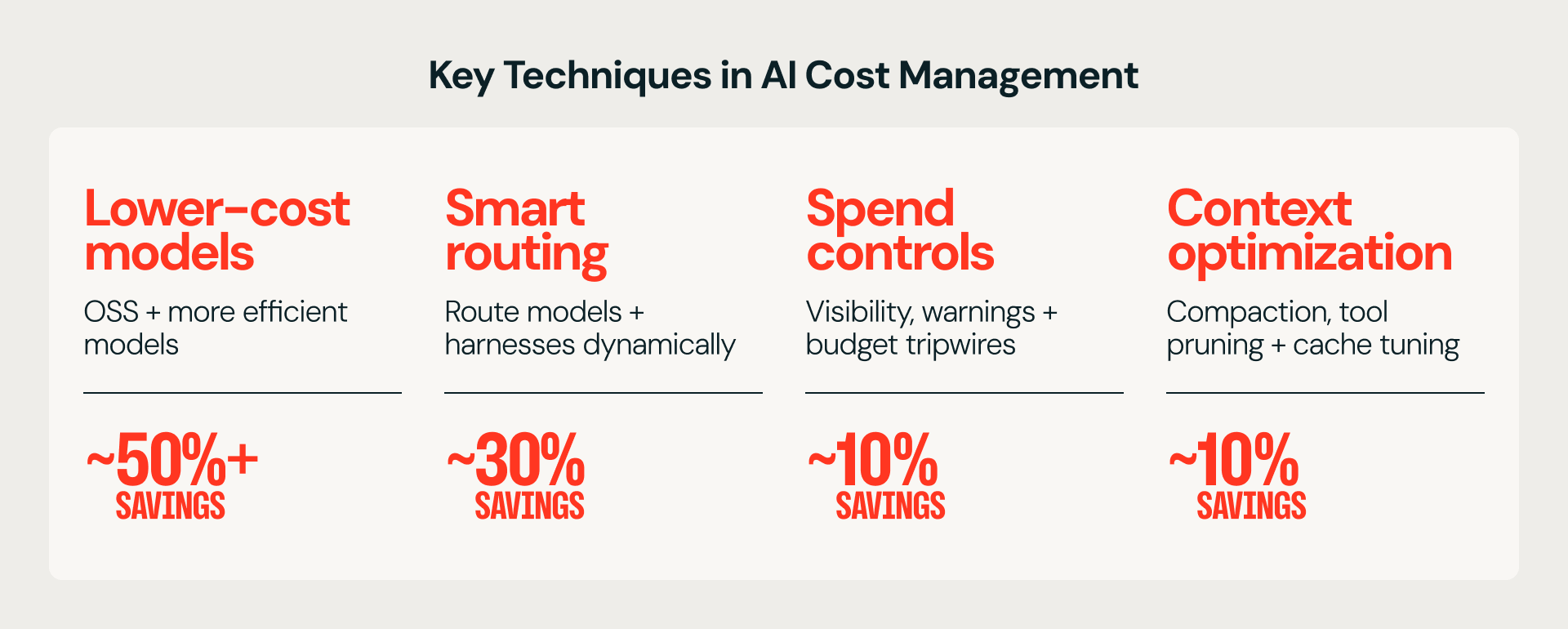
Some of these techniques can be easily implemented with software many companies already use. Others require new infrastructure, particularly techniques that modify end-user clients or shift traffic across models. At Databricks, we’ve open sourced or made freely available our key infrastructure components: an end user meta-harness (Omnigent) and our AI Gateway (Unity Gateway). For completeness, this post also covers software used by other companies we spoke with.
The “Efficiency Frontier” for Coding Models
The single greatest cost lever is moving coding spend to more efficient models as they are released. This point bears some discussion, as the simple explanation of "cheaper models” in fact hides a nuanced relationship between model cost and quality.
Colloquially, the term frontier model means “the highest intelligence model,” and frontier labs largely focus on advancing peak intelligence. Frontier models can now solve novel problems in math or cybersecurity. But when AI is deployed at scale, a different type of frontier matters more: the efficiency frontier. The efficiency frontier is defined by the set of models that have the best price point for a given level of intelligence. Most day-to-day coding doesn't require mathematical proofs or novel security insights, so what matters in aggregate is the cost of models that meet the quality bar for typical software engineering work. This "efficiency frontier” is advancing far faster than the intelligence frontier, with new models being released almost weekly that present better intelligence-per-unit-price than prior models.
Cost Lever #1: Moving to open source and lower cost models
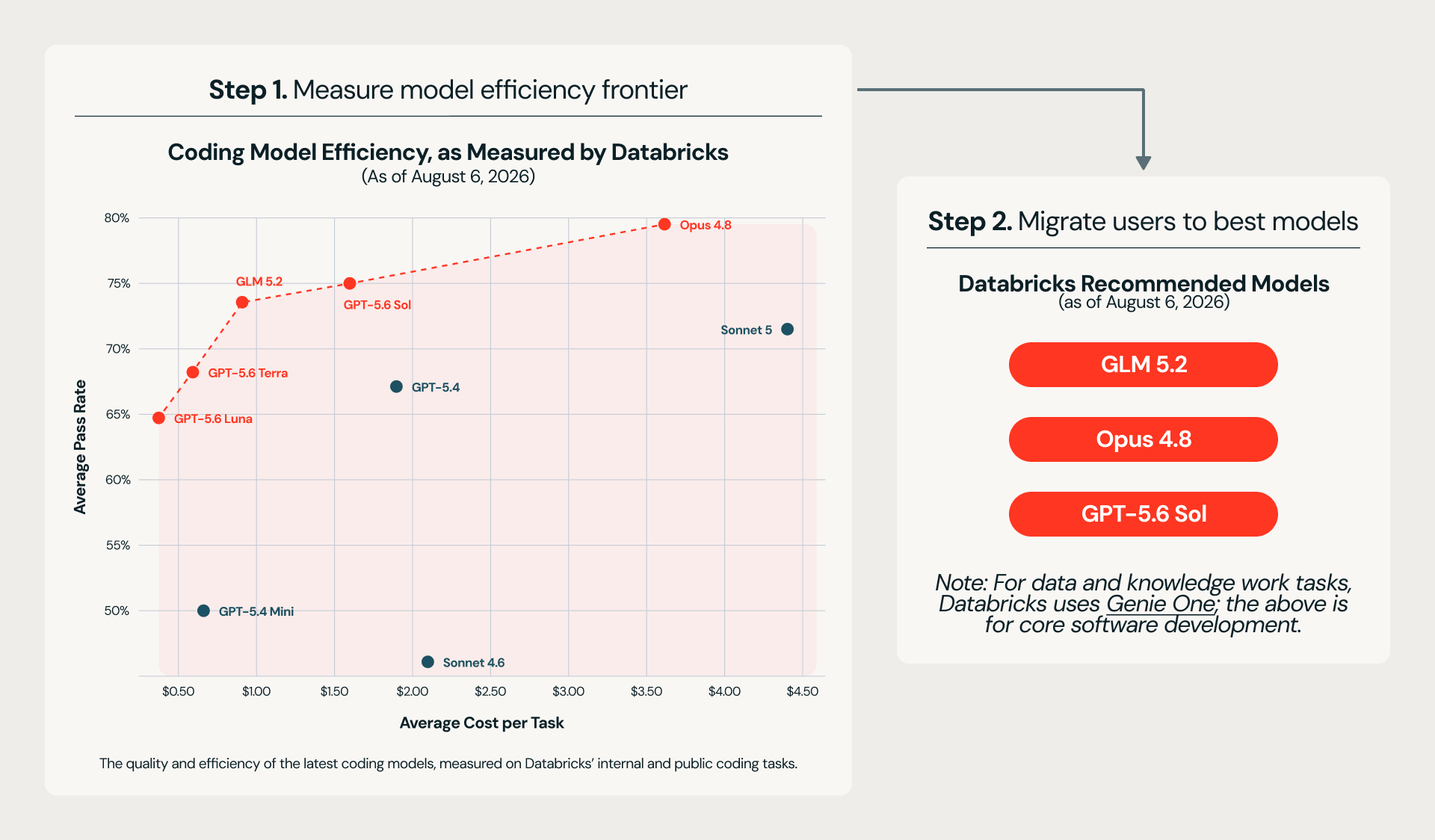
Rapidly adopting newer, more efficient models delivers the largest cost wins of any technique. But to capture those gains, a company first needs to know which models actually beat its incumbents. This can be difficult because public benchmarks do a poor job of indicating real-world performance on coding tasks. To size up new models, many companies have built automated evaluations that they believe are more representative of their internal development mix. Databricks recently published an example of such a benchmark, in which we observed highly competitive price/performance for GLM models. That benchmark led us to roll GLM out to developers internally. Often, new models do not advance the efficiency frontier, and evaluations frequently produce negative results: Stripe found that Opus 4.7 did not meaningfully improve quality over Opus 4.6, while increasing cost. They therefore declined to make Opus 4.7 available internally. Databricks saw similar cost regressions when comparing Opus 5.0 to 4.8.
Harness and Model Flexibility
Since the biggest wins come from switching to new models, adopting end user tooling that allows for model flexibility is becoming a critical component of keeping costs down. The tool most commonly used in concern with a particular model is called harness. Proprietary frontier models are increasingly co-designed to work well with specific harnesses, meaning certain harnesses “work better” with certain models. If a company wants to preserve model independence there are roughly two approaches:
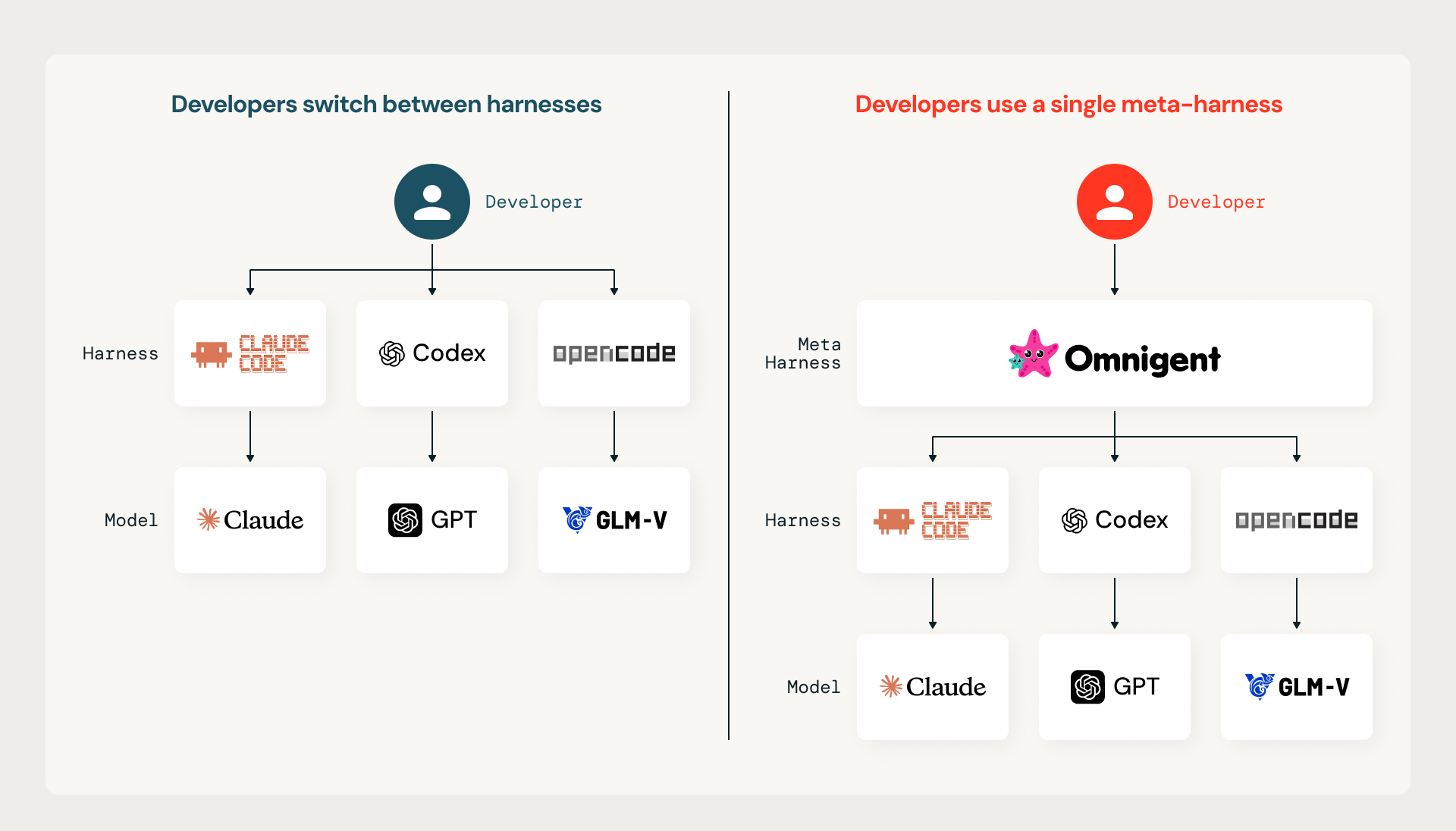
Ask users to switch harnesses. One approach is to provide developers with a set of harnesses (Claude Code, Codex, or Cursor) and then ask them to switch between harnesses when a company wants to migrate spend to lower cost models. This lets users work in their preferred harness when possible, but the downside of this approach is that switching costs for an individual developer can be high. If switching costs become too high, the harness itself becomes a de facto lock-in to a model family, limiting the ability to move spend to more competitive models.
Use a meta-harness. A new and increasingly popular approach is to use a meta-harness that surfaces a common user experience to developers while dispatching requests to underlying harnesses (both proprietary and open source). This approach allows both model/harness independence while also reducing developer switching costs. At Databricks, this is the default mode for developers who leverage Omnigent. Some companies we talked to have built custom internal meta-harnesses that integrate with their development toolchain.
Cost Lever #2: Dynamic Request and Task Routing
Instead of asking users to choose task-appropriate models themselves, a growing body of research suggests that automatic model and tool selection may further squeeze efficiency out of agentic coding workflows. Routing approaches roughly fall into three categories:
- Request Level Routing: A stateful proxy sits in between a client (such as a coding harness) and the underlying foundation models. The proxy attempts to route requests to the lowest-cost model capable of answering each inference request. Routing for agentic use cases also needs to account for server-side caching, since a cold cache hit has a very high cost for large context workloads. A new wave of products is showing early, promising results for routing. Examples are: Cursor Router, OpenRouter’s AutoRouter, Ramps Router feature and Databricks own Smart Routing feature in Unity Gateway.
- Task Level Routing (Meta Harness): A client-side process dispatches user tasks to different harnesses based on the complexity of the task. A user task might be “rename this component from X to Y” (a simple task) or an open-ended task like “Explore design considerations that would reduce latency” (a complex task). The dispatcher, often called a Meta Harness, examines which level of underlying model is required for a task and then delegates that entire end-to-end task to the model. Omnigent is an example of a Meta Harness that supports this pattern.
- Escalation/Delegation Patterns: A single harness pairs two models (an expensive, high-intelligence model and a cheap worker model). In some approaches, such as Claude’s Advisor Tool, the cheaper model runs the show and escalates when it thinks a task requires more horsepower. The inverse pattern also exists: In Cognition’s Devin Fusion, the higher cost model is the main loop, and it selectively outsources work to a cheaper model.
Internal results at Databricks suggest that our AI Gateway Smart Router is able to consistently reduce average task cost by more than 30%, while roughly matching the quality of the most expensive model in the working set. Other companies we spoke with have seen similar results.

Cost Lever #3: Giving developers visibility, tripwires, and budgets
It may be surprising that this entire article did not start and end with “Give users a monthly budget and be done with it.” Hard budgets, where usage is entirely cut off at a specific spend threshold, are often used only as a last resort option in every company we spoke with. There are two reasons that hard token budgets are not particularly effective for AI spend management: First, if a developer hits their budget ceiling, cutting off further access to AI tools would be debilitating to productivity. Neither the company or employee actually wants that outcome. Second, at least some of the “high spending” users are in fact those who have achieved monumental efficiency gains with AI and are producing immense output. Discouraging those users is self-defeating.
Instead of a hard user spending cap, most companies are adopting a more nuanced and progressive approach that focuses on visibility for end users and increased degrees of friction as spend increases.
Visibility: Every company we spoke with had a mechanism to provide near-instantaneous feedback to users on their ongoing spend, with many also offering specific tips or insights on how to reduce spend by using less expensive models. It is important that users be able to see their spend across all tools, since they may want to influence their choice of tool where they get the highest ROI.
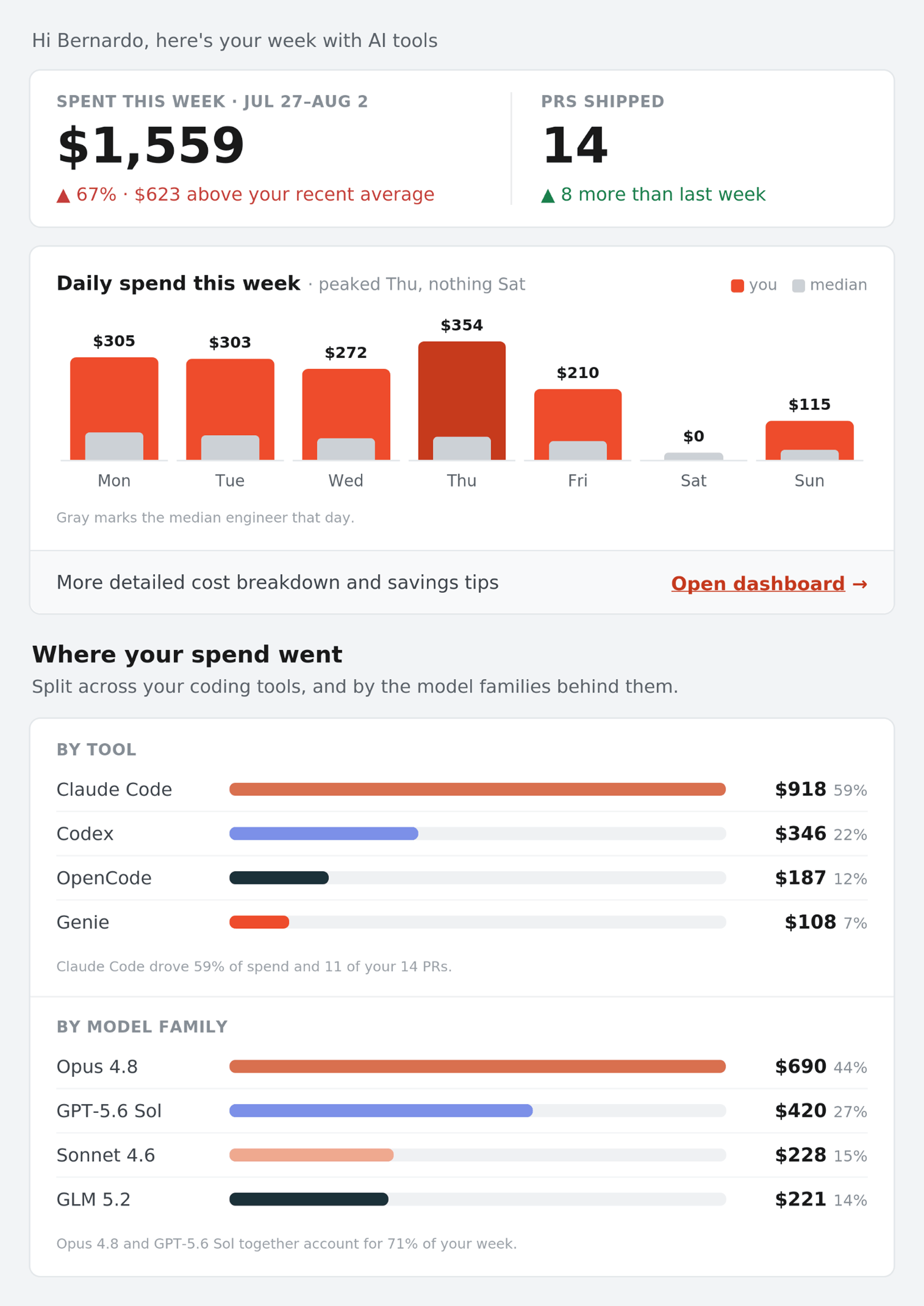
A developer dashboard at Databricks showing active spend
- Spend Gates: Developers can be asked to take actions or seek approvals at increasing levels of spend. The simplest form of spend gate is one that can be self-cleared and serves as a warning that the spend rate is increasing above some threshold. At Databricks, we’ve found self-clearing gates a useful mechanism for preventing accidental or unintentional spend. Further gates can be introduced that require explicit budget approval (often through a management chain).
- Downshifting: If a developer has hit a spend gate, they can be downshifted to a lower-cost model rather than being entirely suspended from token access. Since the lowest-cost models are drastically less expensive than frontier-intelligence models, this technique allows developers to continue getting work done without incurring massive ongoing spend.
- Suspension: In the limit case, most systems do retain the ability to fully suspend users from all token access. As stated above, this is often a temporary measure only and the starting point for a conversation about how to efficiently leverage AI.
Cost Lever #4: Reducing Token Overhead
When a user types a relatively simple request into an AI coding agent (such as “Please investigate and fix this bug.”), that agent subsequently gathers massive amounts of relevant context, invokes a large number of tools, searches through the codebase, and integrates skills or system information provided by the company. By the time costly LLM inference occurs, the user's initial statement accounts for only a negligible fraction of the data fed into the AI system, meaning costs are dominated by context the user did not explicitly include. Techniques in reducing context bloat are still new, but several promising approaches are being explored, such as:
- Coercing more frequent compaction (compression) of the active context.
- Using harnesses that are “less chatty” (more token efficient), or tuning existing harnesses to generate less token overhead.
- Auditing popular tools and decreasing their verbosity.
- Encouraging developers to break tasks into smaller individual units of work, decreasing context scope.
When contexts get large, prompt caching also plays a meaningful role in overall performance. Both proprietary and open source LLMs have settings that allow you to enable prompt caching and tune how long the cache is stored. Cache writes cost money, but cached reads can drastically reduce per-inference cost. This trade-off is dependent on a company’s specific workload, so hand-tuning of default cache settings to increase overall cache hit rate can have drastic improvements to overall cost.
At Databricks, relatively simple tuning of our harness and caching settings led to an almost 50% reduction in the number of generated tokens and associated costs, with no observed quality degradation for developers. We continue to explore techniques in this area and think meaningful additional optimization remains possible.
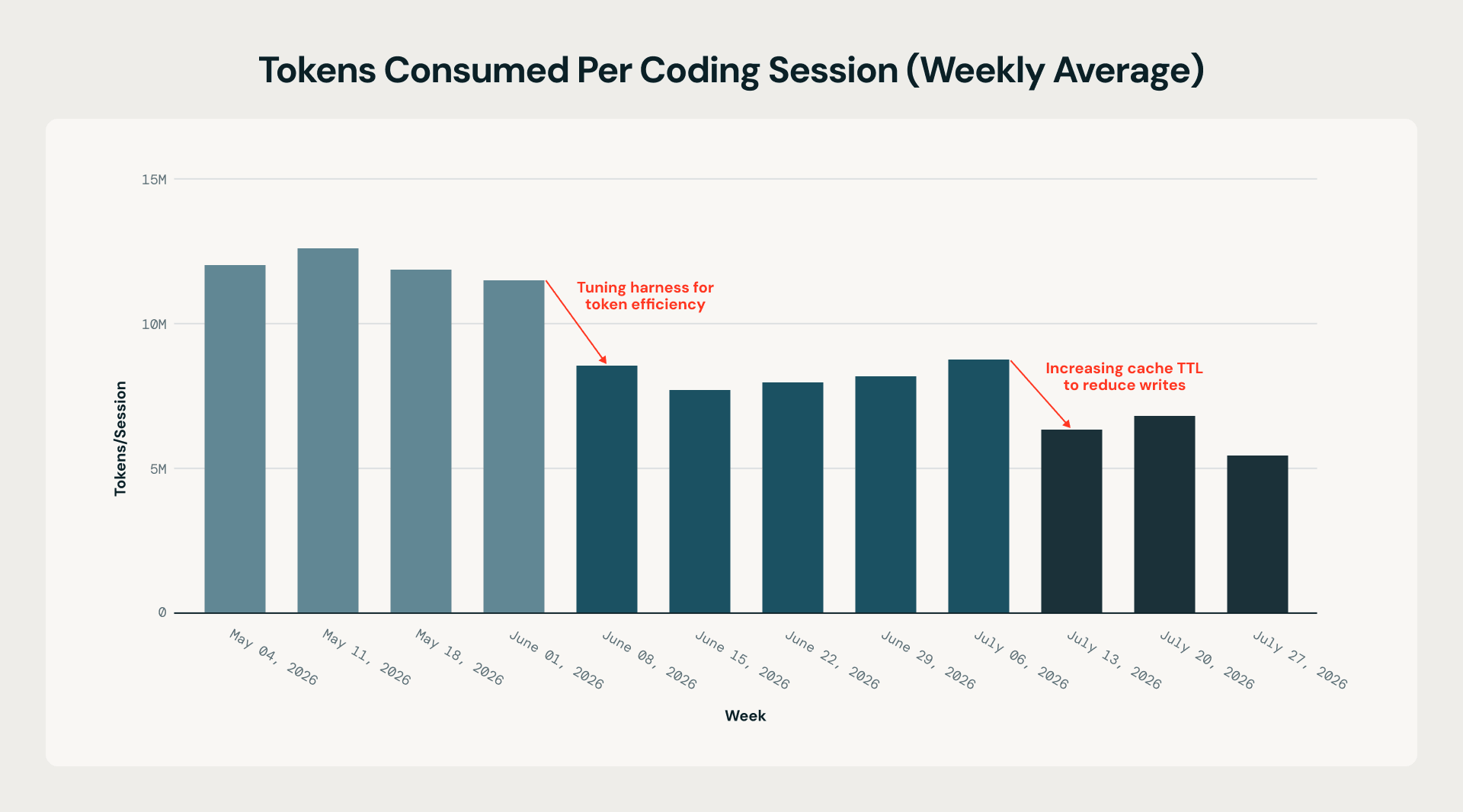
A drastic reduction in tokens per session by eliminating extraneous inference calls and reducing cache writes.
The AI Gateway design pattern
The techniques above had many implicit technical requirements: To rapidly take advantage of new models, companies must have a central location where the “model menu” is managed, and end-users must have a toolchain that supports model mixing. To provide budget visibility across multiple AI tools, a unified cost observability capability must exist. To manage context bloat, companies need a way to observe typical toolcall outputs and enforce compression or compaction. These needs are collectively being solved by a new class of infrastructure software, best described as an AI Gateway. An AI gateway is a central location where all of the following occur:
- Capacity management and proxying of access to underlying models (both proprietary and OSS models).
- Budget tracking and enforcement, including complex budget policies such as progressive friction levels and model downshifting.
- Configuration management for end-user tools, to enforce model allow-lists, compaction settings, and other locally mediated aspects.
- Logging of coding session traces for downstream efficiency analysis and benchmark.
At Databricks, we rely heavily on Unity Gateway for all of these capabilities.
Putting it all together
The exponential growth of AI coding costs is not an inevitability, it's a solvable engineering and governance problem. Companies that have tamed it share a common playbook: relentlessly chase the efficiency frontier rather than the intelligence frontier, adopt tooling that preserves model flexibility, route work intelligently to the cheapest capable model, replace hard budgets with visibility and progressive friction, and cut the token overhead that dominates real-world spend. None of these techniques requires sacrificing the productivity gains that made AI adoption worthwhile in the first place; together, they let organizations satisfy the dual mandate of broad, low-friction access within a predictable cost envelope.
A set of new infrastructure abstractions is emerging to give companies the tools to manage their costs. At Databricks, we’ve released the key components in our cost management stack as open source or free software products: Our Unity Gateway for central management and Omnigent for developer tooling. Thousands of companies use these components every day. We invite more companies to share findings and compare techniques as this technology landscape rapidly evolves.
Acknowledgments: Thank you to infrastructure leaders at Uber (Ty Smith), Stripe (Aaron Spinks), Coinbase (Siwei Shen), and Ramp (Veeral Patel) who provided commentary and reviews of this article. Thank you to Thrive Capital for feedback on an early draft of this article.
Get the latest posts in your inbox
Subscribe to our blog and get the latest posts delivered to your inbox.