The New Monday Morning Report: How Generative AI can deliver the insights your executives need.
How shared, real-time data gives retail and CPG Monday-morning velocity to protect trade ROI and margin
*The Monday Morning Report is where the joint business plan gets executed or quietly slips. Most partnerships are stuck at the ritual stage, meeting every week and leaving without deciding what to fix, fund, or ship.
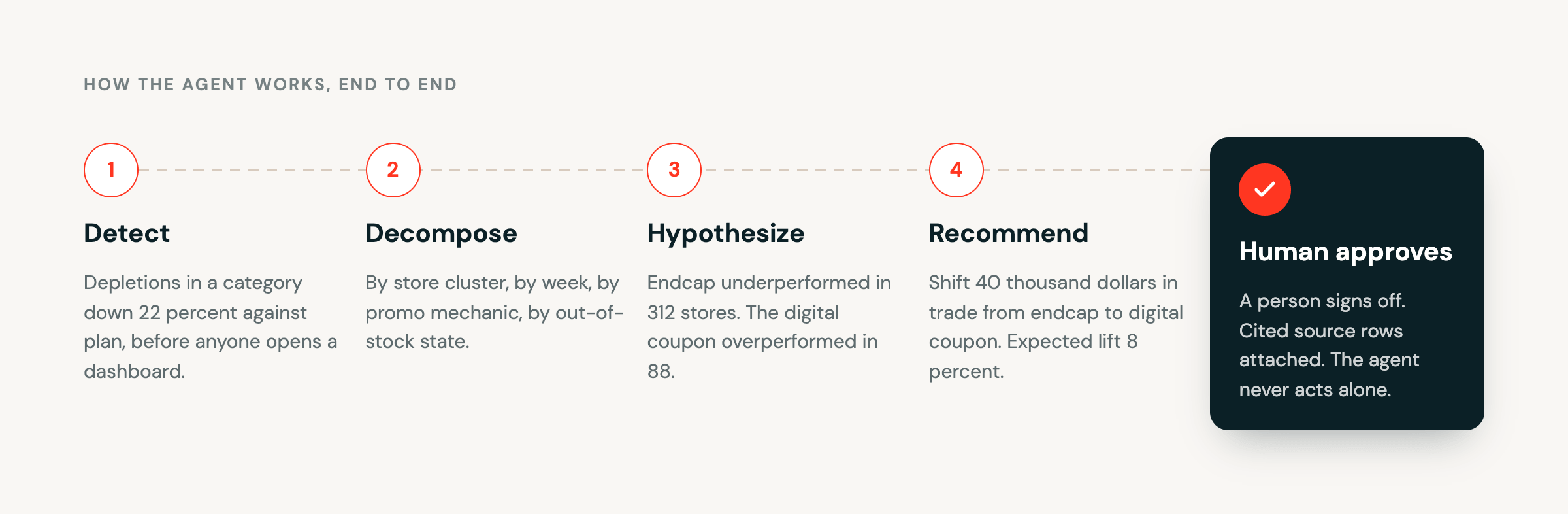
*A rebuilt Monday arrives fresh, fuses internal and external signals into one governed view, scans thousands of SKUs and stores to surface ranked watch outs, drafts a recommendation for human approval, and answers follow ups in plain English.
*It works because of three things on your own data: context through Genie Ontology, control through Unity AI Gateway, and choice of any cloud and any model, all on one governed lakehouse.
A VP of Sales at a major CPG has three decks open before her first coffee. One from her customer team, one from demand planning, one from her revenue growth lead. None of the three agree on what happened at her largest retail account last week, and the partner call is at ten. She’ll know what happened by nine thirty. She still won’t know why.
Twenty minutes of that call go to reconciling whose number is right. Thirty go to arguing about it. The last ten end in a promise to look into it, which really means Tuesday, and by Tuesday the week is already gone. Ops feels this same Monday from the other side, holding the inventory and fulfillment numbers nobody in the room fully trusts yet. This is the Monday Morning Report: both sides' data on one table, meant to end in a decision, shift spend, fix a stock-out, correct a forecast. Almost everywhere it ends in an argument about the data instead.
The three levels of the Monday Morning Report
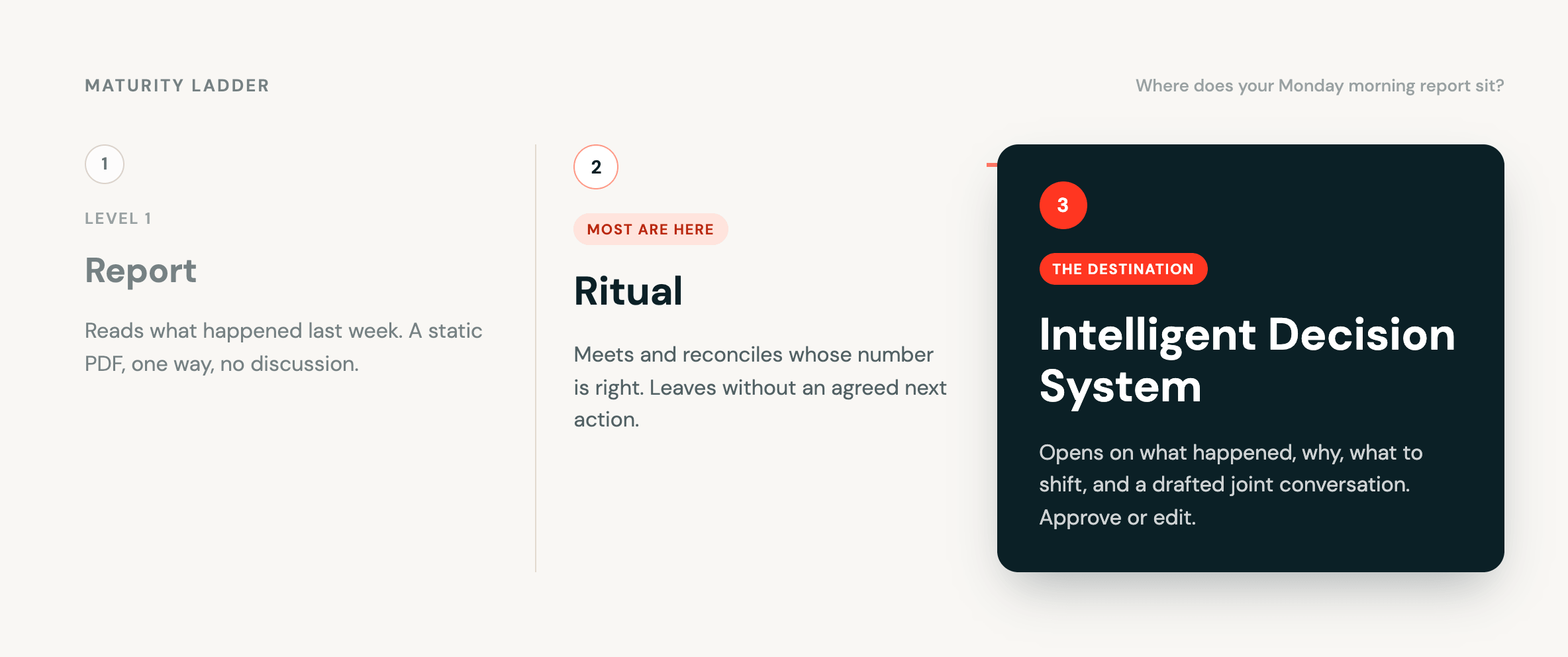
The Monday Morning Report runs at three levels of maturity: report, ritual, and intelligent decision system. Most CPG and retail partnerships are stuck at level two, the ritual stage, meeting every week and still leaving without deciding what to fix, fund, or ship. The climb to level three is how the lost week gets recovered.
Why the Monday Morning Report breaks down in retail and CPG
Talk to any joint team for ten minutes and the same five problems surface.
- Data is fragmented across nine domains and dozens of systems on both sides of the partnership.
- The report is pulled Sunday night, so it's stale before the meeting even starts.
- Two warehouses and two definitions turn the first half of every call into a war over whose version of the truth is right.
- The deck is stitched by hand in spreadsheets, with no lineage and no audit trail.
- Nothing in the room produces a decision on spend, stock, or forecast, because the report drifted into analytics when the moment needed a call.
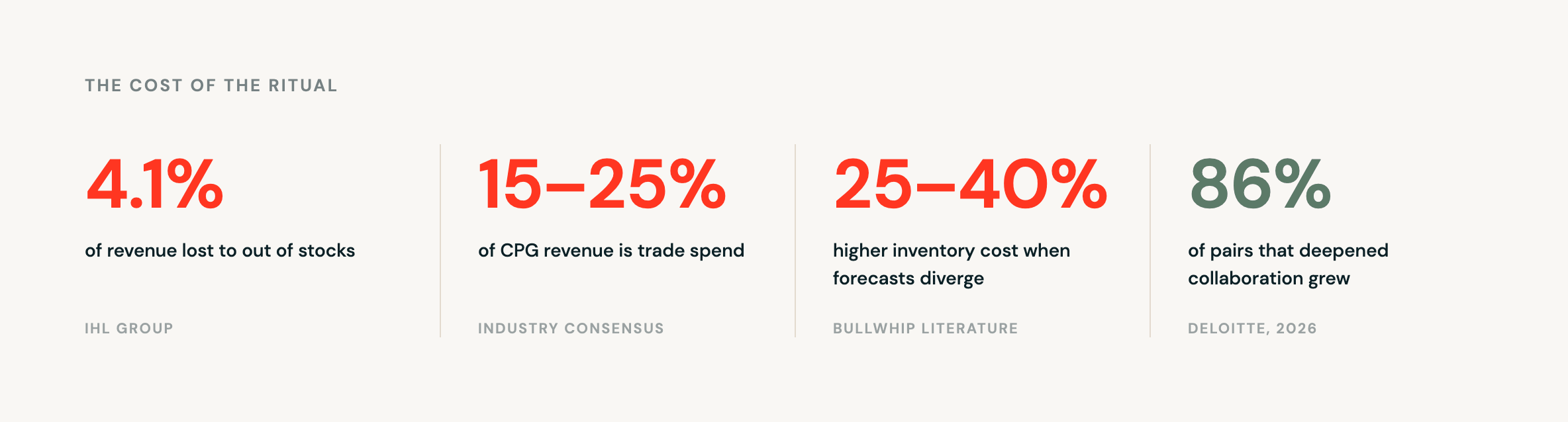
Field interviews with joint teams also point to roughly forty analyst hours a week lost to stitching and a three to five day lag between signal to action. The deepest loss in joint planning meetings is time. Every Monday spent proving whose data is right is a Monday nobody spent shifting trade dollars, fixing a stock-out, or protecting revenue.
What an AI-powered Monday morning brief actually looks like
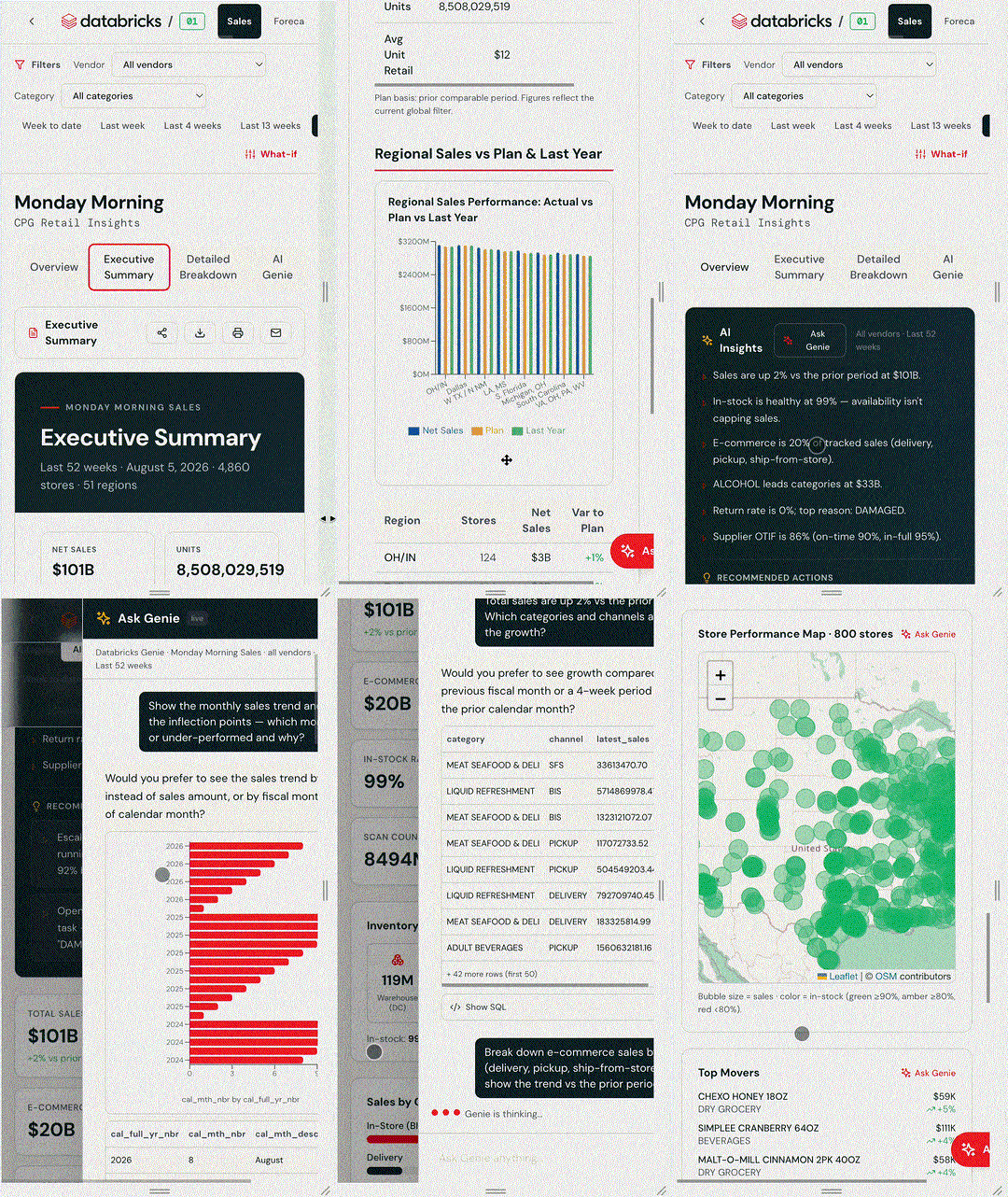
Picture the same Monday. At half past six the VP of Sales is on the train, and her phone already shows a short brief of an agent assembled overnight. It is different from the Sunday night deck in four ways.
It is fresh. The old report was pulled Sunday night and was already a day and a half stale when the meeting started, and a week stale by the time anyone acted on it. This brief is current as of this morning, because point of sale, shipments, and inventory stream in continuously instead of arriving as a weekly extract. With the optimized freshness of data, the team is making forward-looking decisions, not confirming what already happened.
It draws on every signal at once. The read that used to be stitched by hand from a dozen exports on both sides of the partnership now assembles into one governed view. Internal signals sit together: depletions and point of sale, shipments, on hand inventory, trade spend, promo execution, and the forecast. External signals sit right next to them: syndicated category share, retail media performance, foot traffic, competitor pricing, even weather. Delta Sharing lets the manufacturer and the retailer bring their halves into the same view without either side copying or losing control of its data, so for the first time the picture is whole.
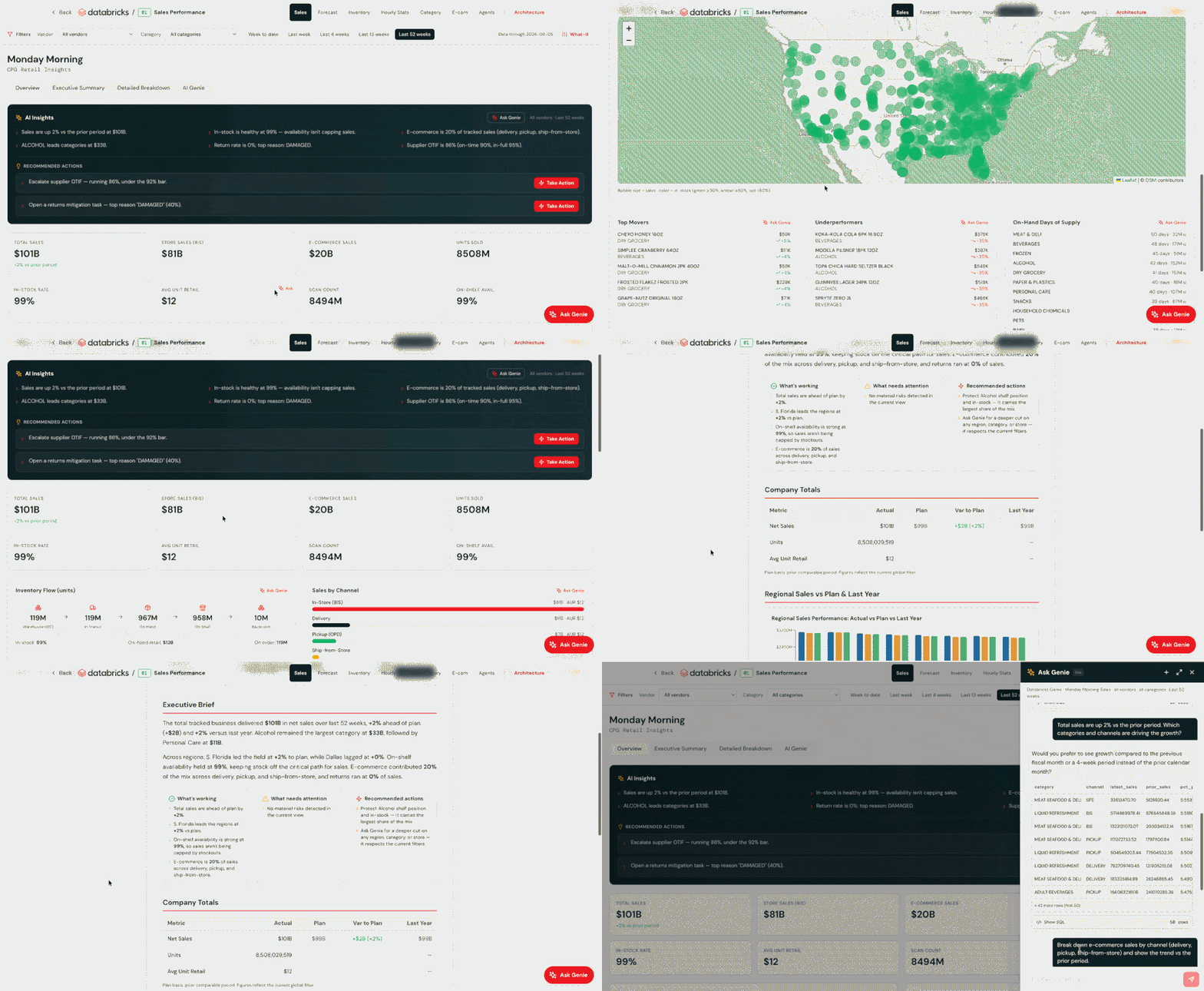
It works at a scale no person can. A single category can run a couple of thousand SKUs across a couple of thousand stores, which is millions of item and store combinations every week. No team can review that manually, so a handful of stores drifting off plan goes uncaught for weeks, until it shows up as a stock-out or a markdown. The agent reads the whole grid overnight, every item in every store cluster, and surfaces the short list of watch outs that actually move the plan, ranked by how much they move it. Monday stops being a hunt for the problem and starts with a recommendation already on the table.
And anyone can ask. Because the same governed data sits behind a natural language interface, the brief is where the conversation starts. The VP, the buyer, or the planner can ask a follow up in plain English and get a cited answer in seconds, with no SQL, no ticket, and no waiting on an analyst until Tuesday. She asks whether supply is constrained anywhere, and the answer comes back with the purchase order recommendation already adjusted. The ten o'clock call opens with a clear ask because both sides are looking at the same scorecard.
Where a rebuilt Monday morning report pays off, by scenario
The same overnight pattern applies far beyond one promo. These are the situations a joint team meets most weeks.
- A promo missing target mid flight. Move trade from the weak mechanic to the strong one, and recover the ROI in the same period instead of a post mortem six weeks later.
- A supply constraint upstream. Flag out of stock risk days before the shelf empties and draft the purchase order fix, protecting the revenue an out-of-stock would otherwise cost.
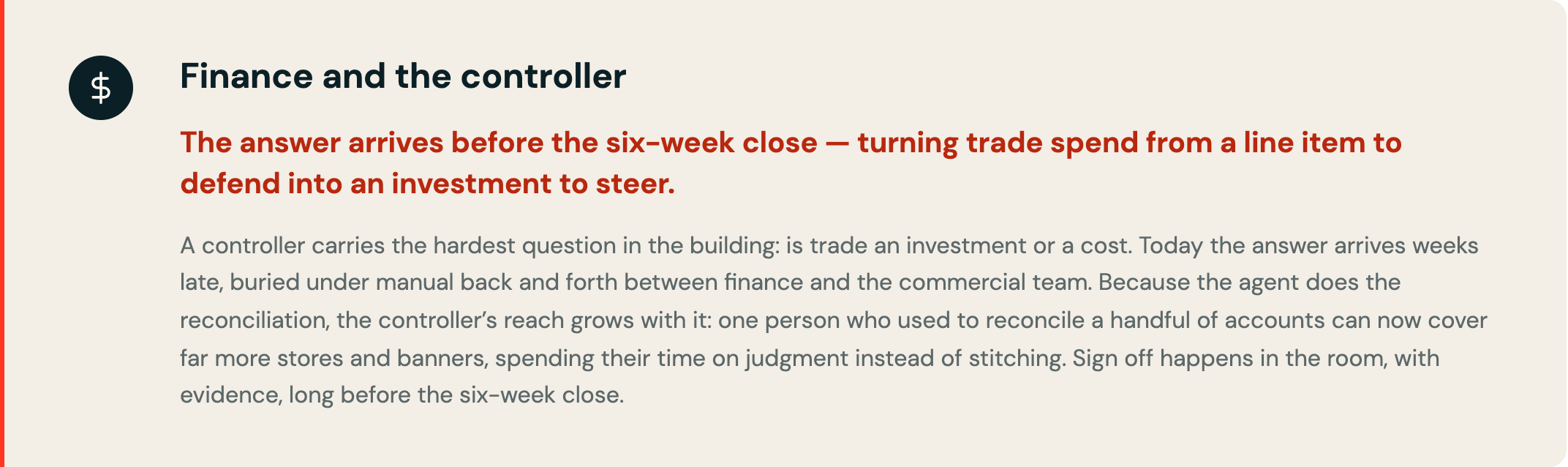
- Two sides forecasting apart. Both plan to one number on shared data, which cuts the bullwhip tax on inventory.
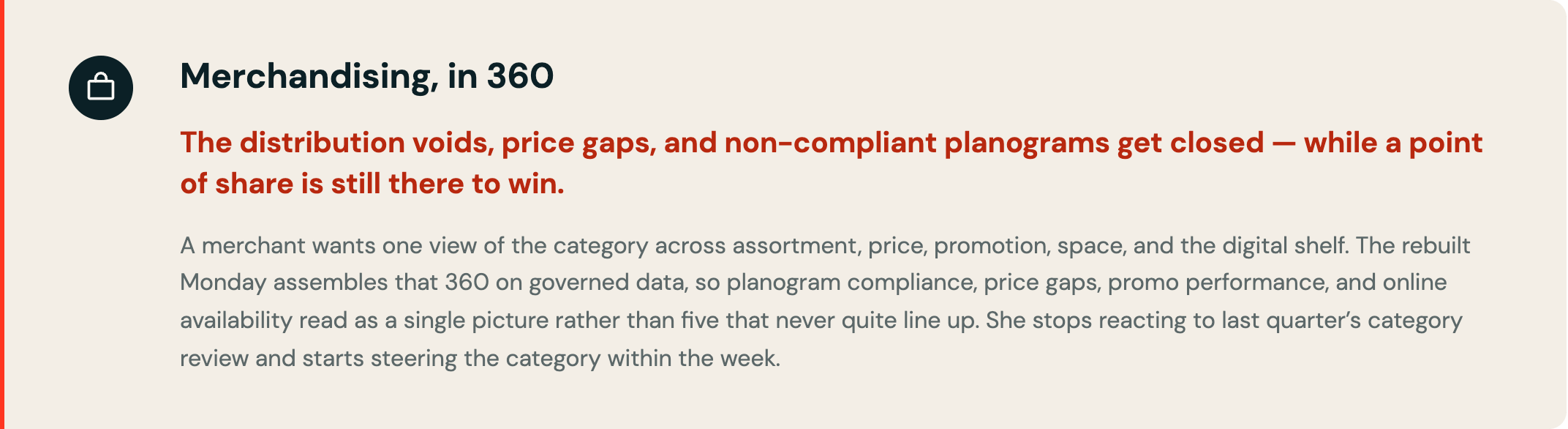
- A new item launching below plan. Surface distribution voids by banner in week two, so a stumbling launch is corrected early instead of at week eight.
- Slow movers crowding the shelf. Rank delist and facing moves by cluster, freeing shelf and working capital for the items that are winning.
- Retail media running apart from trade. Media impact sits next to trade spend in one model, so you fund what actually lifts sales.
- A promo cannibalizing a sibling. Measure the net category effect, so you protect category profit rather than a single line.
Two of these change what a whole function does on Monday.
Why it works: context, control, and choice
Retail and CPG teams are already finding real uses for AI that answers a business question well. The realistic next question is what has to be true for that same capability to run on their own data, with their own governance, at Monday morning stakes. It comes down to three things, and each shows up in the Monday moment.
Context, through Genie Ontology
When the VP asks why the category missed at her top account last week, the model has to know what that category means in your data, what that account means, and which week is last week. On Databricks that job belongs to Genie Ontology, the context layer introduced at the 2026 summit. Instead of guessing from raw tables, it builds a self improving knowledge graph from your tables, queries, dashboards, and connected apps, grounded in the certified definitions you keep in Unity Catalog: your metric views, business glossary, and domains. When more than one definition of net sales exists, it ranks the one your business trusts, using an authority score Databricks calls OntoRank. Genie answers in your language, on your definitions, so the room stops arguing about what a number means.
Control, through Unity AI Gateway
On Monday the agent is proposing to move real trade dollars, so someone has to govern what the model can see and do. Unity AI Gateway is that control plane, built on Unity Catalog. Every model call, every tool call, and every request to an outside system routes through it. Guardrails catch things like exposed customer data and prompt injection before they reach a model. Rate limits and spend caps hold cost. It runs on the permissions of the person asking, so the agent can never reach data the buyer could not. It logs the full record of every call to a governed table, so finance and compliance can see which model answered, on what data, and for whom. And because a policy can require human approval before an action proceeds, the rule that agents recommend and humans approve becomes something the platform enforces.
Choice, any cloud and any model
The best model for drafting Monday's brief this quarter will not be the best next quarter, and the cloud your retail partner runs on may not be yours. The same lakehouse, the same Unity Catalog, and the same Monday run natively on AWS, Azure, and Google Cloud, so a partnership is never blocked because the two sides picked different clouds. Behind the same gateway you serve open and proprietary models from any provider through one API, route the strongest to each task, and swap in next quarter's leader as a configuration change rather than a rebuild. Any cloud, any model, and the Monday you build this year keeps working next year, without a rebuild.
All three rest on one governed foundation: a lakehouse where structured point of sale and unstructured promo creative live together, Unity Catalog for lineage and access, and Delta Sharing to exchange data between the two sides without copying it, which is what finally turns two versions of the truth into one both sides trust.
What's next: agentic AI for retail and CPG decisions
Today the Monday brief is drafted for a human to approve. For decisions that carry real money, that's where the judgment should stay. But the direction is clear. Databricks has moved Genie from a question answering assistant to Genie One, a coworker that assembles a daily brief from a calendar, an inbox, and governed data and takes governed actions across the tools teams already use, and Genie Agents let a team turn a recurring prompt into a shareable agent that acts within policy. For a joint team the trajectory is simple: the routine moves that follow a rule both sides already agreed to get handled inside the guardrails, and only the judgment calls come to the room. None of it works without context, control, and choice. The agent can act because Genie Ontology gives it meaning, Unity AI Gateway gives it a boundary, and the freedom of any cloud and any model keeps it from locking in place. Trust widens the agent's latitude one approved recommendation at a time, and no faster.
What changes for each seat in the room: Sales, Retail, Supply Chain, and the JBP Lead
A rebuilt Monday pays off differently for each team.
- VP of Sales: walks in with one clean ask instead of three open questions.
- Revenue growth lead: gets trade ROI by SKU, cluster, and mechanic in real time, defended to finance with cited evidence.
- Retailer's category manager: stops arguing whose number is right, exposes only the governed views she defines, and keeps her data hers.
- Replenishment planner: learns of out of stock risk before it reaches the shelf, with a drafted purchase order fix waiting.
- JBP lead: finally has the joint scorecard both sides trust, and is the one person who can bring both sides to the table.
How to get started: the ninety minute discovery workshop with Databricks
Within a ninety minute discovery workshop, we can map the current Monday, the pain, and the future state, and leave with next steps locked in.
- Day 30: the pilot is scoped
- Day 90: the first live Monday runs on real shared data.
- Day 180: a case study is in motion
Get the latest posts in your inbox
Subscribe to our blog and get the latest posts delivered to your inbox.