Skip the learning curve: rethinking data migration for real outcomes
by Vijay Anala
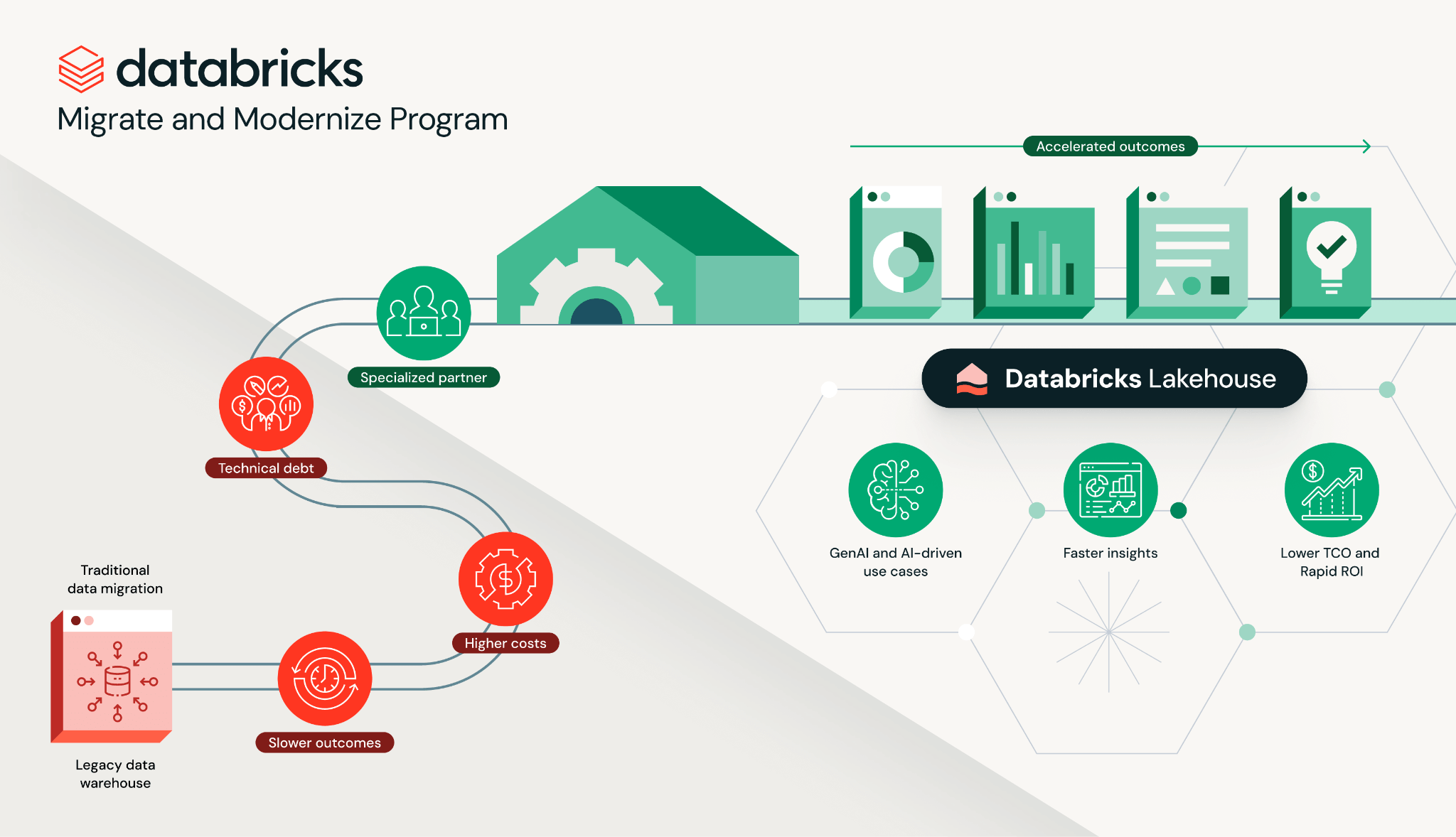
- Flipping the Migration Timeline: Why “migrate first, modernize later” slows progress, and how a parallel approach delivers value sooner.
- Navigating the Human Bottleneck: How to overcome learning curves and skepticism with experienced partners and AI-driven automation.
- Collapsing the “Double-Bubble” Cost: How to reduce overlapping costs through progressive decommissioning and smarter incentives.
Data migrations have a reputation for being high-risk, stressful initiatives. They often drag out timelines and run over budget, using up so much energy that, by the time you get there, it’s hard to focus on adoption. It’s not usually a failure, just that the real strategic value ends up delayed or watered down.
If you’re a data leader navigating a platform transition, that concern is understandable. What typically starts as a technical initiative quickly becomes something much broader: operational complexity, financial trade-offs, and pressure to show meaningful results.
What’s changing now isn’t how hard migration is. It’s how leading organizations are approaching it. Most companies only change their data warehouse once every 10–15 years, so even strong engineers may only go through one migration in their career. It’s a rare, high-stakes moment for your team, but routine work for specialized partners. Bringing in experts who’ve done this dozens of times helps you avoid trial-and-error and move faster with confidence.
Flipping the Script: Parallel Progress
The traditional model is familiar: migrate first, modernize later, and hope value shows up at the end. In practice, that approach often delays realizing the value until the very last phase, where timelines tend to stretch and momentum slows.
With the new AI-led paradigm shift, a different pattern is emerging. Instead of treating migration, modernization, and value creation as separate steps, organizations are now bringing them together to accelerate outcomes. The goal isn’t just to land on a new platform like Databricks, it’s to start seeing value early through better data access, faster analytics, and new AI-driven use cases.
That shift changes the conversation in a meaningful way. It moves from “When will we finish?” to “What are we already getting out of this?”
Addressing the True Bottleneck: The Learning Curve
One of the biggest factors behind this shift is a more honest recognition of the learning curve. Technology is rarely the bottleneck.
Even strong engineering teams hesitate to bring AI into daily workflows, often seeing it as hype or a risk to stability. But avoiding it creates friction that slows modernization more than any technical barrier.
To address this, many organizations are choosing to augment their teams with partners who bring practical experience, repeatable approaches, and automation. Increasingly, these partners are using AI and agents to simplify / complement the traditionally manual work, whether that’s accelerating code conversion, validating data quality, or helping modernize pipelines more efficiently. The result isn’t just faster execution, but fewer missteps along the way.
Why "As-Is" is a False Safety Net
At the same time, there’s growing awareness that simply lifting and shifting existing workloads is rarely enough. Moving legacy complexity and tech debt into a new environment doesn’t create progress; it just relocates the problem.
The teams getting real value from platforms like Databricks use migration as a moment to simplify and use modern patterns. They retire what no longer matters, get rid of old, accumulated tech debt, streamline what has become overly complex, and align data to the actual needs of the business. That’s what makes the platform immediately useful, not just technically complete.
Redefining Migration Risk
Risk is being redefined. The real danger isn’t a technical glitch, it’s spending a year rebuilding your backend only to deliver no business value. Retiring legacy debt, cutting costs, and improving performance matter, but those are table stakes. A successful migration shouldn’t just replace an old system; it should start delivering new business outcomes from day one.
Avoiding that outcome requires a more continuous approach, validating as you go, modernizing along the way, and keeping a sharp focus on usability and outcomes. The goal isn’t just to complete the work, but to make sure it translates into something meaningful.
Navigating the "Double-Bubble" Cost
Costs spike when old and new systems run in parallel, but many teams wait until the migration is fully complete before shutting anything down. A better approach is progressive decommissioning: retire legacy components as workloads move, shrinking that expensive overlap window in real time instead of waiting until the end.
Faster execution, better coordination, and structured approaches, supported by Migrate & Modernize incentives, can help shorten that window so value begins to outweigh cost sooner.
A Growing Ecosystem of Specialized Partners
Partners play an important role in making all of this work in practice. Every migration is different, and experience matters, especially when combined with tools, accelerators and AI-driven proven methods.
That’s exactly why the Migrate and Modernize Program exists, to connect organizations with experienced partners who’ve done this before. It helps you choose based on proven results, specialized capabilities, and the right tools to make the migration smoother.
Driving Real Customer Outcomes
We’re already seeing strong impact from our Migrate & Modernize Specialized Partners, with teams helping customers reduce migration costs and accelerate time to value. We’re building this program with experienced partners who got involved early and are already delivering real customer outcomes:

Their teams are already on the ground proving this model works, actively delivering faster cutovers and getting complex workloads into production ahead of schedule.
For partners who are just starting to engage, this is very much a journey. We are rapidly expanding the ecosystem and continuing to build together as more organizations and partners come onboard. In future articles, we will highlight stories, best practices and the ecosystem of partners investing in being an AI leader in Migration & Modernization transformation.
No matter how complex, fragmented, or massive your legacy data warehouse architecture is, our goal is to ensure a specialized partner is equipped to streamline your path forward.
From Migration to Momentum
There’s no version of migration where it’s effortless. The organizations pulling ahead aren’t the ones that finish first, they’re the ones that start realizing value sooner, unlocking data, enabling AI, and building momentum from day one. With the right strategy and partners, migration stops being an infrastructure hurdle and becomes a launchpad for what’s next.
Attending Data + AI Summit? Visit the Databricks Partner Pavilion to meet our Migrate & Modernize Specialized Partners in person, view live migration demos, and discover how your organization can qualify for Migrate & Modernize migration credits.
Get the latest posts in your inbox
Subscribe to our blog and get the latest posts delivered to your inbox.