Unified data discovery with business context in Unity Catalog
How domains, intelligent curation, and shared semantics help teams find and access trusted data and AI assets
by Peter Wang and Kelly Albano
• At enterprise scale, teams struggle to find, understand, and verify the right data across analytics and AI workflows.
• The Databricks Discover experience unifies discovery by embedding business context, trust, and access directly into Unity Catalog.
• Domains, intelligent curation, and governed access help users move from discovery to action with confidence.
Data discovery is built on the foundation of business context
As data estates grow, many organizations struggle with a basic challenge: helping people find the right data and decide whether to use it. Teams get stuck because they can’t confidently answer fundamental questions: Does this data exist? Where is it? Which data should I use? What does it mean? Is it trusted? And how do I get access?
In practice, discovery is fragmented. Data is organized around sources and production systems, while business meaning lives elsewhere, in dashboards, documents, wikis, or institutional knowledge. Trust signals and access workflows are often disconnected from the places where people actually look for data.
When discovery lacks business context, users waste time searching or duplicating work, stewards become bottlenecks, and adoption stalls even when the right data already exists.
One unified and intelligent discovery experience across all data and AI assets
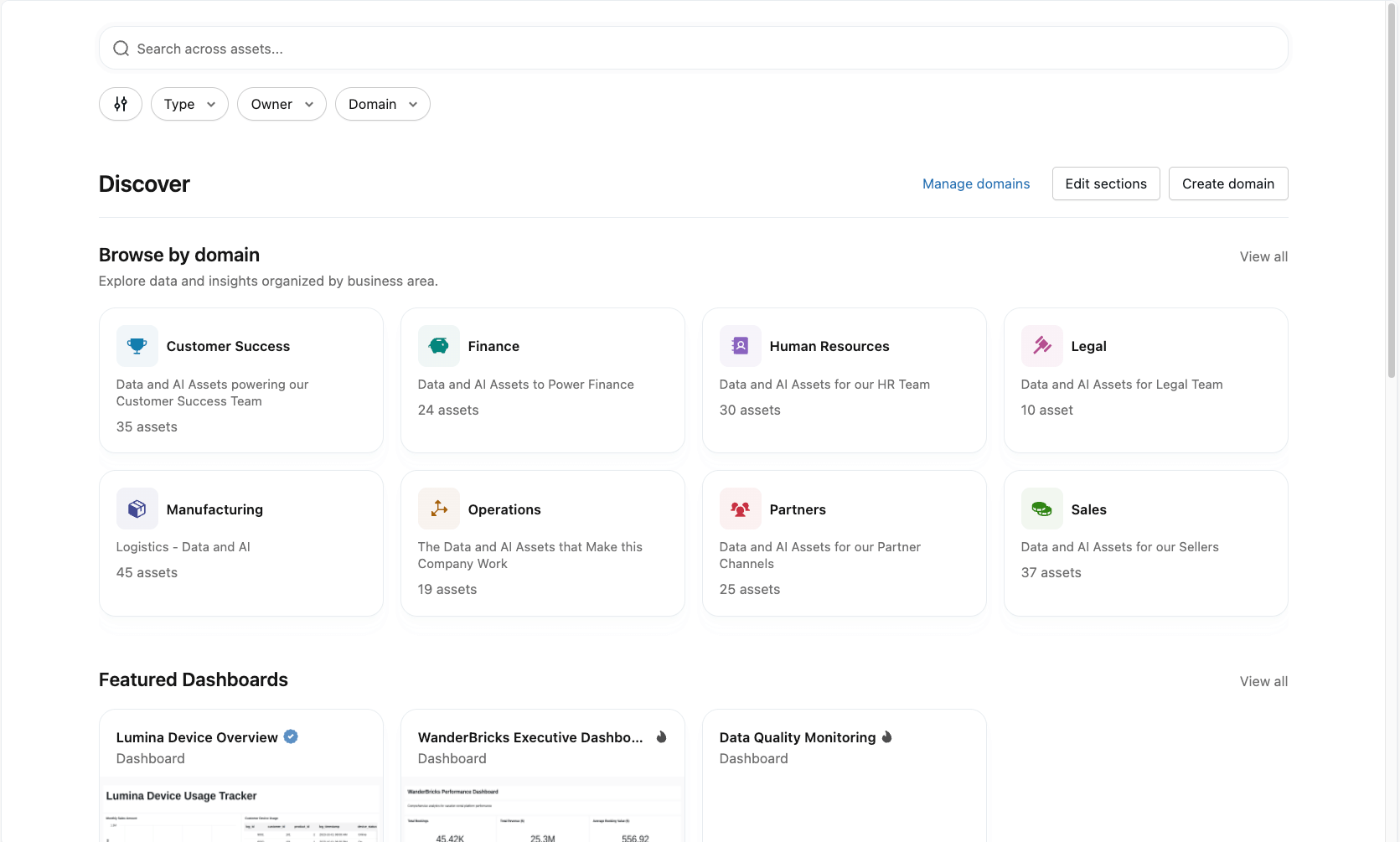
Today, Databricks is introducing a new Discover experience, now available in Beta, built directly into Unity Catalog. The Discover page replaces fragmented, tool-specific discovery with a single, curated way to find and understand data, analytics, and AI assets. Instead of searching across tools or guessing which dataset to use, users can find relevant, trusted assets in one place.
Unity Catalog enables data intelligence applied to discovery, where:
- Business meaning is embedded directly in the catalog through Domains (business-aligned groupings of assets) and governed metadata, so users understand what data represents, not just where it lives.
- Certifications and deprecations surface trust and quality signals alongside assets, helping teams focus on the data that matters most
- Platform-native data intelligence uses signals like usage, lineage, and ownership to provide context on how assets are used and who is responsible for them
- Integrated request-for-access workflows allow users to move from discovery to action without leaving the experience
The Discover page spans your entire lakehouse from structured and unstructured data to dashboards, metrics, notebooks, applications, and AI assets like Genie spaces, all surfaced through a single, governed experience.
Implementing the Discover page will streamline data exploration across our Databricks estate. Adopting a domain-driven approach will make our data landscape far more navigable for decision makers. Our favourite features are the introduction of Certification tags for improved data governance, and clearly defined ownership in Domains to improve collaboration between teams by simplifying follow-up queries. —Rhys Coghlan, Senior Data Analyst, Octopus Electric Vehicles
Domains: organizing discovery around how the business works
Domains, now in Beta, provide the foundation for business-aligned discovery.
Rather than forcing assets into rigid technical hierarchies, domains organize data and analytics assets by business unit or use case, such as Finance, Marketing, or customer telemetry. Importantly, assets can appear in multiple Domains. This eliminates the tradeoffs of traditional folder structures, where teams must decide which single hierarchy an asset belongs to.
Domains combine metadata intelligence with human control:
- Popular and frequently used assets are surfaced automatically
- Stewards can pin high-priority or newly published assets to ensure the most important datasets and dashboards are easy to find
- Assets can be curated across multiple Domains without duplication
Domains also allow stewards to:
- Curate relevant assets across data and analytics
- Customize the browsing experience on each Domain page
- Add rich descriptions and designate both technical and business owners
For users, this means discovery is intuitive and aligned to their work. For organizations, it means business context is encoded flexibly into the catalog without imposing brittle hierarchies.

AI signals guided by human expertise with intelligent curation
Our Discover page experience builds on existing Unity Catalog capabilities, combining AI-powered signals, such as usage and popularity, with human curation through certifications and deprecation tagging.
Certifications act as clear trust signals, helping users quickly identify which assets are recommended and approved sources of truth. AI-powered recommendations then help surface relevant, high-value assets without overwhelming users.
The Discover page also allows stewards to create custom sections to highlight key assets on the Discover Page and on individual Domain pages. This can guide users who are unfamiliar with the organizational data landscape to the right data and insight.

Trust and access built directly into discovery
Discovery only works if users can act on what they find. The Discover page is built on Unity Catalog’s permission model, allowing organizations to grant broad metadata access via Browse while still enforcing access controls on querying the underlying data. Users can understand an asset’s purpose, quality, and ownership and then request access directly when they’re ready to use it.
By embedding access workflows into discovery, teams reduce manual approvals, shorten time to insight, and scale governance without turning stewards into bottlenecks.

Getting Started
The Discover page and Domains are now in Beta on AWS, Azure Databricks, and GCP, and are built for enterprises with distributed data, domain-oriented teams, and data platforms serving both technical and business users. We invite you to enroll in the beta and share feedback to help shape the roadmap. Check out our demo to see how it works in action!
Learn more about how Unity Catalog ensures your data, models, agents, and apps are discoverable, governed, and secure by visiting our website.
Get the latest posts in your inbox
Subscribe to our blog and get the latest posts delivered to your inbox.