

How does Databricks power the governed, multicloud data platform behind ChatGPT?
OpenAI’s data platform powers one of the fastest-scaling products in tech history. ChatGPT, the OpenAI API, and the internal tools used by thousands of OpenAI employees require a foundation that can withstand sudden growth, run governed analytics across multiple business units, and operate across multiple clouds simultaneously. That foundation has grown up around Databricks.
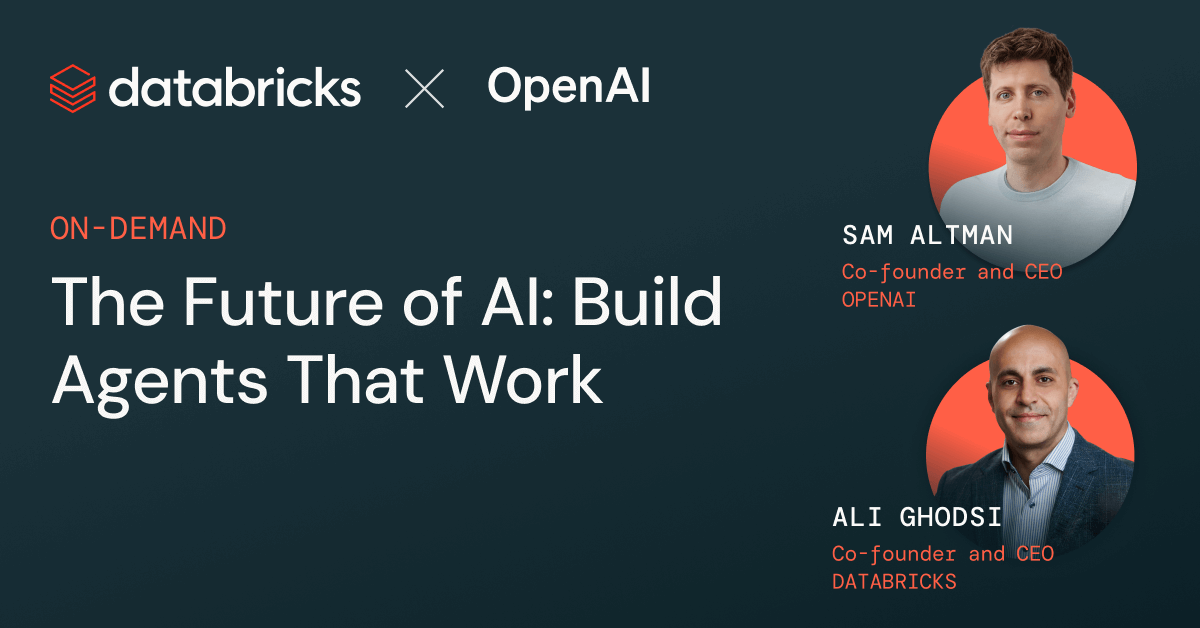
Since 2024, OpenAI has leveraged Databricks in Azure and AWS, with usage data landing in Delta tables governed by Unity Catalog. Databricks Jobs and Data Warehouses transform that data through layered pipelines to serve product analytics, finance, security, and trust, and safety teams. Workloads have ranged from abuse-detection pipelines to privacy-sensitive analytics to company-wide dashboards, with thousands of internal users accessing the platform for ad hoc analysis. The result is one of Databricks' largest and most sophisticated deployments. "We're very happy to be a Databricks customer," said Sam Altman, CEO of OpenAI, in a prior interview with Ali, celebrating the launch of our partnership.
How does Databricks help OpenAI respond to security threats?
OpenAI’s Security team uses Databricks to detect cybersecurity threats across high-volume infrastructure, cloud, and vendor audit logs. Streaming pipelines standardize raw events into governed Delta tables, giving security engineers a trusted foundation for threat detection, investigation, audit analysis, and incident response.
Databricks also supports AI-assisted investigations: Codex agents can query governed security data through SQL APIs. This unified platform helps OpenAI identify threats faster, reduce duplicated ingestion, and scale security operations with built-in governance and auditability.
How does Databricks help OpenAI scale their marketing operations?
OpenAI’s marketing team uses Databricks to scale operations for one billion weekly active users. A Bronze-Silver-Gold architecture provides a trusted data foundation, eliminates $400,000 per month in storage costs, and enables marketers to build audiences without writing SQL—demonstrating that accurate, governed data is essential for effective AI agents.
How did OpenAI + Databricks’ engineering teams work together?
OpenAI's engineering teams are small relative to the scale in which they operate, which makes the depth of the engineering relationship between the two companies an important part of the strategy. Databricks engineers work as an extension of OpenAI's Data Platform Team rather than as a typical vendor support model.
The integration runs in both directions. Databricks accelerates feature delivery for OpenAI-specific requirements, with platform capabilities such as Photon, Databricks Lakehouse, Spark Declarative Pipelines, intelligent caching, and storage-level tuning, shaped in part by the workloads OpenAI runs in production. Both teams sit close enough to the same architecture decisions that OpenAI's needs influence where Databricks invests next.
Databricks also helped OpenAI achieve true multi-cloud operations, with workloads spanning both Azure and AWS. ChatGPT telemetry, API analytics, security monitoring, and internal decision-support pipelines all run on Databricks across both clouds. In a conversation with Databricks CEO Ali Ghodsi, OpenAI CEO Sam Altman summed up how the company viewed the relationship as he discussed bringing AI to enterprises: “We cannot imagine a better partner than Databricks to make that happen.”
How do Databricks and OpenAI bring governed frontier models to the enterprise?
The operational trust between the two companies lays the foundation for a larger commercial partnership. Through a landmark multi-year agreement, Databricks and OpenAI have partnered to make OpenAI's frontier models, including the latest GPT models and Codex, available natively inside the Databricks Data + AI Platform. Enterprises can now use those models without moving sensitive data, invoking them via SQL or API calls against data already under Unity Catalog governance.
The native availability pairs with Agent Bricks, Databricks' framework for building, evaluating, and scaling production-ready AI agents. Agent Bricks measures accuracy and helps optimize models like GPT-5.6 for domain-specific tasks, while Unity Catalog provides the access controls, lineage, and audit trail needed for enterprise deployment. Together, the integrations mean customers no longer have to choose between frontier model quality and enterprise-grade governance.
Greg Ulrich, Chief AI and Data Officer at Mastercard, said the combination unlocked something specific for his team: "For any use case, AI agents come down to three things: quality, scale, and trust. This partnership between Databricks and OpenAI provides us the opportunity to build trusted AI agents." The partnership extends what OpenAI is already proving at its own scale: that frontier-AI workloads can run on a governed, lakehouse-based foundation, available to every Databricks customer.
In addition, for business users already reliant on OpenAI apps such as ChatGPT, Databricks Genie is now available via MCP Server which exposes Genie’s AI-powered conversational capabilities, allowing users to ask questions about their organization's data in plain, natural language. Accessing governed lakehouse data by asking analytics questions, summarizing dashboards and packaging insights for teams has never been easier with Genie access either directly through Databricks, the Genie mobile app or ChatGPT Work.
Explore more
FAQ
OpenAI leverages the DatabricksPlatform as a governed, multicloud foundation to support its marketing, analytics, security, and finance operations by processing ChatGPT usage data. In addition, ChatGPT business users can talk to enterprise data with Genie MCP integration.