Databricks for Telecommunications
Boost network performance and grow revenue with AI, apps and agents built on your data
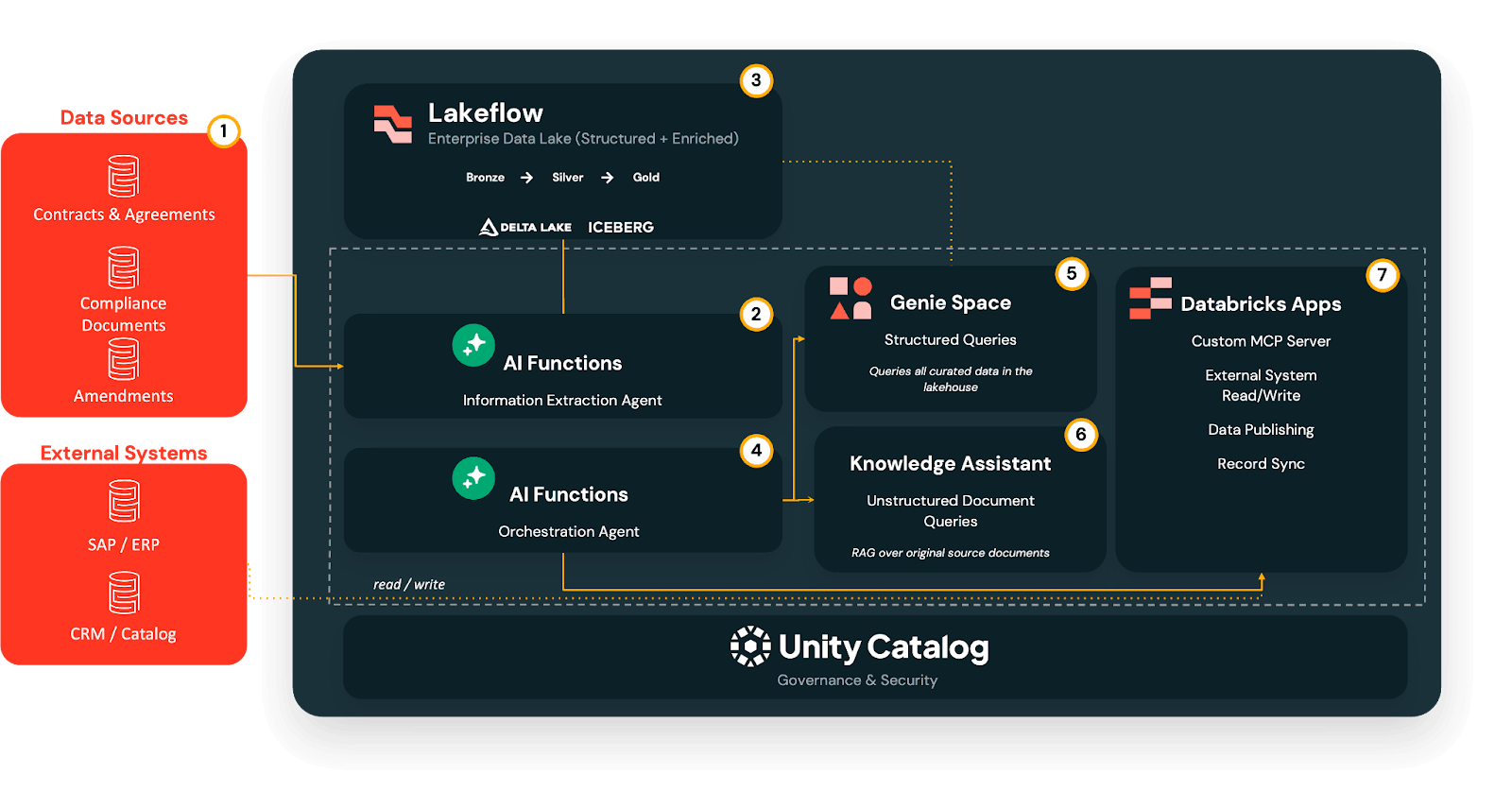
Your data, your AI, your future
Deliver superior customer experience, automate network performance and protect customer trust with AI, apps and agents built on your data.
Enhance B2C and B2B customer experience to grow revenue
Onboarding and service activation
Streamline customer onboarding, contract buyouts and zero-touch provisioning so new services activate faster with fewer manual delays.
Personalization and next best offer
Use subscriber and service data to personalize experiences, like the right offer at the right time, that boost new sales and retention.
Customer support and outage communication
Analyze call center transcripts, support interactions and local network events to resolve issues faster and deliver proactive outage updates.

Optimize and automate operations
Autonomous network operations
Optimize network capacity and performance and detect and prevent issues before they occur with agents built on your data.
Field service execution
Match technicians to jobs based on urgency, location, skills, parts availability and pre-visit insights to improve first-time fix rates.

Reduce fraud and risk
Real-time fraud detection
Analyze account activity, network behavior and transaction signals in real time to identify and stop suspicious activity before losses occur.
SIM swap and identity fraud prevention
Verify device history, location signals and customer identity during high-risk events to block account takeovers and fraudulent activations.
Cybersecurity and IoT protection
Combine threat intelligence with network and IoT traffic monitoring to detect compromised devices, anomalous activity and new cyber threats.
Privacy and compliance reporting
Govern sensitive customer data with clear controls, lineage and auditability to support GDPR, CCPA and industry regulatory requirements.

Featured products
Unifying telecom data to optimize network performance, reduce churn and prevent fraud.

Lakebase
Power network, customer experience and fraud detection apps with Postgres unified to your lakehouse.

Genie
Your AI partner for natural language insights into network performance and customer churn.

Agent Bricks
Build AI Agents that optimize network performance and customer experiences.

Lakewatch
Protect telecom networks with agentic SIEM built for machine-speed defense.
Telecommunications partner ecosystem
An ecosystem of cloud, data and telecom partners helping providers modernize networks, unlock AI-driven insights and deliver better customer experiences at scale.
Resources
Blog

Blog
Report
FAQ
Databricks gives telecom providers a unified platform that brings together network, subscriber and operational data in one open, governed environment. Rather than managing separate tools for billing records, streaming network telemetry and call center transcripts, operators can handle all of it in one place, with Lakebase serving as the real-time operational engine that lets AI agents and applications read and write data at millisecond speed.
AI/BI Genie sits on top of that foundation, giving business users across the organization — from retail managers to network ops directors — the ability to ask questions in plain language and get accurate answers without waiting on a data team. No SQL required.
The results speak for themselves: Frontier Communications saw a 20% increase in new logo sales, T-Mobile cut data latency by 75% and Lumen Technologies saved 3,675 hours annually through GenAI-assisted call center support.
Telecoms have always had the data. The challenge has been unifying it and acting on it fast enough to matter. On the network side, Databricks ingests high-velocity telemetry from cell towers, fiber lines and connected devices in real time, enabling machine learning models to predict equipment faults, detect anomalies and optimize energy usage before problems reach subscribers.
On the customer side, churn prediction models surface early warning signs like repeated dropped calls or declining usage, so retention teams can step in before a customer decides to leave. AI/BI Genie makes these insights available to non-technical users, letting marketing and account teams explore churn triggers and build targeted offers in minutes.
Agent Bricks takes this further with autonomous AI agents that can act on those insights directly, whether generating a personalized next-best offer the moment a customer calls in or triggering a network triage before any subscriber is affected.
Operators are driving the most impact across three areas. The first is customer experience: by unifying billing history, usage data and support transcripts, telecoms can predict churn, personalize next-best offers and proactively flag outages before customers call in to complain. AI/BI Genie makes these insights available to any team, without needing a data analyst in the loop.
The second is network operations: Databricks enables predictive maintenance and around-the-clock anomaly detection, shifting teams from reactive firefighting to proactive management. Lakebase and Agent Bricks power the next step, autonomous, self-healing networks where AI agents detect, diagnose and reroute traffic without human intervention.
The third is fraud and risk: real-time fraud detection models score transactions in milliseconds, enabling immediate action on SIM swap attempts, identity fraud and subscription abuse. Lakebase bridges live operational data with long-term behavioral analytics so responses are proactive, not reactive.
In most telecoms, network ops, customer care, marketing and security teams each work from their own data systems, none of which talk to each other in real time. Decisions are slow, opportunities get missed and the customer experience suffers. Databricks resolves this with a single open foundation that unifies structured billing records, streaming network telemetry and unstructured call center data without requiring teams to copy or move data between systems.
Lakebase is central to making this work in practice. As a fully managed Postgres database built natively on the lakehouse, it bridges historical analytics and live operational systems so that a customer service agent, a network engineer and a marketing team are all drawing from the same real-time data layer at once.
AI/BI Genie extends that access to everyone. A CFO can ask about churn trends. A capacity planning lead can pull traffic forecasts by region. A fraud analyst can investigate suspicious activity. No one needs to wait on a data team to get answers.
5G and IoT are generating data at a scale that traditional platforms struggle to keep up with: continuous telemetry from millions of network endpoints, plus billions of additional streams from connected devices across smart meters, vehicles and industrial sensors. Databricks is built for this volume, ingesting and processing live network traffic data and making it available for both real-time decisions and longer-term analytics.
For 5G, this enables use cases like dynamic network slicing, where AI models automatically allocate capacity to high-priority applications based on real-time demand. For IoT, it powers security monitoring at scale, continuously analyzing device traffic to catch compromised endpoints before they can be used to attack the network.
Lakebase and Agent Bricks bring it all together at operational speed. AI agents can monitor network conditions, detect anomalies and take autonomous action, from rerouting traffic to triggering zero touch provisioning for new devices, at the latency 5G environments require. The goal is to turn the data generated by 5G and IoT from a volume challenge into a competitive advantage.