Unity Catalog Pages: a governed home for your business knowledge in Genie Ontology
Enrich Genie Ontology with your organization’s actual business definitions, turning company-specific terminology into authoritative context for data and AI agents.
by Tim Feng and Ashish Singh
- Unity Catalog Pages are a new, governed home for the authoritative definitions of the concepts that run your business, your key terms, entities, and acronyms, organized by domain right next to the data they describe.
- As the newest piece of Unity Catalog semantics, the human-curated layer of Genie Ontology, Pages give Genie One and other agents authoritative business meaning to reason from, so answers are grounded in your organization’s definitions.
- With Genie Code, you can auto-generate a Page from attached source material or bulk-import knowledge you already have in Confluence, Slack, and Google Docs, turning weeks of copy-pasting into minutes.
Every AI agent is only as good as the context it is grounded in. Ask an agent a question about revenue, active customers, or churn, and the quality of the answer depends entirely on whether the agent understands what those words mean inside your business.
In many organizations, that meaning does not live in one place. It is scattered across Slack threads, Confluence pages, spreadsheets, and the tribal knowledge in a few people's heads, and the same term is often defined three different ways by three different teams. So when an agent hits an ambiguous concept, it does what LLMs do best: it guesses confidently, even when it is wrong. This gap is one of the biggest barriers to enterprises trusting AI with real business questions.
This is the problem Genie Ontology was built to solve. Genie Ontology is Databricks’ enterprise context layer for all AI: it automatically learns how your business works by extracting knowledge from your dashboards, queries, tables, pipelines, and connected apps, and organizes it into a living graph that tells Genie and other agents where to look and what to trust.
That automatic understanding covers an enormous amount of ground on its own. But some concepts are too important to leave to inference. When "completed trip" or "active customer" has to be exactly right, you want your own experts to define it once, in a place every person and every agent can rely on. Unity Catalog Pages fill this exact gap. As the newest piece of Unity Catalog semantics, the human-curated layer of Genie Ontology, Pages provide a governed home where your data stewards, with the help of Genie Code, can now define the authoritative meaning of a concept, and Genie treats that definition as the source of truth.
How Unity Catalog Pages enhance Genie Ontology
Genie Ontology brings two kinds of context together. Alongside everything it learns automatically, it draws on the definitions your teams model explicitly in Unity Catalog semantics. Each modeled piece plays a distinct role:
- Metric views define your governed measures and KPIs as reusable calculations, so a number like "quarterly bookings" is always computed the one agreed way.
- Domains and sub-domains scope your data and knowledge by business area, so an agent lands on the high-quality assets for that part of the business instead of searching the whole catalog.
- Certification and deprecation mark which assets are trusted and which are on their way out, so agents know what to lean on.
- Pages now capture the meaning of your business concepts: the terms, entities, and acronyms behind those numbers and assets.
These are complementary, not interchangeable. Metric views tell the agent how to calculate; Pages tell it what a concept means; domains tell it where to look; certification tells it what to trust. Together with the knowledge Genie learns on its own, they form a single, governed picture of your business.
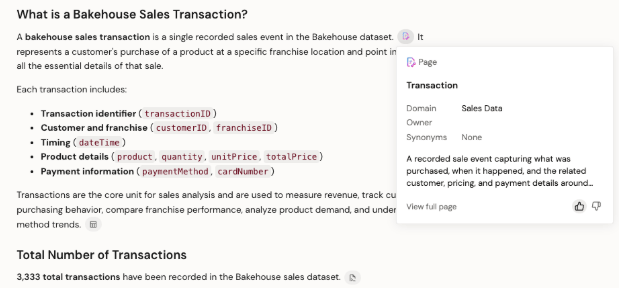
Now, when a question to Genie One touches on a concept your organization has explicitly defined, Genie can retrieve the corresponding Page and use its definition to help interpret the request, rather than relying solely on inference. For example, if your sales organization has documented what qualifies as an "active customer" and which table to derive that entity from, Genie One can use that exact definition when an analyst asks it to analyze 30-day customer trends during a major sales push—delivering accurate results without guessing.
To tie the experience together, Unity Catalog Pages used to ground an answer are cited as clickable sources, so users can inspect the definition, see who owns it, and understand why that context was used. This turns grounding from a hidden AI decision into a verifiable train of thought that users can review before acting on the results.
A single source of truth for all your knowledge
Each Page combines structured fields (an owner, synonyms, and a description) with a rich body that can hold links, images, tables, and inline references to the Unity Catalog and workspace objects the concept depends on. Pages live in Discover, organized under the same domains and sub-domains you can use to structure your data estate. That way, the business context sits right next to the physical assets it describes, rather than in a separate tool.
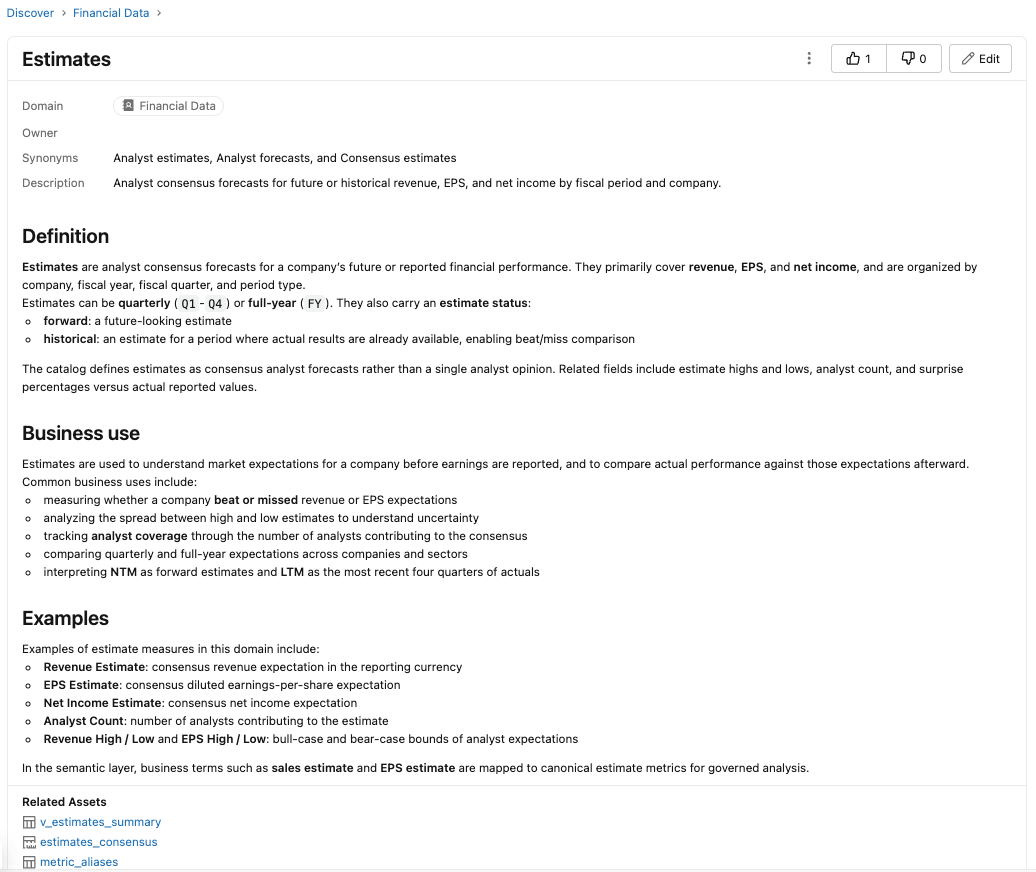
You can also codify the relationships that link a concept to the rest of your data ecosystem, including Unity Catalog assets, dashboards, and even other Pages. In the Related Assets section, you can catalog the specific workspace and Unity Catalog objects that underpin or illustrate the definition. In the Sources field, you can cite the authoritative links and internal objects the Page is derived from, so every definition stays grounded in verifiable evidence.
Bootstrap Unity Catalog Pages at scale with Genie Code
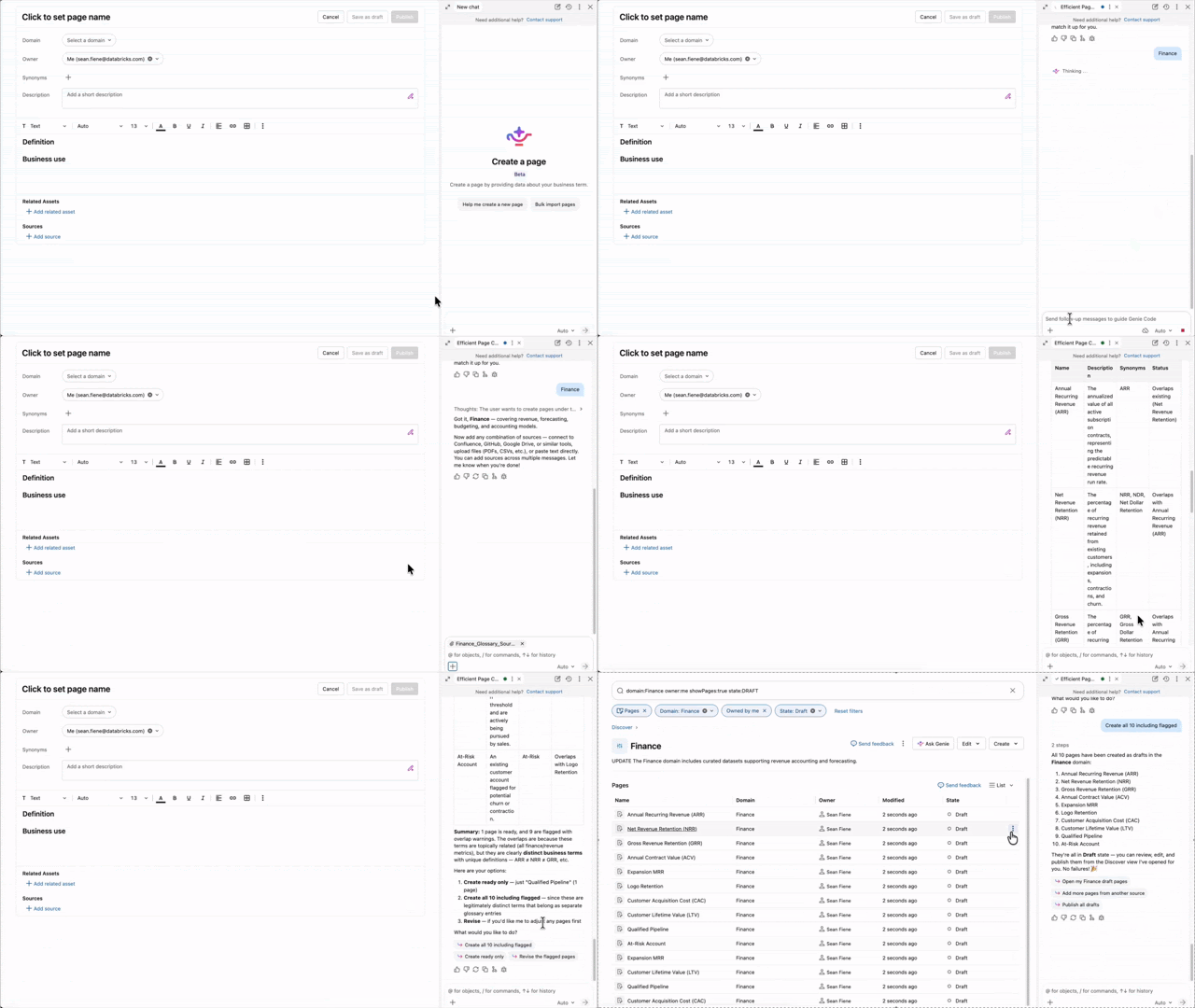
You do not have to write Pages by hand. Genie Code, Databricks' data-smart AI coworker, can author Pages for you, drawing on a range of supported source material: Unity Catalog and workspace assets, file attachments, links, and MCP-connected tools like Confluence, Slack, Google Docs, or GitHub that you configure in Genie Code's MCP setup. Point it at the right sources, and it can extract and import your business knowledge and terminology in bulk, turning weeks of copy-pasting into a few minutes of conversation.
For example, hand Genie Code one of your organization’s key Confluence pages, and it will pull out the concepts and jargon buried inside it and create each one as its own atomic Page. To get started on your first set of Pages, click the "Bulk import pages" conversation starter in Genie Code.
Getting started
Unity Catalog Pages give your enterprise a governed home for the concepts that matter most, and the tools to curate and collaborate on the authoritative meaning your organization relies on. As the latest addition to Unity Catalog semantics, the curated layer of Genie Ontology,, that meaning is served straight to Genie One and your agents, grounding them in consistent, trusted context and connecting your business logic to the data estate where your most impactful work happens.
Pages is available today in Beta. Learn more in our product documentation, and reach out to your account representative to try it out.
Get the latest posts in your inbox
Subscribe to our blog and get the latest posts delivered to your inbox.