Unlocking semantics for AI: How Mercedes-Benz Korea built trusted “Talk to Data” at scale
How Mercedes-Benz Korea and Databricks piloted AI-ready semantics and AI agents using Unity Catalog, Metric Views, Genie, and Agent Bricks
by Sai Yang, Fares Kamal, Alina Kamal, Andreas Jäck, Johannes Laufer and Manuel Culebras
- One KPI layer: Mercedes-Benz Korea built on its established Lakehouse and Power BI stack by making 500+ KPI definitions available in an open, AI-ready semantic layer on Unity Catalog metric views, using an automated DAX-to-Metric-View transpiler from Databricks to accelerate the transition.
- Governed semantics for BI and AI: With Unity Catalog metric views, Mercedes-Benz Korea extended its governed semantic layer for enterprise KPIs. This layer supports both existing BI reports and new “Talk to Data” experiences, with Genie and Agent Bricks providing answers consistent with the existing KPI definitions.
- Scaling “Talk to Data” across markets: Building on Unity Catalog metric views, Genie, and Agent Bricks, Mercedes-Benz Korea is shaping a playbook for persona-based AI agents on top of a shared KPI layer, which can serve as a reference for other Mercedes-Benz sales markets in enabling self-service analytics for sales, product, finance, and marketing teams.
“Talk to Data” is rapidly becoming an important capability across industries, and delivering it at enterprise quality requires a strong semantic foundation. Answer reliability is highest when AI can draw on clearly governed business logic rather than inferring it from complex schemas, report-specific KPI logic, or disconnected dashboards. Consistent KPI definitions, aligned business logic, and well-defined joins and aggregations are what give executives the explainable answers they need.
Mercedes-Benz Korea and Databricks approached this together. Rather than treating “Talk to Data” as a chatbot project, Mercedes-Benz Korea extended its existing analytics foundation with a governed semantic layer for enterprise AI. To enable semantics that can power both BI and AI, Mercedes-Benz Korea made KPI logic available in Unity Catalog Business Semantics in addition to Power BI. Drawing on Metric Views, Genie, and Agent Bricks on the Databricks Data + AI Platform, Mercedes-Benz Korea piloted a unified architecture for data, semantics, and agentic AI. Learnings from the Korea pilot can serve as a reference for other Mercedes-Benz markets.
Mercedes-Benz Korea’s vision in “Talk to Data”: unified semantics for BI and AI
Mercedes-Benz is a market leader in the high-end luxury automotive segment, operating a global sales network in which data-driven, market-specific decision-making is a continuous priority. “Talk to Data” self-service analytics is one capability being explored to further support this priority.
Mercedes-Benz Korea has a mature data foundation. Over time, Mercedes-Benz Korea established gold-layer reporting data, a master KPI catalog, and shared definitions in the Lakehouse and Unity Catalog on Databricks. This foundation serves as the single source of truth for BI reporting, automation, and other data products, covering more than 500 KPIs across business domains such as sales, product, marketing, customer service, and finance. Given this foundation, Mercedes-Benz Korea was selected to pilot the “Talk to Data” approach.
At the same time, a significant share of the business semantics at Mercedes-Benz Korea was defined in Power BI. As part of preparing for AI use cases, these definitions were complemented by an open, AI-ready semantic layer in the Lakehouse.
The broader vision of Mercedes-Benz Korea for “Talk to Data” was to establish a unified, AI-ready, and governed semantic foundation for enterprise decision-making that can support reporting, self-service analytics, and AI experiences on a consistent set of business definitions. In line with this vision, Mercedes-Benz Korea did not approach “Talk to Data” as a migration away from Power BI, but pursued three key objectives:
- Consistent context for AI: The business logic and KPIs were already defined across two layers: in Power BI’s DAX language for reporting, and in curated silver and gold tables in the Lakehouse that were ready to be consumed by AI. The next step is to move the semantic context from BI reports to Unity Catalog to enrich the existing data products in the Lakehouse. This allows Genie and other AI agents to access all KPI definitions in one place, so that the same question, for example, “What’s our total retail sales MTD by vehicle class?”, yields consistent answers across AI experiences.
- Architecture evolving toward agentic AI: Mercedes-Benz Korea has a mature BI stack combining Databricks for data engineering and warehousing with Power BI for semantic modeling and reporting. The next step in this evolution is to extend it with a unified, AI-ready semantic layer based on the business logic from the BI reports, so that downstream BI tools and AI agents can operate on the same governed KPIs.
- From reporting users to persona-based agents: Governance for end users at the table and report level was already in place as part of the existing data infrastructure. The next step is to extend that governance with persona-based access control in Unity Catalog and orchestration rules for persona agents, so that roles like the CFO or Sales VP can have an agent experience tailored to their domains without changing the underlying business semantics.
Following these principles supports the goal that future AI and BI tools can consume the same validated business logic. This contributes to consistency, explainability, and the answer quality required for enterprise use.
A unified architecture for data, semantics, and AI
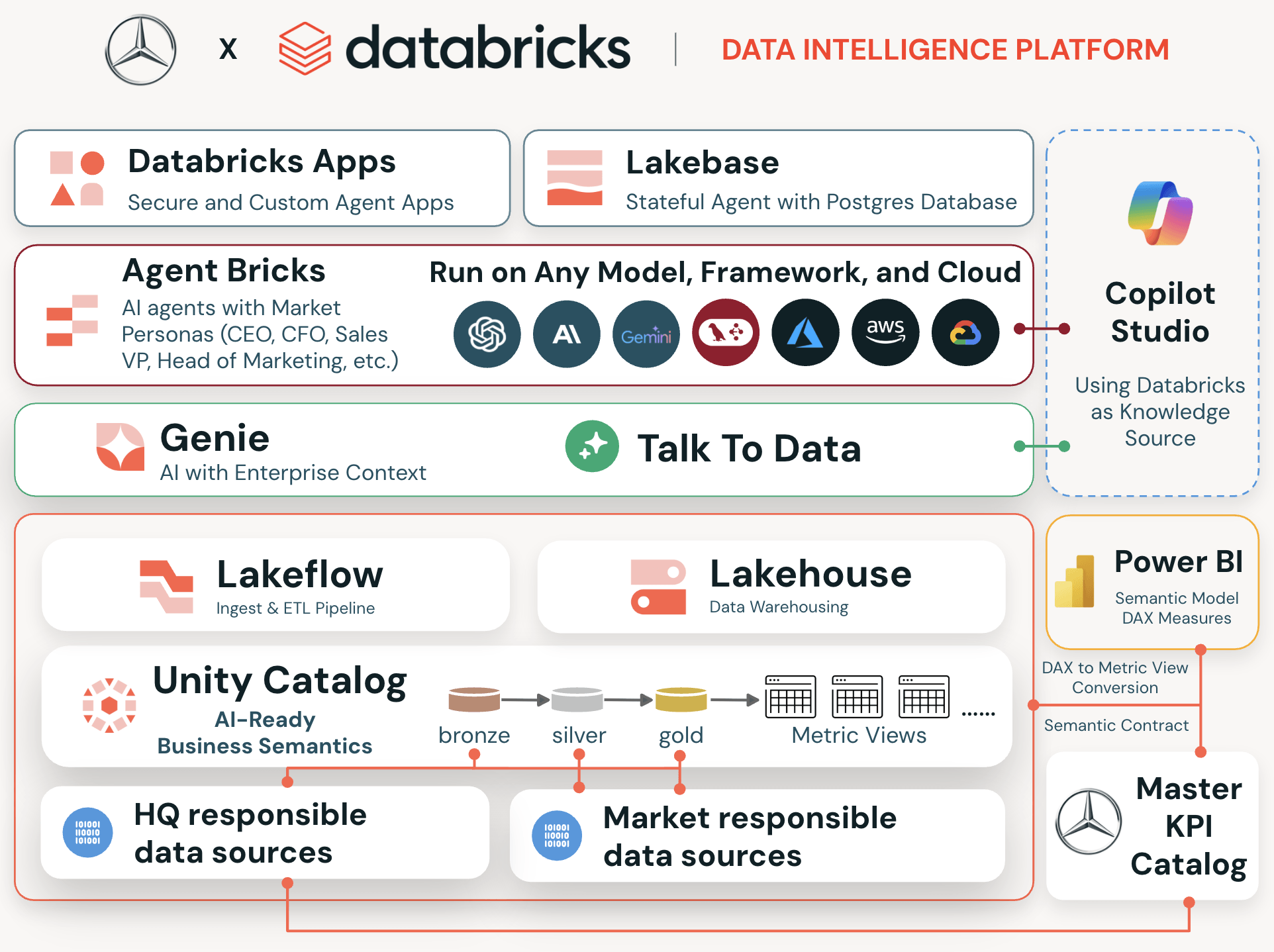
To enable AI-ready semantics, Mercedes-Benz Korea implemented “Talk to Data” with a unified architecture on the Databricks Data + AI Platform, powering trusted AI at scale.
The solution rests on different Databricks capabilities working together:
- Lakeflow and Lakehouse ingest enterprise data from various source systems and prepare it for BI and AI workloads.
- Unity Catalog business semantics serve as the single source of truth for KPIs, translating Power BI DAX measures into metric views: sources, joins, measures, dimensions, comments, and synonyms all live alongside the data, governed by the same permissions as the underlying tables.
- Genie spaces let business teams “talk” to their data. Genie spaces are organized by business domain, each backed by a curated set of metric views. As KPIs in metric views are defined directly on top of the gold-layer data, Genie doesn’t need guesswork or complex joins to figure out the right answers, increasing both the speed and accuracy of its responses.
- Agent Bricks composes persona-based agents on top of multiple Genie spaces, so the CFO, sales VP, and head of marketing each get a "Talk to Data" experience tuned to their role.
- Databricks Apps provides a custom front-end, connections to external services, and other extended capabilities for composed agents, with memory and state stored in Lakebase.
Before this pilot, reporting data was stored in Hive metastore, and “Talk to Data” was explored with other AI solutions based on report-centric semantics in Power BI reports. In that setup, the semantic context for BI and AI was distributed across multiple components, which made it harder for the AI layer to capture semantics consistently across users and workloads. Persona-based access control on KPIs was also not yet available, and other AI solutions required more explicit guidance and prompt tuning than Genie, which operates directly on the governed KPI layer in Unity Catalog.
Adopting this architecture on Databricks provides the foundation for a streamlined “Talk to Data” experience for business users.
Accelerating the pilot: an automated DAX-to-Metric-View transpiler
Making the business logic from Power BI DAX also available in Unity Catalog metric views was a key step in building an open semantic layer. With over 500 KPIs defined in DAX at Mercedes-Benz Korea, an efficient and standardized approach was needed. To support this, Databricks built an automated DAX-to-Metric-View transpiler for the Mercedes-Benz Korea team.
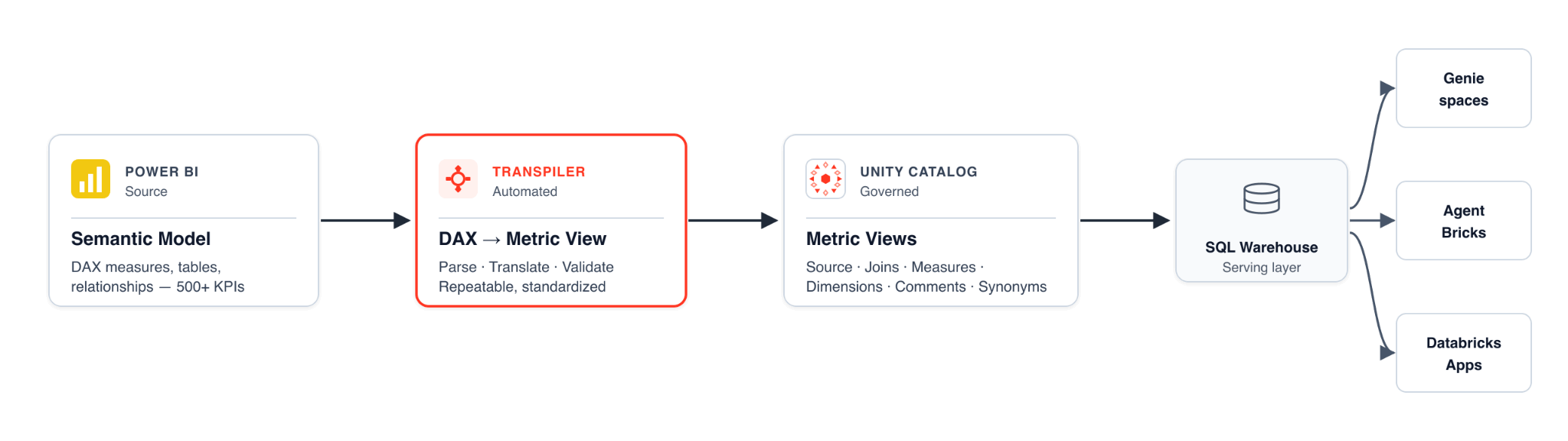
The transpiler runs as a pipeline that turns Power BI DAX measures into deployable Databricks metric views. It:
- Parses Power BI semantic models and extracts every DAX measure.
- Creates a metadata catalog, such as fact tables, dimension tables, join relationships, join keys, etc., for each measure extracted from the Power BI semantic models.
- Maps each measure's source tables to their counterparts in Unity Catalog.
- Generates draft metric view definitions (source, joins, dimensions, measures), translating DAX semantics into metric view measures and the ready-to-run SQL statements that create the metric views.
- Flags non-automatable measures, typically those involving complex DAX-specific features like row context manipulation, for manual review.
- Validates the syntax and aggregation logic before compiling metric views.
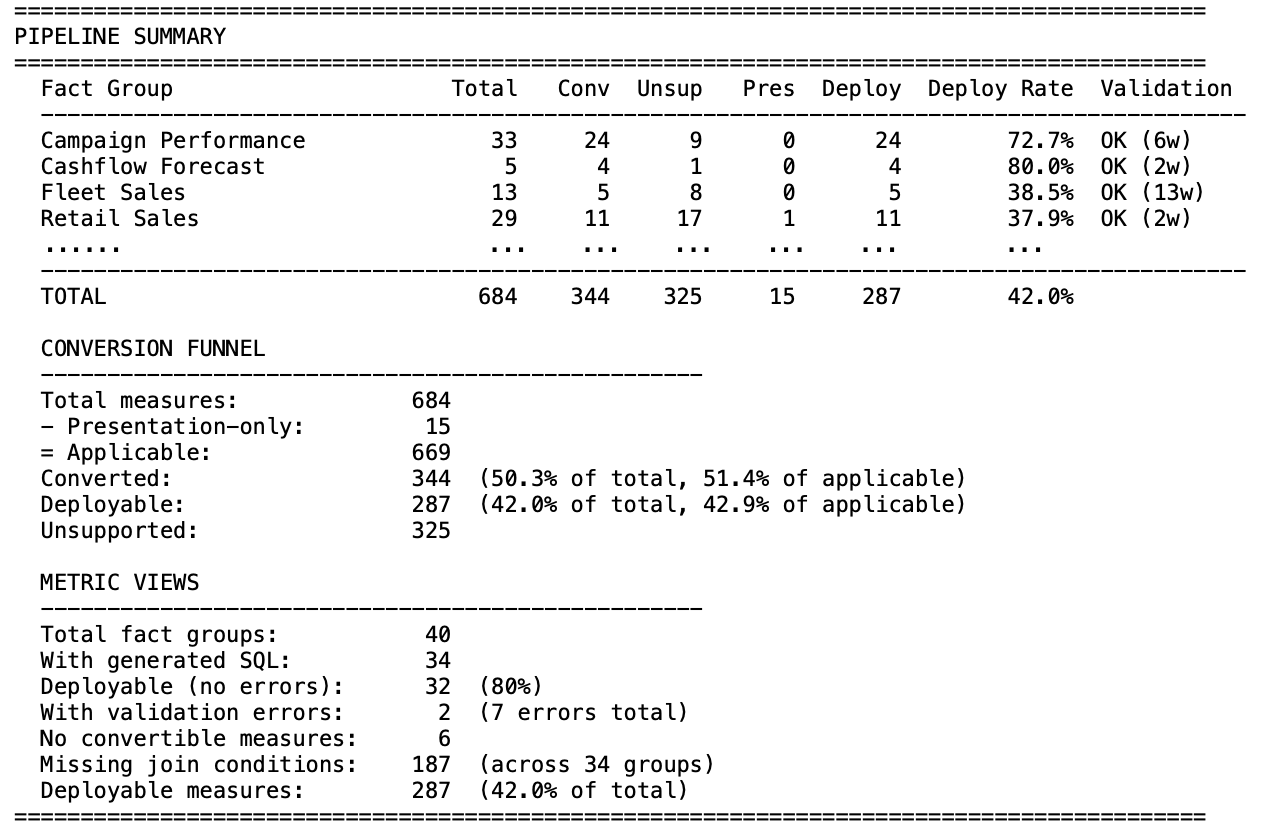
When the pipeline finishes, it produces an evaluation report with conversion statistics, gaps, and remediation strategies for non-automatable DAX measure conversion.
The output is a strong starting point with ready-to-use metric views for automatable DAX measures, saving hundreds of hours of manual work on the semantic migration. From there, the team validates each measure against the corresponding Power BI report and iterates with Genie Code, which refines and optimizes the metric view definitions from natural-language input.
After seeing initial success with this transpiler, Databricks baked these capabilities into a new Genie Code skill for Power BI migration, now in Private Preview and accessible directly within Genie Code without additional tooling, and supporting the further rollout at Mercedes-Benz.
Building trusted, AI-ready semantics
Answer quality is a top priority for the business users of “Talk to Data” at Mercedes-Benz Korea. Onboarding KPIs as metric views into Genie spaces is a key step, but does not on its own guarantee reliable answers from agentic AI. A metric view is only AI-ready once Genie's responses are validated. The internal target for Mercedes-Benz Korea is full alignment of Genie's answers with the corresponding Power BI reports — a 100% match for every KPI in scope.
During the pilot, Mercedes-Benz Korea and Databricks jointly documented best practices for curating, integrating, and optimizing metric views and Genie spaces, including the use of agent metadata and benchmarks. These practices support AI-ready business semantics and consistent answers for business teams interacting with enterprise data.
Following an iterative five-phase process documented during the pilot, Mercedes-Benz Korea built AI-ready business semantics on the Databricks Data + AI Platform that business users can rely on. Databricks is also developing an App solution to automate this process, which Mercedes-Benz could leverage for the further rollout.
Phase 1: Prepare. Pick the KPIs to onboard and map each one to its source tables in Unity Catalog. For Power BI semantic migrations, identify the relevant DAX measures and semantic models. This phase establishes the scope and the source of truth.
Phase 2: Build the semantic layer. Create Unity Catalog metric views with data sources, dimensions, measures, comments, and agent metadata. Validate each KPI individually before adding the next. For KPIs that span multiple fact tables, build a base view first and layer the metric view on top. Always add descriptions at the metric view, dimension, and measure level; Genie reasons over all three.
Phase 3: Organize by domain, not by report. Structure Genie spaces around business domains (e.g., "Marketing") and metric views around KPI groups within subdomains (e.g., "Online Marketing Conversion Metrics"). Limit each Genie space to 30 Unity Catalog items, and always include a space description so a multi-agent system can route questions correctly.
Phase 4: Test incrementally. Onboard measures incrementally. Validate each with sample questions. Save verified queries as example SQL. Then build benchmarks: phrasing variations of each question paired with ground-truth SQL, used to systematically measure answer accuracy. Turn on prompt matching so Genie can map user language to actual data values.
Phase 5: Validate and release. Run regression tests after every change; if a previously passing benchmark fails, the most recent addition is the most likely cause. Once stable, ship to a small group of business users for real-world feedback. Use the Monitor tab to track, review, and address all user feedback in one place. Both regression failures and user feedback feed straight back into Phase 4.
The output is a semantic layer where AI answers align with the corresponding BI report on every KPI in scope, supporting the reliability that business users expect.
From a single Genie space to a multi-agent system with built-in governance
A single Genie space can answer questions about a single domain. A real "Talk to Data" experience for a Mercedes-Benz market needs to span sales, product, marketing, customer service, finance, and more — while tailoring what each persona sees based on their role and permissions.
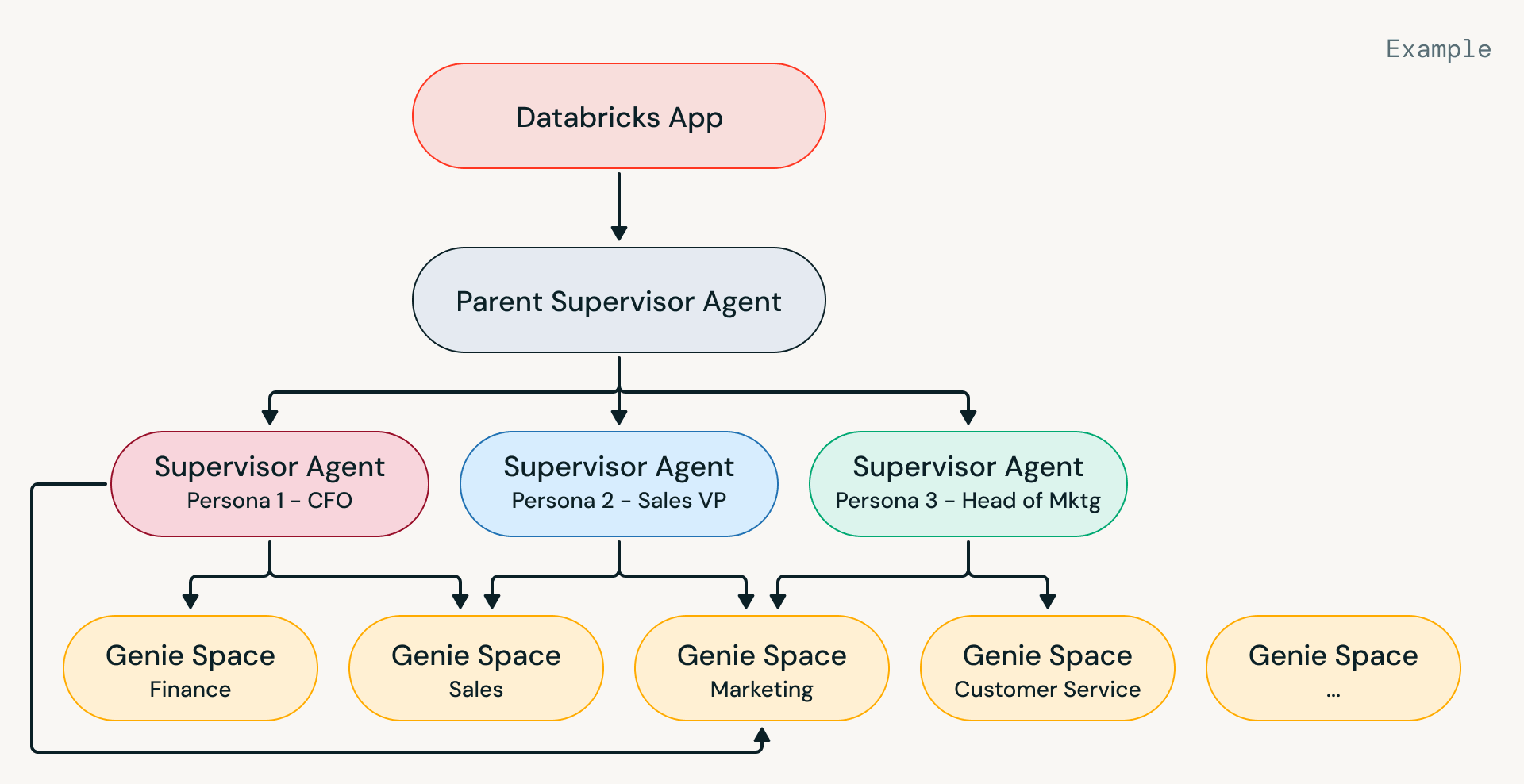
That's where Agent Bricks comes in. The architecture that Mercedes-Benz Korea deployed:
- A parent supervisor agent routes each question to a persona agent with role-specific instructions.
- The persona agent (e.g., “CFO”, "Sales Manager", "Marketing Analyst") consolidates insights from appropriate Genie spaces across relevant domains, selecting the right scope of metric views to answer the question.
- Unity Catalog governance policies enforce row- and column-level access, so a regional manager only ever sees data their role permits, even when asking in natural language.
- The agents are surfaced through Databricks Apps with a custom front-end and extended capabilities like customized visualization, agent memory, and transactional databases on Lakebase. The app also allows the composed agents to be integrated with the tools and services that business users already use, so "Talk to Data" lives inside their daily workflow rather than as a separate destination.
Because the metric views live in Unity Catalog, they are open and reusable across all Genie spaces, agents, and apps. Every answer is fully governed, auditable, and lineage-tracked back to the source data. This multi-agent pattern can serve as a reference for bringing “Talk to Data” to additional Mercedes-Benz markets.
Scaling the pilot: a repeatable playbook for global markets
Korea is still at the beginning of this journey, and the early results are encouraging. The current pilot shows that when “Talk to Data” is grounded in governed semantics, business users can receive answers that align with established KPI definitions and existing reporting logic. Based on these results, Mercedes-Benz Korea has documented a playbook that other markets can reuse: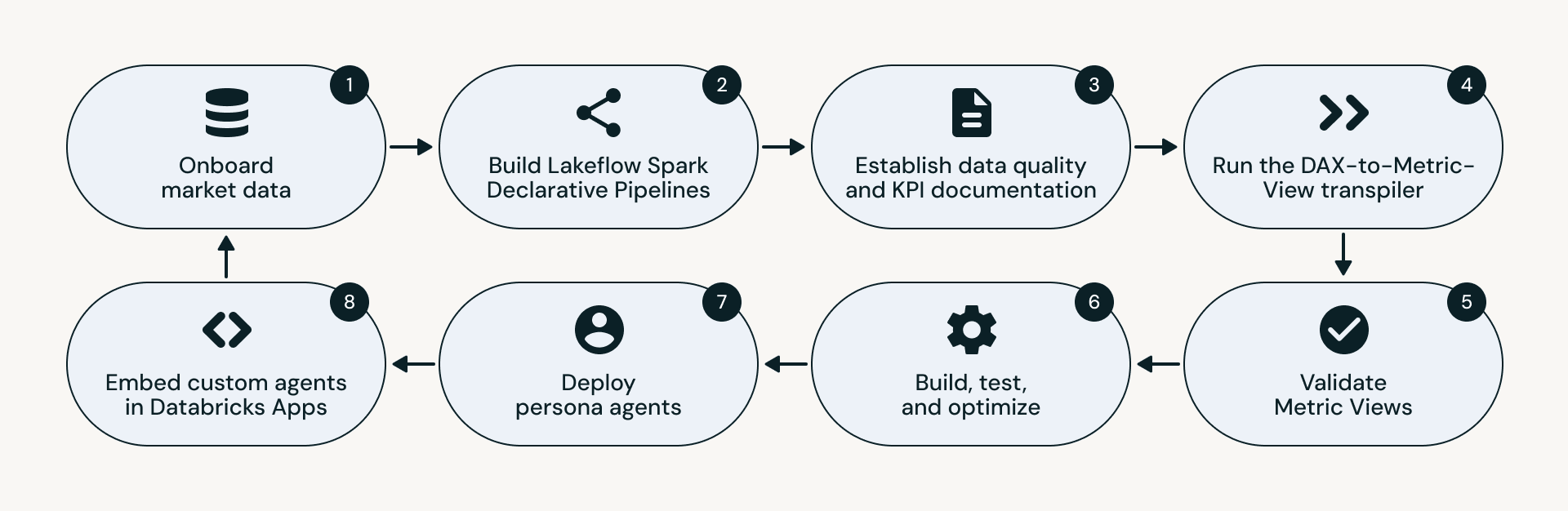
- Onboard market data from both global and local source systems into Unity Catalog.
- Build Lakeflow Spark Declarative Pipelines to curate gold-layer reporting data.
- Establish data quality and KPI documentation at the gold layer.
- Run the DAX-to-Metric-View transpiler to generate first-draft semantic models.
- Validate Metric Views against the Mercedes-Benz Master KPI catalog.
- Build, test, and optimize Genie spaces using the five-phase process above.
- Deploy persona agents with Agent Bricks on top of Genie and Unity Catalog.
- Embed custom agents in Databricks Apps or third-party tools, wherever the user already works.
Markets that choose to adopt the playbook can reuse the architecture and focus on what is local to them: their data, their KPIs, and their AI agents. Together with Databricks, Mercedes-Benz Korea is documenting learnings from the “Talk to Data” pilot that can serve as a reference for other Mercedes-Benz markets.
Getting started
- Join the Mercedes-Benz Korea + Databricks session at Data + AI Summit 2026, where we walk through the architecture and the playbook for AI-ready semantics in depth.
- Explore Unity Catalog Business Semantics, Metric Views, Genie, and Agent Bricks to get started with building trusted agentic AI on unified semantics.
Get the latest posts in your inbox
Subscribe to our blog and get the latest posts delivered to your inbox.