What is a Unified Data Warehouse?
A modern architecture combining data warehouse and data lake capabilities with unified governance, ACID transactions, and support for SQL and ML workloads
- A unified data warehouse is an enterprise data store that brings together all of a company's business information so people across the organization can work from consistent, shared data.
- This architecture pulls data from many operational sources into shared components such as data sources, a core warehouse, data marts, ETL processes and metadata so complex queries do not interfere with day to day systems.
- A unified data warehouse improves decision-making by refining and de‑duplicating data, minimizing manual manipulation, and keeping large volumes of up to date information available for analytics and planning.

What is a Unified Data Warehouse?
A unified database also known as an enterprise data warehouse holds all the business information of an organization and makes it accessible all across the company. Most companies today, have their data managed in isolated silos while different teams of the same organization use various data management tools for various types of data such as data quality, data integration, data governance, metadata and master data management, B2B data exchange, database administration and architecture,etc. The adoption of enterprise DWs in large companies has become a best practice for storing integrated and centralized data extracted from various disparate operational sources. In this way, complicated queries can be executed without conflicting with the transactional operations of the operational systems.
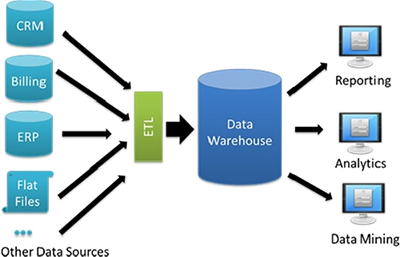
The typical architecture of a DW consists of different components where data is passed from one component to the next after some critical operation is performed on the data. The structure of a unified data warehouse consists of a subset of the components contained in the Data warehouse architecture, namely: the data sources, the core DW, the data marts, the Extraction, Transformation and Loading (ETL) processes and the metadata repositories. The most important benefit of unified data warehousing comes from the fact that all the data is based on one central premise: as a result, there is no need to analyze the data separately in order to convert it into actionable information which can facilitate an improved decision-making process.
The agentic AI playbook for the enterprise

Advantages Offered by a Unified Data Warehouses:
- Data warehouses offer added support for data, in that they are designed to track, manage, and analyze information, providing a great environment that is designed for decision support, analytics reporting, and data mining.
- A unified data warehouse works hand-in-hand with other analytics programs to promote company growth.
- All the company’s data is constantly available for analyzing and planning purposes
- Users can store vast amounts of data with a large variety of parameters. That data can be drawn from multiple, usually unrelated sources.
- A unified data warehouse has the ability to refine data, eliminating redundant information, while increasing overall data quality.
- Keeps data manipulation to a minimum and integrity at its highest level.
- Provides improved and up-to-date information
Additional Resources
Get the latest posts in your inbox
Subscribe to our blog and get the latest posts delivered to your inbox.