Enterprise AI agent trends: Top use cases, governance + evaluations and more
by Kunal Marwah, Mason Force and Ram Murali
• Databricks shares insights from 20,000+ global organizations in its new State of AI Agents report, including trends in the top AI use cases, agentic systems, and database transformations.
• As AI investments deepen, innovators are increasingly prioritizing governance and evaluation. Companies that implemented AI governance pushed 12x more projects to production.
• AI agents are driving core database activity, pushing the transformation to a new kind of database called Lakebase.
There’s a rapid shift happening in enterprise AI. Organizations are transitioning from chatbots to agentic architectures that deliver accurate outcomes for enterprise use cases. To navigate this transition, data leaders and professionals are recalibrating their agent strategies.
What does it take to get AI agents to work for your business? And what are the leading companies doing differently from those that are stagnating?
The State of AI Agents leverages data from over 20,000 global customers to uncover the biggest trends in how organizations are approaching AI agents. This report shares insights across AI in the enterprise: common use cases, evaluations and governance, database transformation, and more.
Here are some of the key highlights:
AI deployments are focused on core tasks
Everyone is talking about enterprise AI. But how is it playing out in the real world? We examined the most common AI use cases across regions and industries. The finding: companies are automating critical, but routine, tasks.
These tasks range from market intelligence to customer advocacy to regulatory reporting. Of the top 15 use cases, 40% focus on customer experience and engagement.
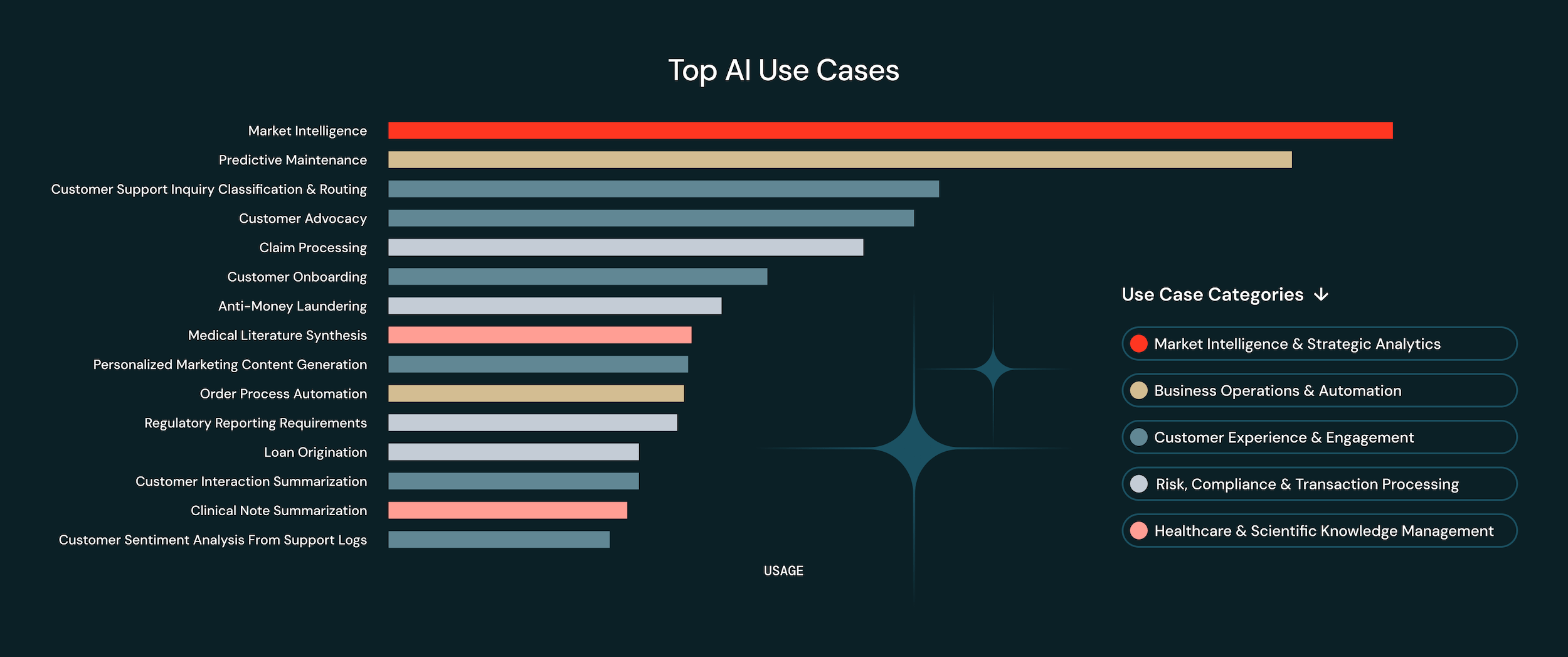
And these applications are tailored to specific sectors. For example, analyzing medical literature is a top use case for healthcare and life sciences companies, while predictive maintenance is more common in the automotive or energy and utilities industries.
AI evaluations and governance are the building blocks of production
A 2024 global survey conducted by Economist Impact found that 40% of respondents believed their organization’s AI governance program is insufficient. It doesn’t adequately define data, set the proper guardrails, or provide the necessary accountability. And without strong checks and balances, enterprises will struggle to scale AI agents in production.
It’s perhaps no surprise that AI governance and security products saw the biggest usage uptick over the past year, according to our data. And companies using AI governance tools get over 12 times more AI projects into production.
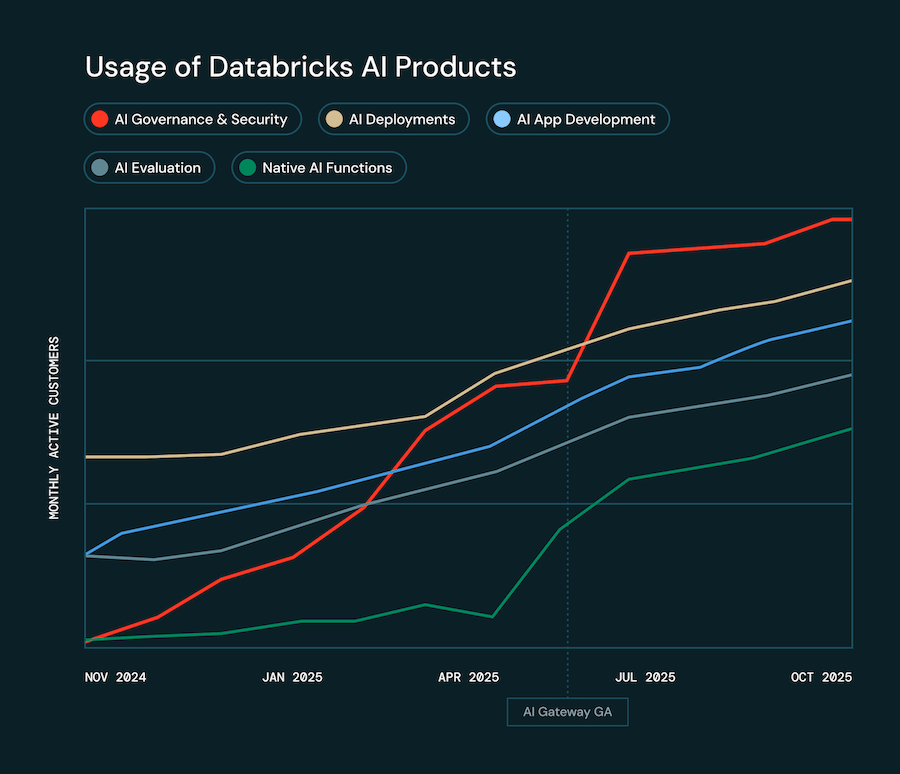
AI evaluations are critical to ensuring high-quality outputs necessary for deploying AI agents into production, and organizations are quickly adopting AI tools. Organizations that use evaluation tools move nearly 6 times more AI systems to production.
AI agents drive an architecture rethink
As vibe coding continues to gain in popularity, the AI-driven approach to application development is quickly overhauling how companies manage their databases. As a result, companies must deliver the elasticity, programmability, and scale in their architecture needed for AI agents to perform as expected.
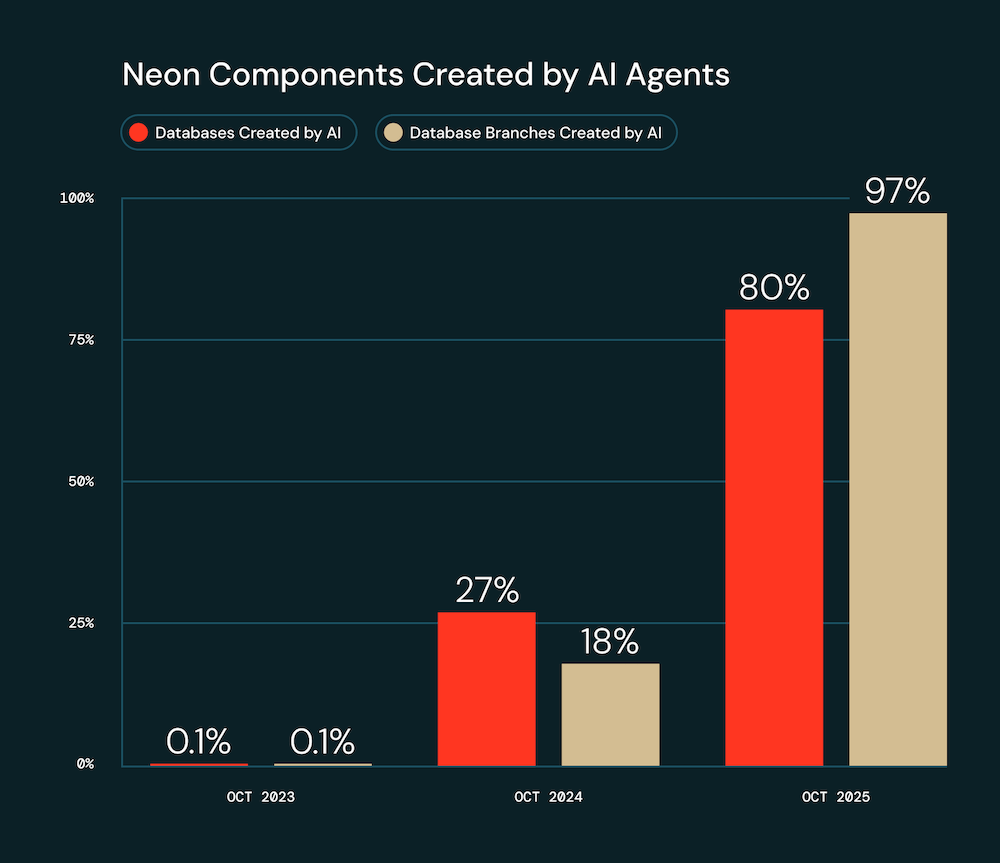
Agents make this scale possible, and we’ve seen this shift happening within our own data. On Neon, a serverless Postgres database acquired by Databricks and the core technology behind Databricks Lakebase, AI agents now create 80% of all databases and 97% of database branches.
327% growth in multi-agent workflows
The value of AI agents in enterprise environments is their ability to orchestrate complex workflows grounded in an organization’s own data. To understand how enterprises are leveraging AI agents, we analyzed the usage of the four types of agents on Databricks Agent Bricks.
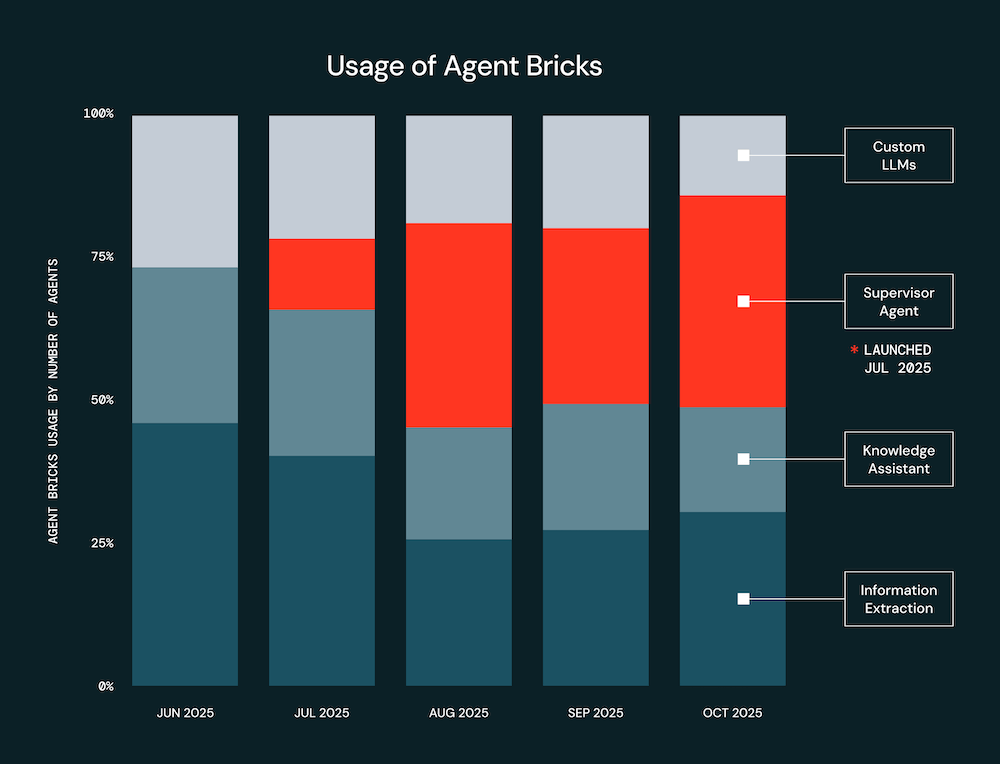
Among our customers, the top agent use case is the Supervisor Agent, which accounted for 37% of usage. Supervisor Agent creates systems of multiple agents – auto-optimized using an organization’s own data – that work together to complete tasks across specialized domains.
Get started with your AI Strategy
Building and deploying AI agents is no longer a barrier for organizations. Now, the challenge is doing so in a secure and governed way that actually drives value for the business.
To learn more about how the most successful organizations are successfully pushing AI deeper into operations, read the full 2026 State of AI Agents report.
Get the latest posts in your inbox
Subscribe to our blog and get the latest posts delivered to your inbox.