7-Eleven’s Journey to Unity Catalog Success
Reorienting a complex migration with UCX and system tables
by Prashanth Subrahmanyam, Ganesh Susarla and Frank Sepulveda
- 7-Eleven migrated to Unity Catalog to centralize governance, improve data discovery, and restore trust across a large, complex analytics estate.
- By using UCX and system tables to assess, prioritize, and phase the migration, the Enterprise Data Platform team reduced technical debt, de-scoped ~40% of low-value workloads, and modernized their architecture without disrupting daily operations.
- Unity Catalog now provides a unified foundation for secure, federated, and scalable analytics, enabling stronger compliance, faster collaboration across domains, and new innovation through capabilities like Delta Sharing, Clean Rooms, and self-service AI/BI.
7-Eleven, Inc. operates more than 85,000 stores worldwide, serving millions of customers every day. Behind that scale sits an equally vast data platform, powering mobile checkout, loyalty programs, on-demand delivery, and AI-driven personalization.
By 2023, that platform was showing strain. As the platform scaled, legacy architectural patterns, including an external Hive metastore and workspace-level governance models, began to limit visibility and consistency. Metadata was fragmented across environments, making data discovery more difficult and reducing trust. Compliance teams lacked a unified, account-level view of data access, while technical debt accumulated as thousands of jobs depended on hard-coded paths, RDDs, and DBFS mount points. At the same time, data sprawl across storage locations and legacy workspaces slowed modernization efforts.
The Enterprise Data Platform (EDP) team at 7-Eleven knew that migrating to Unity Catalog would centralize access control, simplify compliance, and enable a federated data architecture. In this blog, we’ll walk through why we migrated to Unity Catalog, how UCX and system tables helped us reorient the migration, and the benefits we are seeing now that we’ve standardized on UC.
You can learn more about 7-Eleven’s migration to Unity Catalog by checking out their session at Data + AI Summit 2025.
Building a Future-Proof Data Governance Strategy
For 7-Eleven, Unity Catalog was not just about addressing governance gaps; it was about building a foundation for the future. Centralized access control, audit logging, lineage, and data discovery would simplify operations and improve trust in data. A federated architecture would allow business domains to innovate independently while still aligning to enterprise standards. Unity Catalog also promised to standardize business metrics through a semantic layer, ensuring consistent KPIs across analytics and reporting.
However, 7-Eleven faced what they called a brownfield migration. Years of entrenched code patterns, thousands of tables and notebooks, and jobs built around an external Hive metastore meant that a simple lift-and-shift wasn’t possible. The team needed a structured way to assess their estate, remediate technical debt, and migrate without disrupting daily operations.
Steps to a seamless migration with UCX and system tables
7-Eleven turned to UCX, Databricks Labs’ open source migration assistant, to replace manual effort with structured workflows. UCX crawled their estate, delivered a comprehensive inventory of tables, jobs, and permissions, and flagged blockers with a “readiness score.” This visibility helped the team focus on what mattered most.
With system tables and lineage insights, the EDP team prioritized high-value workflows while de-scoping ~40% of inactive or low-value legacy jobs. This “business-value-first” approach kept the migration manageable and aligned with stakeholder priorities.
Key steps included:
- Identity federation: Moving from workspace-local to account-level groups, with UCX automating permission mapping, even across nested hierarchies.
- Medallion architecture redesign: Remapping storage into bronze, silver, and gold layers during migration.
- Incremental migration with sync and reverse-sync: Allowing Hive and Unity Catalog to coexist during transition, minimizing downtime and risk.
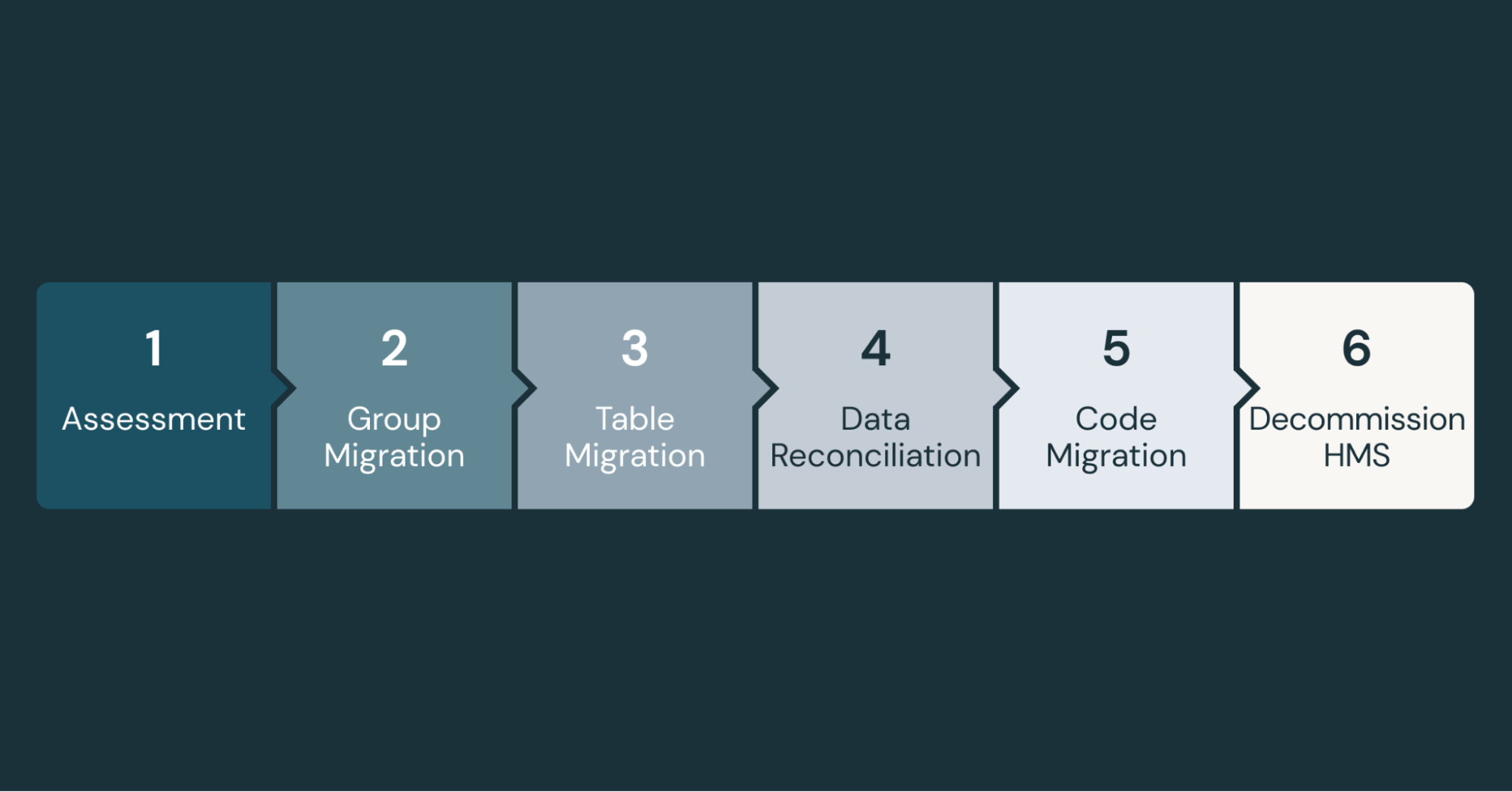
This phased playbook of assess, plan, migrate, validate, and decommission reoriented the project from a daunting challenge to a structured transformation.
Stronger governance, faster innovation with Databricks Unity Catalog
With Unity Catalog in place, 7-Eleven has dramatically simplified governance and unlocked new business capabilities. By eliminating more than 40% of redundant workflows, the team rationalized its data estate and reduced operational overhead. Governance is now unified, with centralized audit logging, fine-grained security, and lineage tracking across all data and AI assets. The platform team manages one set of policies instead of many, improving both efficiency and security.
But the benefits go well beyond simplification. With a central catalog, users across business units can now discover and trust data assets, see how they connect through lineage, and reuse them with confidence instead of recreating reports. Built-in auditability ensures the team can answer questions like “who queried what” in minutes, not days, a critical win for compliance.
Collaboration has also accelerated. Data scientists, analysts, and engineers now work from the same governed platform, sharing data seamlessly across domains. This consistency reduces errors, boosts productivity, and frees teams to focus on business outcomes instead of administrative overhead.
On top of these governance improvements, Unity Catalog has unlocked new capabilities that fuel business innovation:
- Delta Sharing and Databricks Clean Rooms power marketing optimization and secure data monetization.
- Serverless clusters eliminate manual cluster management.
- Self-service analytics with AI/BI Genie Spaces and federated domains give business teams direct access to the insights they need.
Lessons from 7-Eleven’s UC migration
7-Eleven’s UC migration is more than a technical upgrade. It’s a cornerstone of their digital transformation: simplifying governance, enabling federation across business units, and supporting innovation at scale.
Migrating to Unity Catalog was not a lift-and-shift project - it was a strategic reset. With UCX and system tables, we gained visibility, phased our migration, and reduced technical debt. Today, all of our data and AI assets live under a unified governance model, giving us the trust and agility to scale AI across 7-Eleven. —Ganesh Susarla, Director, Architecture and Governance, 7-Eleven
As part of this journey, the Enterprise Data Platform team uncovered several best practices that can guide other enterprises tackling complex migrations:
- Invest in a thorough assessment upfront: Using UCX and system tables surfaced technical debt early and identified low-value assets to de-scope, shrinking the overall migration footprint.
- Migrate identities and permissions first: Establishing account-level governance early created a clean foundation that simplified every downstream step.
- Use the migration as an opportunity to modernize: The team adopted a Medallion architecture to reduce sprawl, standardize patterns, and eliminate long-standing technical debt.
- Phase the work to minimize disruption: Sync and reverse-sync allowed Hive and Unity Catalog to coexist during transition, ensuring day-to-day operations continued uninterrupted.
Get the latest posts in your inbox
Subscribe to our blog and get the latest posts delivered to your inbox.