Addressing HR's widening capacity gap with AI
How MathCo and Databricks help HR teams move from overwhelmed to AI-ready
by Paurul Yadav, Soumya Dash and Bryan Smith
- The math no longer works for HR. With 84% of HR leaders reporting frequent stress and engagement declining across workforces, the cost of inaction — unfilled roles, lost productivity, quiet quitting — runs into millions.
- Transformation is a journey, not a switch. The most successful organizations adopt AI in phases, starting with data consolidation and governance, layering in analytics, and only then introducing AI into workflows with humans firmly in the loop.
- The right foundation changes everything. MathCo's NucliOS platform paired with Databricks' governed lakehouse architecture gives HR teams the secure, scalable infrastructure to move through each phase with transparency and measurable business value at every step.
If you're in HR leadership, you already know the uncomfortable truth: the gap between what your organization expects and what your team can actually deliver is widening, not closing. You're being asked to act as a strategic partner on growth and business transformation while simultaneously handling an unprecedented volume of complex, emotionally intensive employee issues, all with essentially the same headcount and tools you had before the pandemic fundamentally reshaped work.
This isn't about working harder or being more efficient; the math simply doesn't work anymore. Post-pandemic volatility, chronic skills shortages, and constant organizational change have put HR departments in near-continuous crisis mode. At the same time, employees across five generations are demanding consumer-grade personalization in everything from benefits to career development, while leaders expect you to solve strategic challenges like succession planning for an aging workforce, driving measurable business outcomes in the near-term, and preparing the workforce for an AI-augmented future.
A Growing Bottomline Challenge
The strain is showing. Recent research reveals that 84% of HR leaders report frequent stress, 81% feel burnt out, and 95% describe the job as "too much work and stress." Other surveys report HR departments are increasingly “stretched beyond capacity” with survey participants reporting a deterioration in the quality and effectiveness of their work.
The implications for businesses are tremendous, with declining employee recruitment and retention rates tied to an overworked HR team making it harder for organizations to adequately staff for current demands, let alone the future. With the monthly cost of an unfilled position ranging from $5,000 to $25,000, depending on seniority of the role and the industry, and replacement costs as high as 200% of a typical employee’s annual salary, getting the most from existing employees is absolutely critical.
Employee engagement too is in decline due to lack of support, engagement and career clarity with quiet-quiting becoming an increasing norm. This is becoming a troubling trend when a few percentage points decline in employee engagement can translate into millions of dollars lost output for a firm.
Clearly, something has to give, and increasingly, the answer isn't more headcount or another point solution. The organizations pulling ahead aren't doing more with less; they're fundamentally rethinking what HR does, what AI does, and where the two meet.
HR’s Journey to AI-Transformation
In any conversation around HR and AI, it’s important to acknowledge the limited impact AI has had to date. In a recent Gartner survey of HR leaders, 88% reported having not realized any significant business value from AI tools despite widespread attempts to infuse AI into their organizations. AI tools have impacted narrowly defined HR tasks such as sourcing and talent search, resume screening and interview notetaking and summarization, but trust remains a fundamental impediment to wider adoption with more complex workforce management functions.
Despite this, in survey after survey, HR leaders continue to express optimism for the longer-term transformation of HR functions with AI and are continuing to grow their investments in the technology. What many of these organizations are coming to realize is that AI-driven transformation is not a magical quick fix to long-standing organizational needs, but a tool that can be carefully and incrementally woven into existing as well as re-architected processes as technical capabilities evolve and governance policies and practices immerge. This approach re-imagines transformation not as a binary state achieved or not achieved by an HR department, but a long-term journey of incremental change and process improvement the delivers growing benefits over time.
A Proven Path to Success
Together, MathCo and Databricks have enabled a wide range of HR teams to weave AI into the fabric of their processes. The approach we’ve found to deliver the best results proceeds in a series of phases, each building on the success of the previous ones and delivering incremental business value along the way (Figure 1).
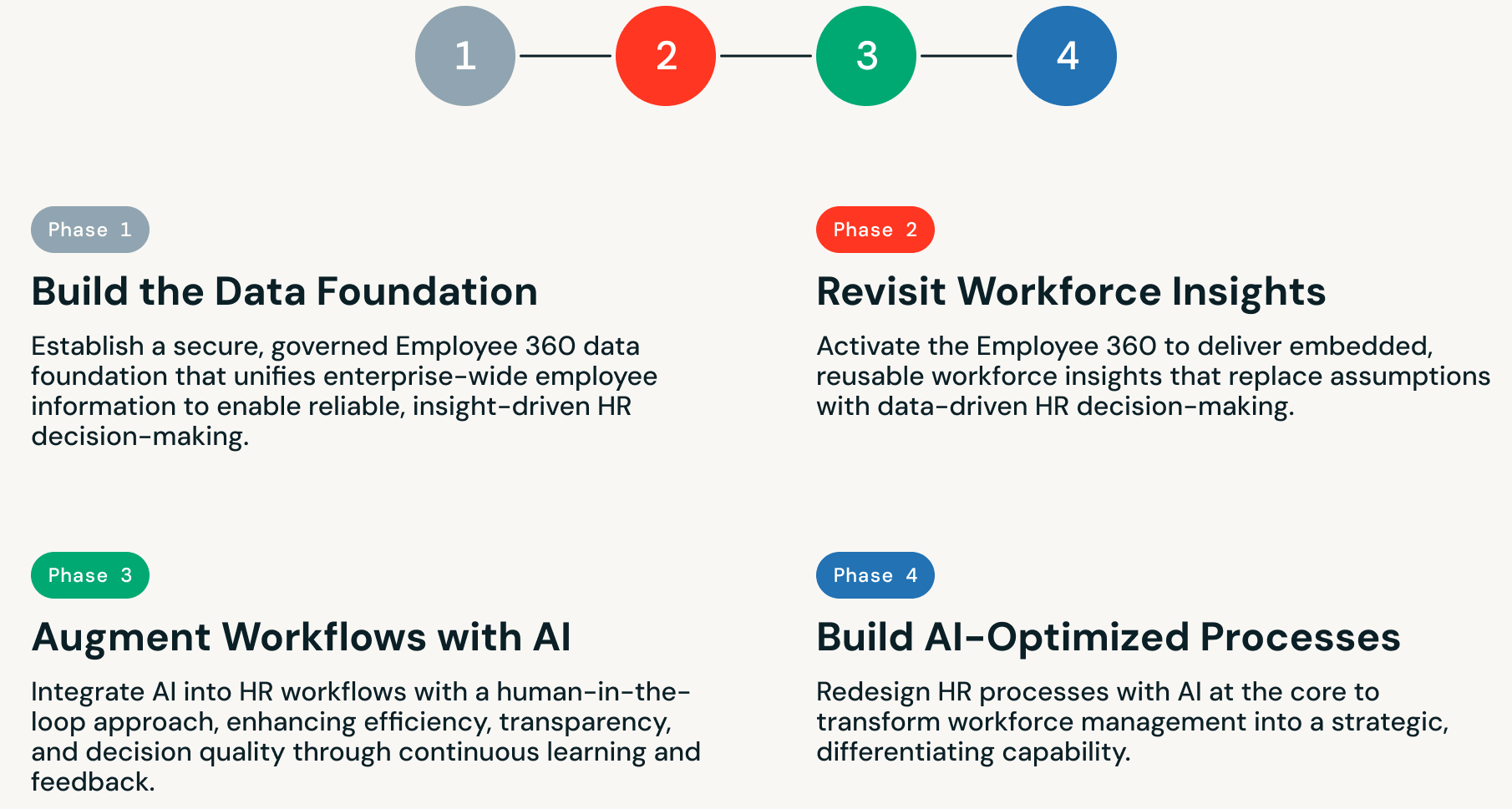
Phase 1: Build the Data Foundation
It’s only when combined with your organization’s proprietary information assets with off-the-shelf AI models can deliver the value you seek. This raises two challenges for most HR teams: how to bring together employees from across the enterprise and how best to ensure this sensitive information is properly secured.
Marketing teams have long recognized these challenges as they relate to consumer data. The core pattern adopted by most of these teams is to build a centralized repository of relevant information, connected around a shared concept of an individual consumer’s identity. This information repository, often referred to as a Customer 360, is easily adaptable to employee information.
Within the Employee 360, employee data is centralized from across the enterprise. Structured information from various operational systems are replicated as are unstructured information from a variety of management and communications systems. Useful metrics and classifications from these data are extracted, and predictive insights are generated as well. The goal is to make the raw data housed in the Employee 360 more immediately workable by HR teams and to bring some standardization to critical interpretations of signals in the employee information.
Data governance is absolutely critical here. While we focus a lot of attention on ensuring appropriate access to data is granted and carefully audited, it’s also critical we pay attention to the quality of information in the repository. Making workforce decisions on unreliable information is not only detrimental to the business, but it can have regulatory and legal implications for the enterprise.
Phase 2: Revisit Workforce Insights
With a strong, reliable, and secure data foundation in place, the next step is to put that foundation to work. Rather than continuing to rely on manual reporting and one-off analyses, organizations can now deliver reusable workforce insight products built directly from the Employee 360, embedding data into the critical HR workflows where it matters most: hiring, performance management, compensation, attrition, and workforce planning.
This shift does more than improve efficiency. For organizations that have operated with limited data visibility, it places workforce intelligence at the center of every key HR decision, building the analytical fluency that HR leaders, managers, and analysts will need going forward. At the same time, widening access to a shared, authoritative source of employee information serves as a natural pressure test of the data itself.
Early in this phase, decision makers will inevitably encounter findings that challenge their expectations. Some of those challenges will surface genuine data or logic issues worth correcting. More often, they will surface something more valuable: the gap between long-held assumptions and how the workforce actually operates.
Both outcomes are constructive. Organizations that work through this phase emerge with cleaner data, sharper analytical instincts, and perhaps most importantly, a leadership team that has seen firsthand where conventional thinking breaks down. That is precisely the mindset required to rethink HR workflows from the ground up.
Phase 3: Augment Workflows with AI
The organization is now poised to take advantage of AI, but issues of trust in the technology remain. Instead of a radical rethinking of HR workflows, it’s best to start with the enhancement of existing HR workflows, keeping humans in the loop for the interpretation of AI-generated results and all critical decision making.
While an exhaustive mapping of all HR processes would be hugely beneficial, this phase often starts with a simple enumeration of workflows that are resource constrained and rely on quite a bit of human interpretation of information. Capturing these workflows, bringing them into a workflow management tool that is capable of employing AI, and selectively using AI for time-consuming, repetitive, interpretative tasks begins to bring more structure to workflows and provides the basis for capturing measurable benefits for the team.
Transparency is critical at this phase. Whenever AI is used, human decision makers must have access to details about not only what decision was made but why. These decision makers need the ability to provide feedback and correction to the AI and this feedback needs to be used to fine-tune the results over time. We never expect AI to deliver perfect, purely deterministic results, but with proper use of feedback, they can deliver results exceeding the reliability and consistency of an experienced professional. But it takes time to get there.
Phase 4: Build AI-Optimized Processes
Quite a bit of time will be spent in Phase 3, enhancing existing workflows through a more limited use of AI. Sizable benefits can be accrued in this phase, but as teams become more comfortable with the use of AI and more deeply familiar with their own workflows, there comes a point where the organization is ready for a radical rethink in some areas.
At this point, the conversation turns from where it is that AI can alleviate resource constraints within the organization and instead where AI can help the organization turn HR and workforce management into a differentiating capability.
There is no one path forward at this phase as each organization’s needs will differ, but having taken the incremental approach outlined here, organizations have the data and technology foundation they need to support such an effort. They have also established the familiarity and trust of both the HR team as well as people leaders across the enterprise to explore the wider range of opportunities that AI can unlock for their workforce.
Tap into MathCo’s Experience
Turning this four-stage roadmap into reality requires more than intent. It demands the right technology foundation to bring strategy to life. MathCo bridges this gap through NucliOS, an enterprise-grade AI platform designed to accelerate business transformation (Video 1).
Video 1. MathCo’s NucliOS studio featuring modular building blocks and pre-configured blueprints
Rather than starting from scratch, NucliOS applies modular building blocks and pre-configured HR blueprints that help organizations move quickly from fragmented data to a unified, secure Employee 360 view. This approach shortens implementation timelines and ensures the foundation is governed, reliable, and tuned to the unique nuances of workforce data.
As teams progress through later phases, NucliOS provides built-in accelerators that make AI adoption scalable and context-aware. Every model and insight, from hiring recommendations to attrition alerts, is transparent and explainable, enabling HR teams to maintain full visibility into how AI works and to keep people involved in guiding and refining its outcomes.
Aligned with the four phases of transformation, NucliOS delivers three integrated environments to support continuous progress:
- Data Studio automates and secures the data foundation.
- AI Studio operationalizes models and ensures human feedback loops remain central.
- Decision Studio enables the creation of custom applications that turn mature insights into strategic action.
Together, these capabilities give HR the tools to evolve their processes at the pace of business, moving beyond basic automation toward AI-driven excellence grounded in transparency, governance, and sustained innovation.
Power the Transformation with Databricks
Every successful AI transformation begins with trusted, high-quality data. Databricks provides the foundation that makes this possible: the secure, governed environment in which the Employee 360 takes shape. Acting as the central hub for all workforce data, Databricks unifies structured and unstructured information across HR systems, ensuring a consistent, auditable, and privacy-compliant view of the organization.
Built on a lakehouse architecture, Databricks combines the reliability of enterprise data warehousing with the flexibility of data lakes, enabling seamless data sharing and real-time collaboration across teams. Robust access controls, lineage tracking, and quality checks protect sensitive employee information while maintaining the transparency and traceability required for regulatory compliance.
Crucially, Databricks goes beyond secure storage. Its deep integration with advanced AI and machine learning capabilities allows data to flow safely and intelligently into tools like NucliOS, where it fuels predictive models, human-in-the-loop workflows, and continuous process optimization. This balance between protection and innovation ensures that workforce data is not locked down, but responsibly activated to unlock new strategic value.
Begin Your HR Transformation Journey
The widening capacity gap in HR won’t close on its own, but with the right data foundation, trusted AI, and experienced partners, it can become a catalyst for organizational change. MathCo’s proven approach, powered by Databricks, helps HR leaders turn vision into action through secure, transparent, and scalable AI transformation.
If you’re ready to explore how AI can reimagine HR in your organization, connect with MathCo to start your journey toward a more agile, data-driven, and future-ready workforce.
Get the latest posts in your inbox
Subscribe to our blog and get the latest posts delivered to your inbox.