Announcing the Databricks analytics engineer learning pathway
A new pathway that teaches SQL practitioners how to model data, build pipelines, define metrics, and ship Genie spaces on Databricks
by Maroua Lazzarou and Pratyarth Rao
- Reliable analytics and AI depend on well-built data foundations, and SQL practitioners are the ones building the pipelines, models, and metrics that power them.
- A new learning pathway for SQL practitioners that covers skills to use the full SQL ETL toolkit on databricks - data modeling, declarative SQL pipelines for lightweight transformations or governed end-to-end workflows, consistent semantic layers, and conversational agents.
- Courses are available now on Databricks Academy, in self-paced and instructor-led formats so you can start learning today. Also included with any active Databricks Learning Subscription.
Today, we are launching the new Databricks Analytics Engineer Learning Pathway. This curriculum teaches you how to transform raw data into governed, AI-ready semantic models and metric views, the trusted foundation that powers analytics, dashboards, and AI agents on the lakehouse. The pathway is built for SQL practitioners ready to take on more ownership of the data their teams rely on.
Why analytics engineering is becoming essential
SQL has always been the foundation of modern analytics. But the work built on top of it is widening — into modeling, pipelines, metrics, and the data layers that agents and dashboards now depend on.
Reliable analytics and AI run on the same foundation: data that's governed, modeled, and trusted. Building that foundation is more difficult than it used to be. Data lives across more sources and feeds more downstream consumers. Data teams traditionally responsible for getting data ready are tapped out. According to a recent Economist Enterprise report, nearly two-thirds of organizations are fully dependent on data engineers for every aspect of pipeline creation, and almost half of those engineers spend most of their time just configuring and fixing data source connections. There is limited capacity to absorb the new work. Increasingly, it's falling to the practitioners closest to the business: the ones working with SQL.
SQL practitioners sit closer to the business and understand the questions being asked, the data underneath, and the metrics teams care about. Analytics engineering is the discipline of using that context to build models, pipelines, and metrics the business can rely on. The tools for this work are now SQL-native. The judgment to use them well is what this pathway teaches.
Inside the pathway
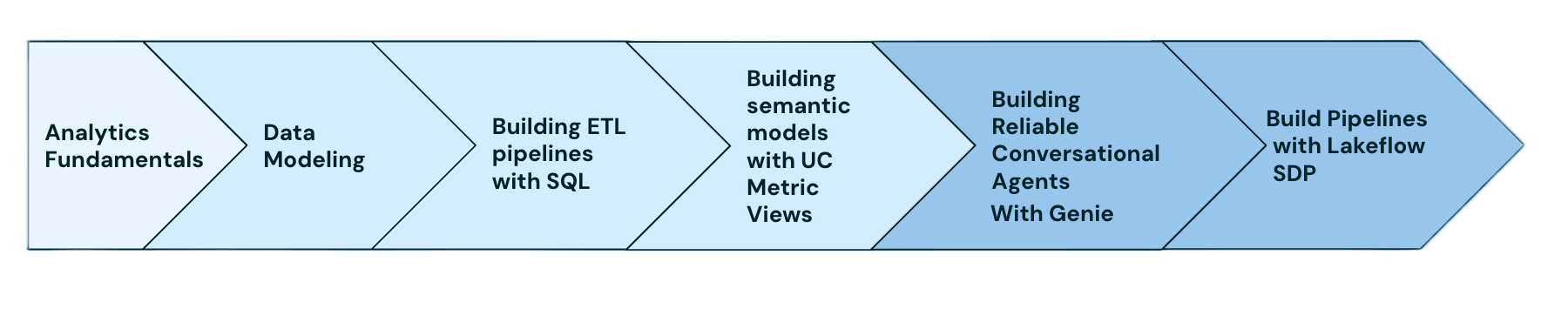
The Analytics Engineer Pathway consists of hands-on courses that cover the full SQL ETL toolkit on Databricks. Start with Analytics Fundamentals to ground yourself in how analytics works on the lakehouse. From there, the rest of the curriculum goes deeper into each part of the analytics engineering skillset taught by Databricks experts and built around hands-on examples.
1. Analytics Fundamentals: Learn how analytics works on Databricks: unified semantics, AI/BI Dashboards, and Genie. A one-hour grounding course.
2. Data Modeling Strategies: Learn how to design data models that hold up in production on the lakehouse.
- Align data organization and model design with business requirements
- Define data architectures using Delta Lake and Unity Catalog
- Understand the data products lifecycle on the lakehouse
- Apply techniques for data integration and sharing
3. Build ETL Pipelines with SQL: Learn how to build production SQL ETL pipelines with Materialized Views, Streaming Tables, and Lakeflow Jobs
- Leverage Streaming Tables, Materialized Views, and AUTO CDC for declarative pipelines.
- Implement incremental ingestion and transformations across the medallion architecture.
- Handle SCD Type 1 and Type 2 with AUTO CDC.
- Orchestrate pipelines using Lakeflow Jobs and SQL-based workflows
4. Build Semantic Models with UC Metric Views: Learn how to define and govern business metrics in SQL, then surface trusted numbers everywhere they're consumed.
- Define and manage metric views in Unity Catalog
- Model advanced metrics including windowed and semi-additive measures
- Integrate with Databricks dashboards, Genie spaces, and SQL workflows
- Apply governance, security, and maintenance practices
5. Build Reliable Conversational Agents with Genie: Learn how to design, ship, and continuously improve Genie spaces business users can trust.
- Configure Genie Spaces with Unity Catalog tables, SQL warehouses, and benchmarks
- Curate the Knowledge Store with synonyms, descriptions, and prompt-matching features
- Encode business logic in SQL with derived expressions, joins, and instructions
- Govern access with Unity Catalog permissions and ABAC policies
- Iterate using benchmarks, user feedback, and observed outputs
6. Build Pipelines with Lakeflow Spark Declarative Pipelines: Learn how to build governed, end-to-end SQL pipelines using the Spark Declarative Pipelines editor.
- Understand streaming tables, materialized views, and temporary views
- Enforce data quality with built-in expectations
- Handle slowly changing dimensions with AUTO CDC INTO
- Analyze pipeline execution through event logs and metrics
Every course is available in self-paced and instructor-led formats. The full pathway is also included with any active Databricks learning subscription.
Start Your Journey Today
The analytics engineer learning pathway is available now on Databricks Academy. By the end, you'll be modeling raw data, shipping pipelines, and defining the metrics that power dashboards and AI alike.
If you're leading a team, the pathway is also the fastest way to get your team delivering insights that business users rely on to make decisions.
Start exploring with Analytics Fundamentals today, and visit Databricks Academy to continue building your skills across the rest of the pathway.
Get the latest posts in your inbox
Subscribe to our blog and get the latest posts delivered to your inbox.