Claude Fable 5 is now available on Databricks, fully governed through Unity Gateway
Anthropic's most capable generally available model for autonomous knowledge work sets a new state of the art on agentic enterprise benchmarks — rolling out on Databricks across AWS, Azure, and Google Cloud over the next week
by Ahmed Bilal, Ivan Zhou, Yash Oza, Gautam Venkatesh, Alice Li and Harish Gaur
Claude Fable 5, Anthropic's most intelligent generally available model, is now available on Databricks
Claude Fable 5 achieves state-of-the-art performance across our internal benchmarks spanning enterprise workflow automation, agentic search, data reasoning, and multimodal document understanding.
Databricks customers can access Claude Fable 5 through Unity Gateway with centralized governance, cost controls, and observability
Databricks and Anthropic share a conviction: the most powerful AI is the AI that works on your hardest problems, on your data, under your governance. Claude Fable 5 — Anthropic's most intelligent model ever made — is now generally available and rolling out on Databricks across AWS, Azure, and Google Cloud over the next week via Unity Gateway.
Claude Fable 5 is a Mythos-class model designed for problems that were previously too complex, too long-running, or too ambiguous for a model to handle. Now, Fable 5 can accomplish these tasks and more; completing end-to-end workflows that would take a person hours, days, or even weeks.
By bringing native access to Fable 5 on Databricks, you can run it directly against your enterprise data, connect it to your existing tools and workflows, and build domain-specific agents on top of it, with the governance your organization already relies on for everything else.
State of the art on agentic enterprise tasks
Claude Fable 5 is built for long-horizon autonomy, first-shot correctness on complex problems, and reliable delegation across parallel sub-agents. Databricks evaluated Claude Fable 5 across three internal benchmarks covering the hardest agentic and document AI tasks enterprises face. The results are clear: Fable 5 is the quality leader for complex, autonomous knowledge work.
OfficeQA Pro — SoTA
On our OfficeQA Pro benchmark — which tests frontier models in their respective agent harnesses on hard document QA tasks requiring file search, web search, code execution, and multimodal document understanding — Claude Fable 5 achieves 57.9% correctness, setting a new state of the art.
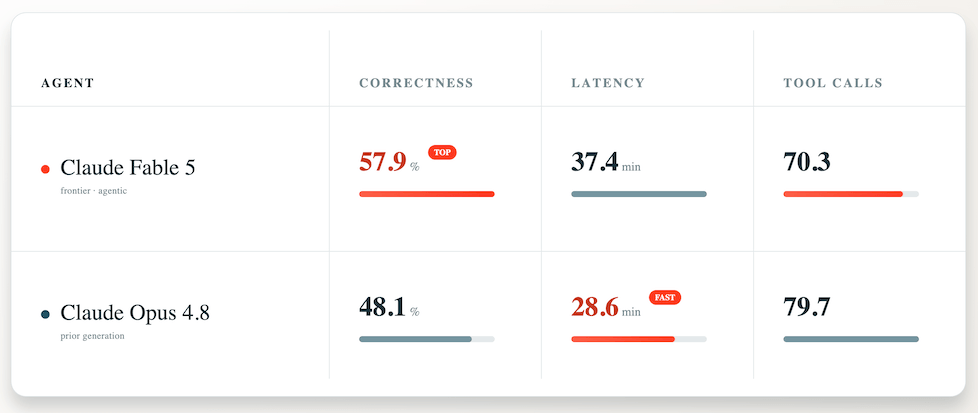
Compared to Claude Opus 4.8, Fable 5 is +20% more accurate and uses 12% fewer tool calls — though it is approximately 30% slower and generates 2.5x more output tokens per question. Fable 5 is a quality-first model, not an efficiency point.
What's new in Claude Fable 5 for Databricks customers
Fable 5 is built to go further on its own: tackling longer, more complex workflows with greater accuracy and less hand-holding. Here's what that means in practice for Databricks customers.
- Long-horizon autonomy for enterprise workflows: Fable 5 sustains productive output over extended periods, successfully completing multi-day, goal-directed runs. For Databricks customers, this means AI-powered workflows that run further and require less human intervention.
- First-shot correctness on complex problems: Early testers reported single-pass implementations of systems that had previously taken days of iteration. For Databricks customers building data pipelines, analytics workflows, or AI applications, this translates directly to faster time-to-production.
- Stronger code review and investigation: Bug-finding recall is noticeably higher than Opus 4.8. Outage triage, repository history investigation, and complex debugging are similarly improved, making Fable 5 a strong choice for engineering teams on Databricks.
- Reliable delegation to parallel sub-agents: Fable 5 is significantly more dependable than prior models at dispatching and sustaining parallel sub-agents, a critical capability for complex agentic workflows built on Databricks Agent Bricks.
- High-quality vision: Fable 5 interprets dense technical images, web applications, and detailed screenshots with much greater accuracy than prior models, enabling richer document AI and multimodal workflows on Databricks.
Securely Access Claude Fable 5 with Unity Gateway
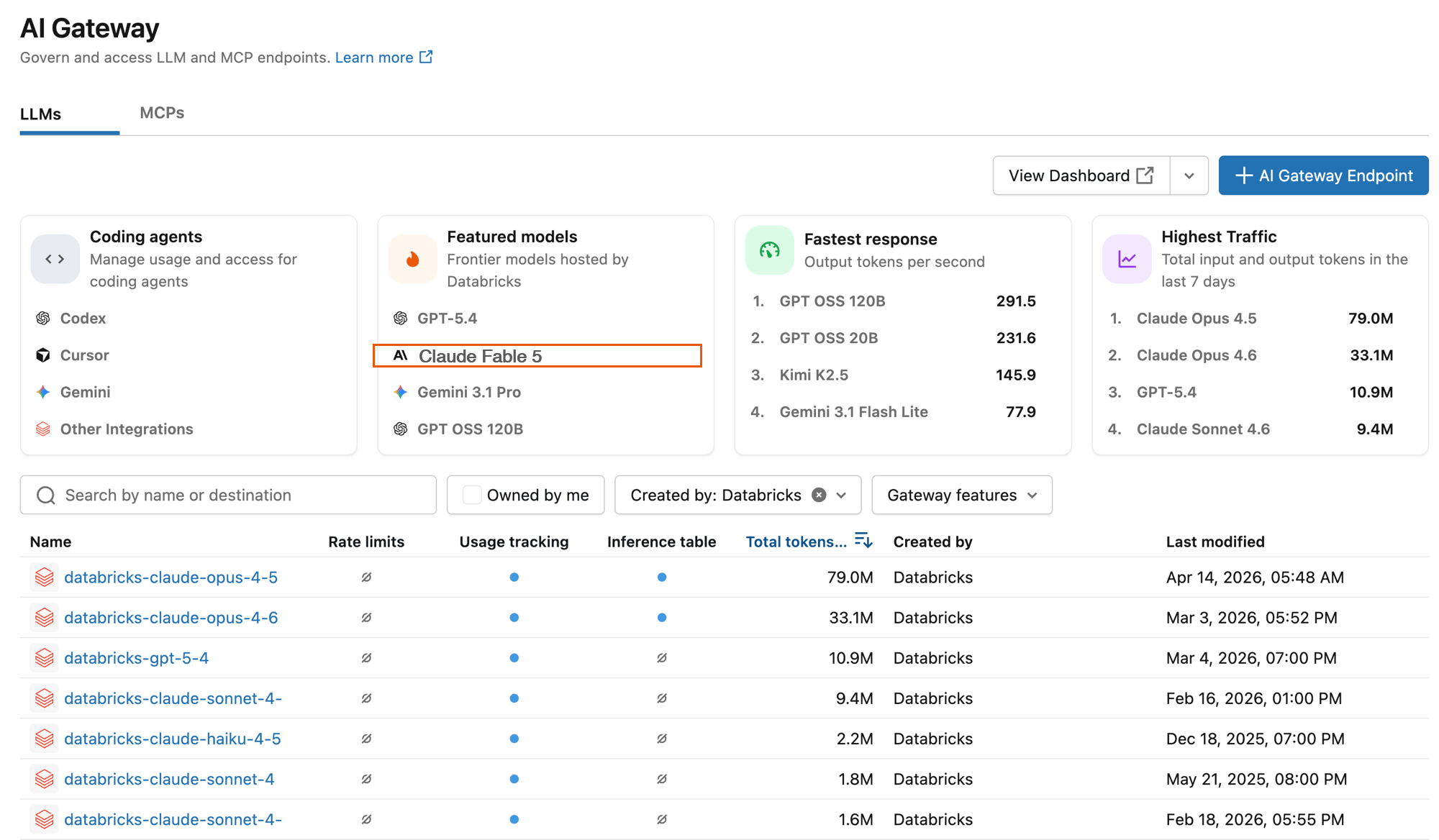
Fable 5 is accessible through Unity Gateway via a unified API and Messages API endpoint, consistent with every other model on Databricks. Admins control which users, teams, and service principals can call it, with fine-grained permissions. Every request and response is logged to Unity Catalog, providing a complete, queryable audit trail of usage across the organization. And because the interface is standardized, Fable 5 can be swapped out for any other model without changing application code.
Scale Guardrails to Match Agent Autonomy
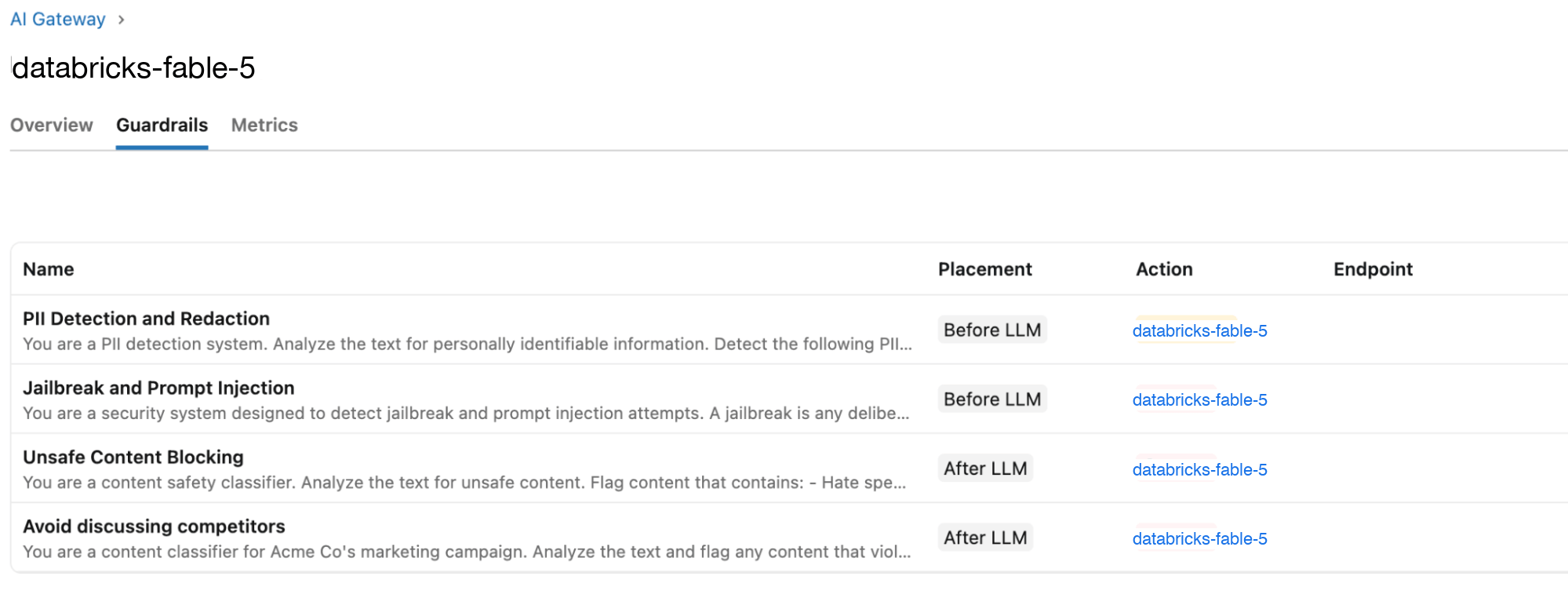
Fable 5 is built to complete work end-to-end, not just respond to individual prompts. It runs for hours, coordinates parallel sub-agents, and executes across tools and systems with minimal hand-holding. That level of autonomy is what makes it valuable, and governance in the infrastructure is what gives teams the confidence to deploy it at scale. Databricks provides two layers of control.
- Apply guardrails to every LLM call. Unity Gateway enforces guardrails on every request before the model sees the prompt and on every response before it reaches the user, blocking PII, jailbreak attempts, unsafe content, and custom business-specific rules you define. Every action is logged to Delta via inference tables.
- Extend guardrails to every tool call. Unity Gateway service policies evaluate every tool call before it executes, for example, blocking delete_file entirely, restricting drop_table to admins only, or requiring explicit consent before any write operation. Every action is logged to a Delta table regardless of outcome.
Track and Optimize Fable 5 Spend at Scale
Fable 5's long-horizon runs consume significantly more tokens than typical model calls, and AI workloads can fail in ways that traditional cloud budgeting tools are not designed to detect. AI Spend Controls in Unity Gateway let platform teams set thresholds per user, per use case, per workspace, and per account, with alerts that fire before limits are hit. The Cost Analytics dashboard breaks down spend by model, provider, workspace, and user so teams have full visibility as adoption scales.
Build Domain-Specific, Long-Running Agents
With Agent Bricks, teams can build agents on Fable 5 that are specific to their domain — grounded in their own data, connected to their tools, and evaluated and improved over time on their actual workflows. This is where Fable 5's capabilities translate into something purpose-built for a business.
Once built, agents deploy as Databricks Apps: fully managed, serverless, with built-in authentication, access controls, and Lakebase-powered memory so agents maintain context across sessions. The result is a domain-specific agent that runs on the most capable model available, connected to your data, governed by your policies, and deployed on infrastructure your organization already trusts.
Data Retention for Safety
Given the increased model capabilities, we are respecting Anthropic new data retention policy for the Fable 5 model, which includes 30-days retention for trust and safety purposes only (see data retention policy specific in Anthropic announcement blog).
Get started with Claude Fable 5 on Databricks
Claude Fable 5 is rolling out now on Databricks across AWS, Azure, and Google Cloud through the Databricks Marketplace and Unity Gateway.
- Try Fable 5 in AI Playground: Available now in the Databricks Marketplace
- Configure Unity Gateway: Set up governance, cost controls, and fallbacks in your Databricks workspace
- Explore Agent Bricks: Build long-running autonomous agents powered by Fable 5 on Databricks
- Contact your account team: For enterprise access, safety classifier guidance, or migration support from Opus 4.8
Get the latest posts in your inbox
Subscribe to our blog and get the latest posts delivered to your inbox.