Introducing Genie Code
Your Autonomous AI Partner for Data Work
by Patrick Wendell, Matei Zaharia, Weston Hutchins and Gal Oshri
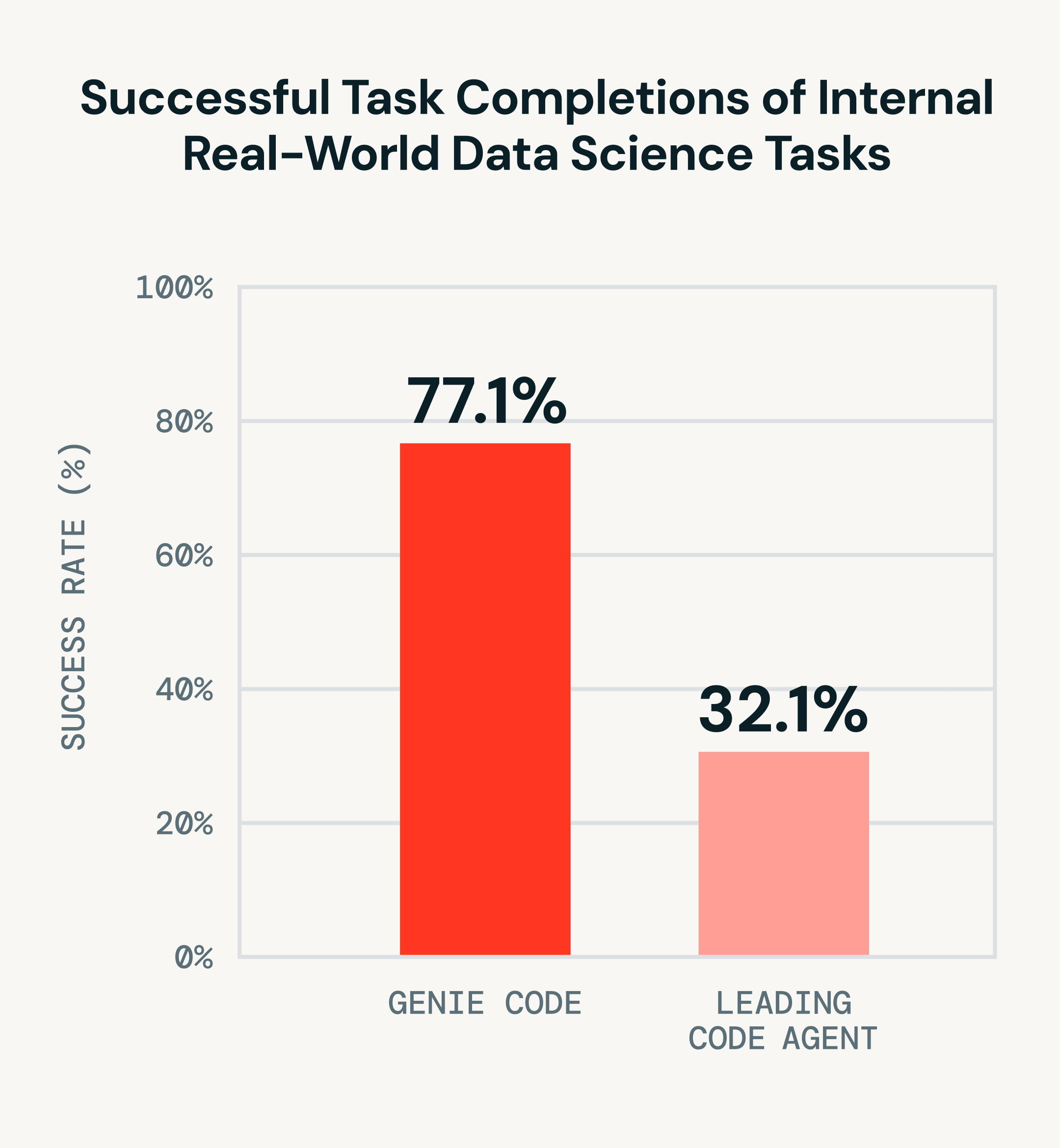
- Genie Code is a state of the art AI agent built specifically for data. On our internal benchmark of real-world data science tasks, Genie Code more than doubles the success rate of leading coding agents.
- Proactively maintains and optimizes Lakeflow pipelines and AI models in the background to triage failures and investigate anomalies. It autonomously analyzes agent traces to fix hallucinations and tunes resource allocation before a human intervenes.
- Genie Code works with your data wherever it lives. Through Unity Catalog and Lakehouse Federation, it understands data across Databricks, external platforms, and on-prem systems, all with full governance. Through MCP, it connects to external tools like Jira, Confluence, and GitHub, enabling autonomous workflows beyond the Databricks workspace.
We are excited to announce Genie Code, the newest addition to the Databricks Genie family. In the past six months, agentic coding tools have fundamentally changed software engineering; Genie Code brings that same transformation to data teams. Genie Code can autonomously carry out complex tasks such as building pipelines, debugging failures, shipping dashboards, and maintaining production systems.
Unlike agents that focus only on writing code, Genie Code also operates as a proactive production agent. It monitors your Lakeflow pipelines and AI models in the background, triaging failures, handling routine DBR upgrades, and investigating anomalies before your team even notices.
It does all this by deeply integrating with Unity Catalog so that it understands your enterprise's data, semantics, and governance policies. Genie Code significantly outperforms a leading coding agent by more than 2x on real-world data science tasks.
Rise of Agentic Data Work
Agentic coding tools have transformed software engineering, moving developers beyond autocomplete and toward agent-driven development. With a single prompt, engineers can now scaffold features, refactor code, and deploy prototypes in seconds. This shift has been driven by advances in LLMs and by agentic systems that can interpret the complex context of modern software codebases.
Most agents on the market focus on code as the final product. However, for data teams, code is merely a vehicle to manipulate and understand the underlying data. This is exactly why software-centric agents often struggle with data work. In a data ecosystem, context lives not just in the script but also in usage patterns, lineage, and business semantics.
Accessing this context is vital because the stakes are high. Dashboards drive business decisions, pipelines power production systems, and machine learning models influence real-world outcomes. For data teams, the speed and leverage offered by agents must be paired with absolute accuracy, reproducibility, and governance.
Genie Code is an AI agent built specifically for data. It leverages Unity Catalog to automatically curate the most relevant data and content as you work. It creates personalized search indexes, custom instructions, knowledge stores, and extracts usage patterns from lineage. Best of all, it gets smarter the more your team uses it. This deep integration into Unity Catalog is far superior to any system that simply reads the data from the outside.
We've seen the impact of Genie and Genie Code firsthand at Databricks, across both technical and non-technical users. Our sales team uses it to get a complete picture of every customer before meetings, summarizing key consumption metrics, support tickets, and recent interactions in seconds. Product Managers use Genie Code to build dashboards from a hand-drawn sketch of charts and graphs. Our finance team runs budget-versus-actual analysis and advanced ROI modeling. Our leadership team answers data questions in real time during strategic discussions, reducing follow-up and accelerating complex decisions. Across the company, these tools have changed how we work with data.
What Genie Code Does:
- Acts as an expert machine learning engineer: Genie Code handles full ML workflows end-to-end. It reasons through complex problems to plan, write, and deploy models, while logging experiments to MLflow and fine-tuning serving endpoints for peak performance.
- Deep data engineering expertise: While a novice engineer might write a script that works on test data, Genie Code designs like a senior architect. It accounts for the differences between staging versus production environments, builds workflows for change data capture and applies data quality expectations.
- Proactively maintains and optimizes: Genie Code monitors Lakeflow pipelines and AI models in the background to triage failures and investigate anomalies. It autonomously analyzes agent traces to fix hallucinations and tunes resource allocation before a human intervenes.
- Understands enterprise context: Integrated with Unity Catalog, Genie Code enforces existing governance policies and access controls. It understands business semantics and audit requirements and federates enterprise data, including data from external platforms.
- Improves over time: Genie Code grows smarter the more teams use it. Through persistent memory, it automatically updates internal instructions based on past interactions and coding preferences. On internal data science tasks, Genie Code outperforms leading coding agents 77.1% to 32.1% on quality.
With Genie Code, data teams move from prompting a copilot to delegating real work: building pipelines, debugging failures, shipping dashboards, and maintaining production systems — autonomously, end to end.
At SiriusXM, Genie Code supports everything from authoring notebooks and complex SQL to reasoning through table relationships and debugging pipelines. It acts as a hands-on development partner that helps our data teams deliver high-quality work in less time.—Bernie Graham, Vice President, Data, Sirius XM
Highest Quality Agent for Data and AI Work
Genie Code is not powered by a single model. It is an agentic system that routes tasks across multiple models and tools, automatically selecting the best model for each job, whether that is a frontier LLM, an open source model, or a custom model hosted on Databricks. This eliminates the need for users to manually switch between models or guess which one will produce the best result.
Genie Code is also deeply integrated with Databricks APIs, allowing it to identify the right data assets, assemble rich context, and generate higher quality queries. Databricks Research continuously tunes the system, benchmarking the latest models from leading AI labs alongside custom models running on the platform.
In our recent performance benchmarking on real-world data science and analytics tasks collected from internal users, Genie Code significantly outperformed a leading coding agent equipped with the Databricks Model Context Protocol (MCP) servers.
- Genie Code: 77.1% Solved tasks
- Leading Coding Agent + Databricks MCP: 32.1% Solved tasks
Genie Code Supports the Full Lifecycle of Data Work
Train and Evaluate Machine Learning Models
Genie Code acts as a dedicated ML engineer embedded in your workflow. Ask it to "train a forecasting model predicting sales in @sales_table" and it will reason through the full pipeline:
- Identifying and profiling features
- Split training, validation, and test datasets correctly
- Train multiple model types and compare them, running hyperparameter sweeps to train the best possible model.
- Evaluates results across metrics like AUC, F1, RMSE, and R²
- Generate plots for feature importance, confusion matrices, and ROC curves
- Track experiments in MLflow
- Recommend improvements based on model diagnostics
Once deployed on Databricks Model Serving, Genie Code stays in the loop: it can check endpoint health, analyze traces, and recommend optimizations. You can read more on this in the “From Code to Production: Observability with Genie Code” section below.

Genie Code changes how our data teams operate. Instead of stitching together notebooks, pipelines, and models manually, we can hand off complex workflows to an AI partner that understands our data, governance, business context, and internal libraries such as Repsol Artificial Intelligence Products. It accelerates everything from time series forecasting to production deployment, without sacrificing rigor or control.—Emilio Martín Gallardo, Principal Data Scientist, Data Management & Analytics, Repsol
Create Production-Ready Data Pipelines
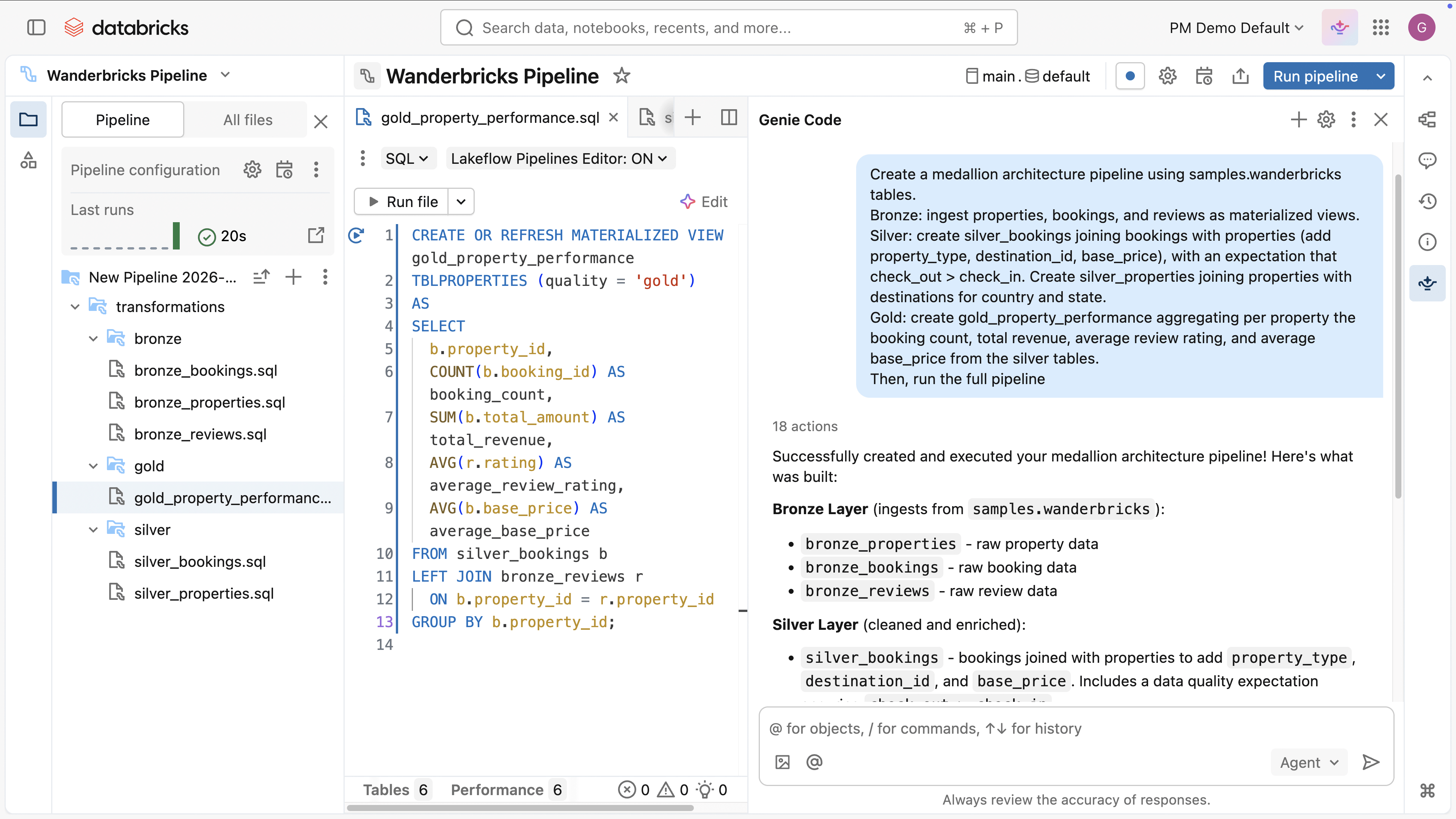
Genie Code is your expert data engineer, built to help you design and evolve reliable data pipelines.
- Create pipelines from natural language: Describe what you need and Genie Code generates a complete Spark Declarative Pipeline with ingestion, transformations, and data quality expectations built in.
- Extend existing pipelines: Add datasets, modify transformations, write AutoCDC flows, configure Auto Loader, and apply data quality expectations, all within the context of your current pipeline.
- Understand pipeline behavior: Inspect outputs, trace data flow into downstream tables, and surface unexpected changes in row counts or schemas.
Genie Code has moved us beyond assisted coding into true agentic data engineering. It can analyze our Lakeflow pipelines, propose multi-file changes with diffs, execute runs with safeguards, and iterate through failures until issues are resolved. It feels less like autocomplete and more like a collaborator embedded in our workflow.—Nishit Gajjar, Tech Lead, Global Infrastructure Technology Provider
Create Dashboards with Reusable Semantic Definitions
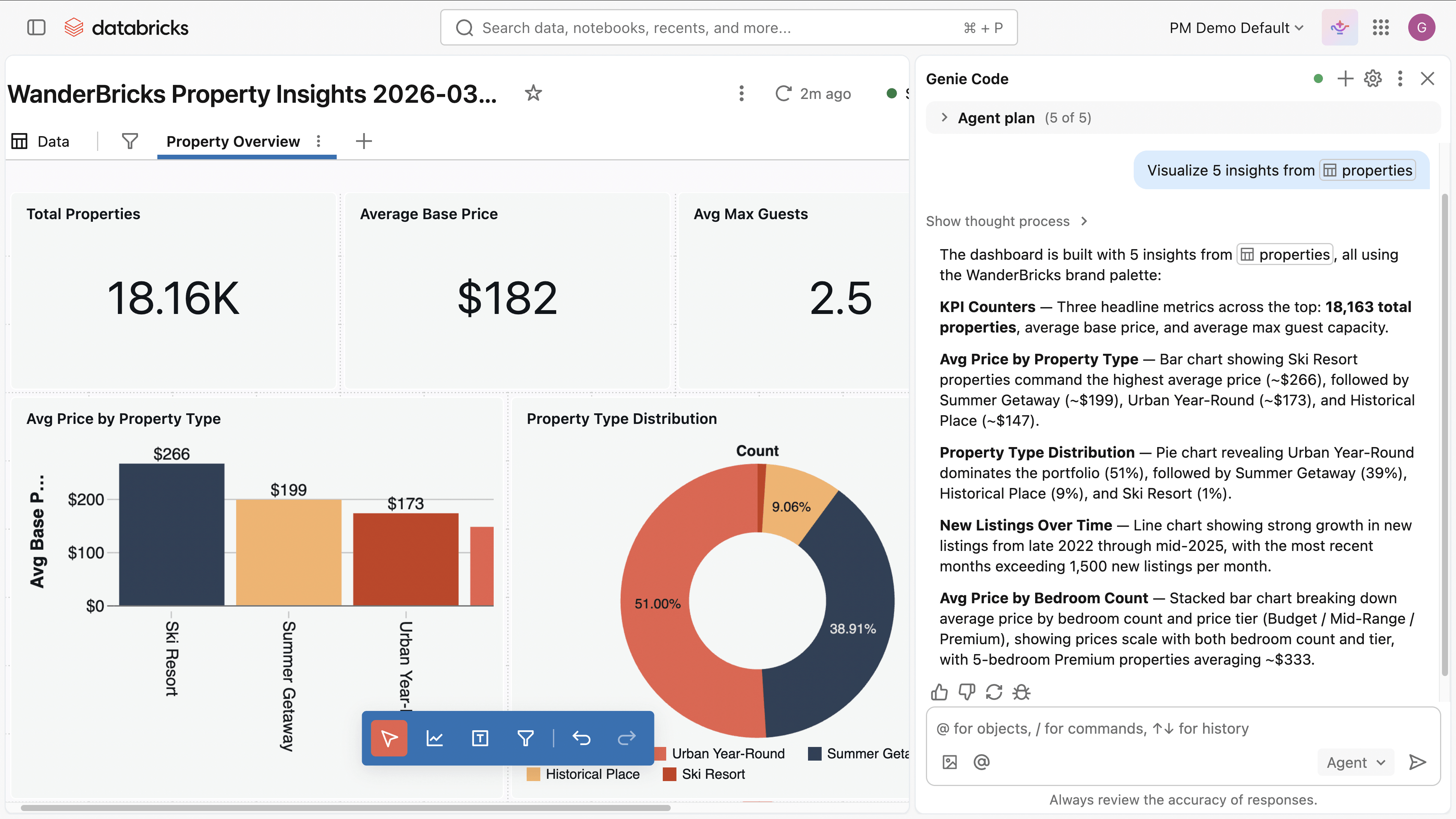
Genie Code can generate visualizations, configure filters, and organize multi-page dashboard layouts, all with reusable semantic definitions. It connects those definitions to filters, calculations, and layouts that scale as dashboards grow, helping teams move faster while maintaining consistency.
With Genie Code, our teams are delivering AI-driven analytics and automated workflows in weeks, not months. Low-code agents help us move faster while staying aligned to governance, enabling project and engineering teams to get natural-language insights from complex data without slowing delivery.—Russell Singer, Chief Data Architect, Bechtel Corporation
Autonomous Multi-Step Planning and Execution
Provide a high-level objective, such as "Identify flight delay risks and build a monitoring dashboard". Genie Code reasons through the requirements, formulates a multi-step plan, and executes it across all Databricks Notebooks, AI/BI Dashboards, and Lakeflow in a single conversation thread.

What we’re seeing at Danfoss is that Genie Code changes the roles inside a data team, supporting our strategic focus on digitalization and AI. Data scientists still provide direction and review, but engineers, analysts, and domain experts can now actively work in notebooks with the assistant and contribute to advanced analytics workflows. It turns data science into a much more collaborative team activity.—Radu Dragusin, Principal Engineer, Data & AI, Danfoss
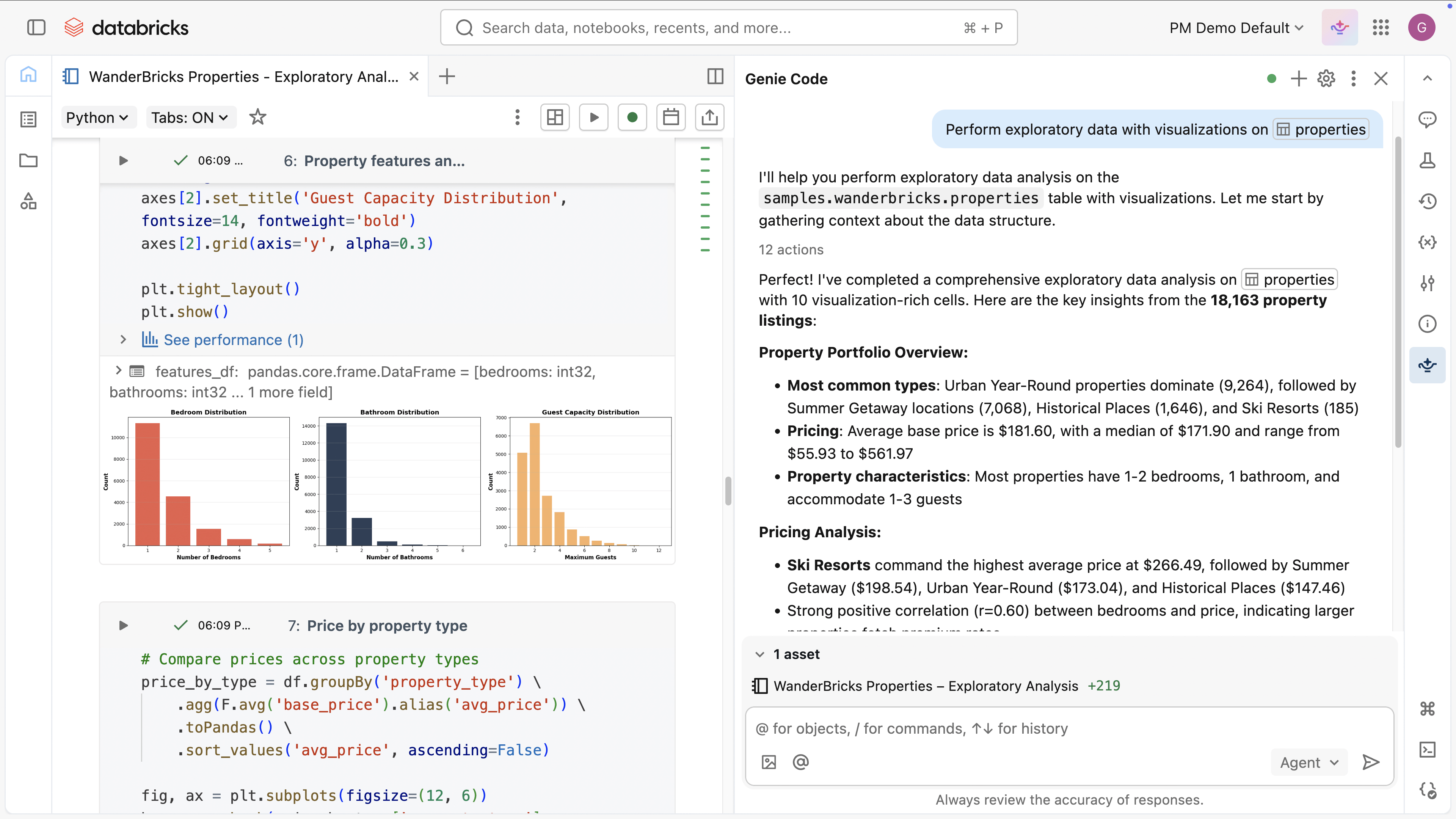
Exploratory Data Analysis with Deep Contextual Search
Genie Code uses popularity, lineage, code samples, and Unity Catalog metadata to find the most relevant datasets for any analysis. This deep contextual search eliminates the manual effort of hunting for data and ensures that your work is based on the most accurate and frequently used tables within your organization.
I’m genuinely mesmerized. Genie Code feels like a glimpse into the future of how data work gets done.—Sameer Yasser, Sr. Data Engineer, Sundt Construction
Customization and Extensibility
Genie Code is a flexible platform designed to be tailored to your team’s specific standards and external tech stack. There are three primary ways to extend its capabilities:
- External Tooling via Model Context Protocol (MCP)
Genie Code supports Model Context Protocol (MCP), an open standard that allows it to securely interact with your external tools, APIs, and documentation. This enables autonomous workflows that extend beyond the Databricks workspace.
For example, when you're assigned a Jira task to train a new ML model, Genie Code can automatically gather context from it, perform the task, and update the ticket with the results.
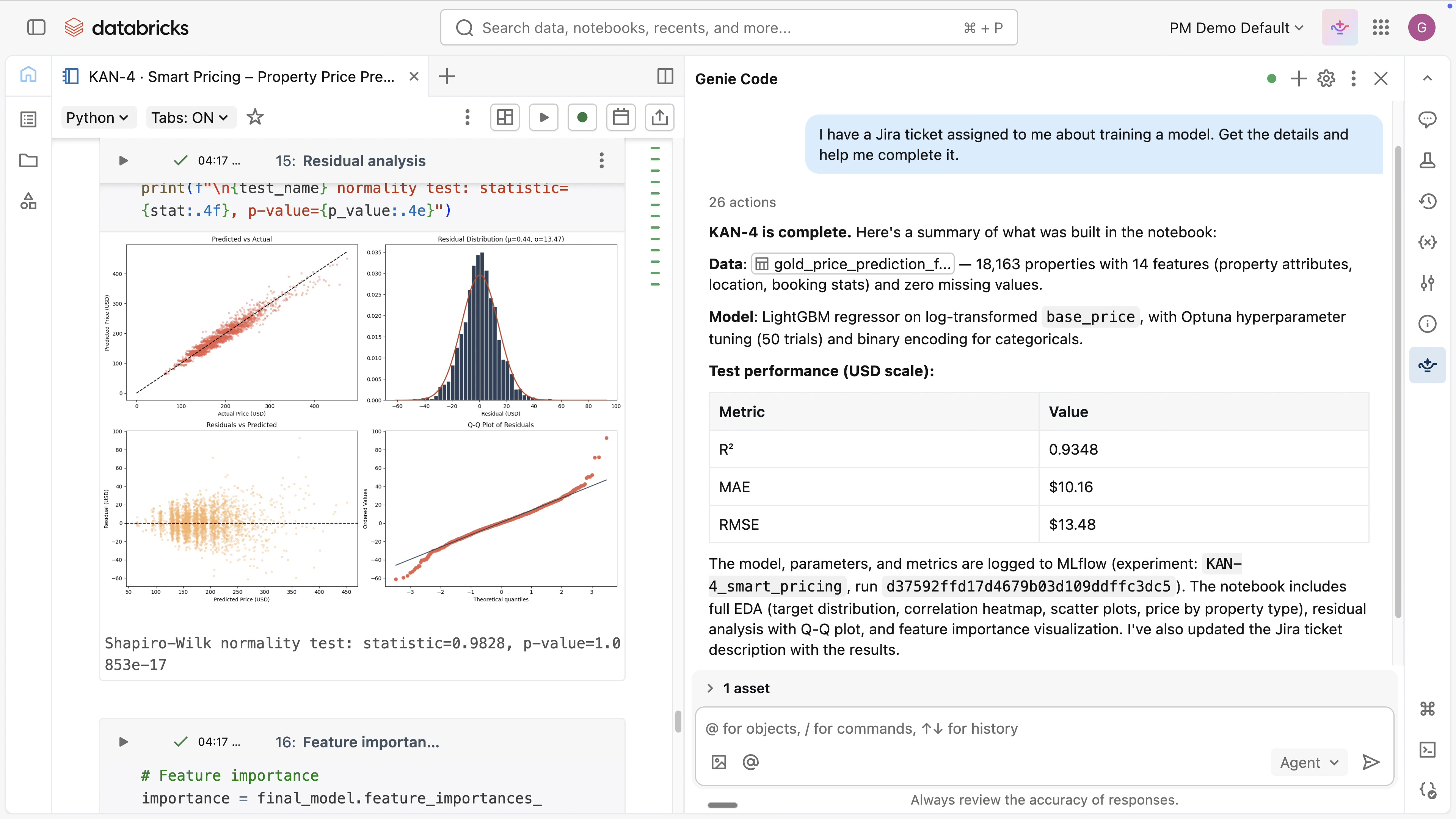
Connect Genie to your internal Confluence, Google Drive, GitHub, or Notion via MCP so it can reference your team's specific runbooks and data dictionaries when troubleshooting.
- Agent Skills: Define domain-specific capabilities to teach Genie Code how to perform complex tasks consistently. Whether it’s a specific way your company handles PII masking or a custom framework for data validation, Skills ensure that the AI follows your organization’s best practices every time. Skills follow the open Agent Skills format.
- Memory: Genie Code grows smarter the more you use it. Through persistent memory, the agent automatically updates its internal instructions based on your past interactions. It learns your coding preferences, remembers which datasets you use most frequently, and retains context across sessions.
From Code to Production: Observability with Genie Code
Writing code is only the first step. Maintaining it is the real challenge. Genie Code acts as an observability agent to keep your data and AI workflows healthy. While thousands of customers use Databricks to serve sophisticated AI applications, debugging those models in production is often the most time-consuming part of the lifecycle.
Genie Code now integrates directly with Databricks Model Serving and MLflow 3.0 to automate this process. Instead of manually searching through logs and traces, you can use Genie for:
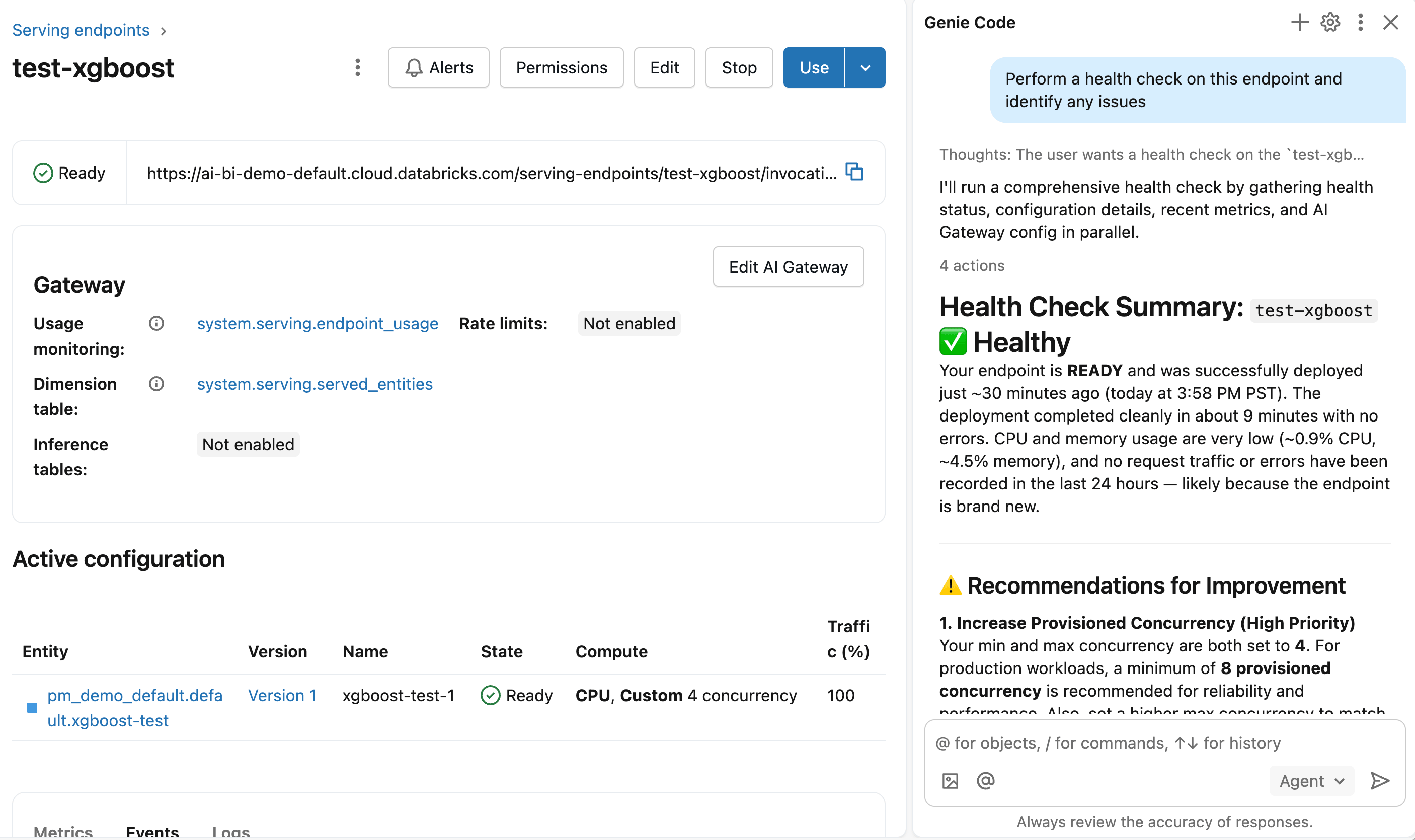
- Endpoint health checks: Get a full status report across compute, request handling, and server logs in a single prompt.
- Agent quality analysis: Surface subtle issues like hallucinations, incorrect tool calls, and user frustration patterns across complex agent traces in real time.

- Production troubleshooting: When incidents occur, Genie cross-references server logs and metrics to automate the first round of diagnosis and reduce time to resolution.
- Endpoint optimization: Get recommendations on provisioned concurrency, hardware configs, and auto-scaling based on Databricks best practices.
Background Agents that Keep Workloads Healthy
Genie Code is designed to work in the background so that your data remains healthy even after you close your laptop. You can deploy multiple agents in parallel to handle the operational work that typically consumes a data engineer’s week. These background agents move beyond reactive support toward proactive maintenance by handling repetitive tasks such as responding to job failures and managing routine upgrades. When a pipeline breaks, the agent identifies the root cause and suggests a fix only after validating it in a secure sandbox environment.
For example, if a production pipeline fails due to a schema mismatch, such as a column changing from an INT (150) to STRING (“150 USD”), Genie Code will pinpoint the failure and automatically fix the broken pipeline.
Background agents are coming soon.
Grounded in Unity Catalog: Integrated Security and Governance
Genie Code is built directly on Unity Catalog. This integration ensures that the agent follows the same security and governance rules as the rest of the Databricks platform.
When Genie Code searches for data, it only surfaces assets the user is authorized to access. When it builds a pipeline, it adheres to existing lineage and access controls.
- Native Revision History: Every edit is tracked through the Databricks versioning system. You can roll back changes across notebooks, queries, files, and Lakeflow pipelines with full confidence.
- Built-in Guardrails: Genie Code is designed to proactively ask for confirmation before executing code that can modify underlying tables.
- Access Control Enforcement: Genie Code never exposes data assets that a user is not permitted to see.
- Comprehensive Audit Logging: Your organization maintains full visibility into how Genie Code is being used through existing audit infrastructure.
Available in your Workspace today
Genie Code is Generally Available in your Databricks workspace right now. You can find the Genie Code panel in your notebooks, SQL editor, and Lakeflow Pipelines editor today—no complex configuration required.
Learn More
If you would like to learn more about Genie Code:
- Visit our web page to understand key Genie Code features and use cases and learn how it works across the Databricks platform
- Watch the demo to see Genie Code plan and execute real data workflows end to end
- Read the documentation to start using Genie Code in your own workspace today
We’re excited to see what you build with Genie Code and how autonomous agents will reshape the way your data teams work in Databricks.
Get the latest posts in your inbox
Subscribe to our blog and get the latest posts delivered to your inbox.