Talking to the Ground: How Databricks Genie Brings Natural Language Analytics to Drilling Operations
Using Genie to Turn Drilling Data Into Conversational Insights for Oil and Gas Teams
by Reishin Toolsi, Abhay Singh, Siarhei Khaletski, Jason Viel and Amar Sethi
- TL;DR: Drilling operations generate massive volumes of sensor, log, and operational data — but most field engineers can't write SQL. This post shows how Databricks Genie enables natural language queries over drilling data, letting engineers ask questions like “What was the average ROP in the lateral section last week?” and get instant, governed answers. The approach uses Unity Catalog for data governance, Lakehouse architecture for scale, and Genie Spaces for conversational access.
- From dashboard hunting to direct answer: Drilling operations managers can simply ask questions like "Tell me about my operations today" or "Why are my mud pumps failing?" and get narrative, cross-domain answers instead of spending hours navigating dashboards, reports, and siloed systems.
- Breaking down the data silos: By unifying OSDU well logs, real-time IoT data from rigs, and business context from ERP systems in the Databricks Lakehouse, Genie Agent mode becomes a single place to explore operational, financial, and geological questions without needing to know where the data lives or how it is structured.
- From reactive NPT firefighting to proactive optimization: Daily health checks evolve into ‘what-if’ exploration, testing ways to cut NPT, adjust drilling parameters for challenging formations, and rethink maintenance strategies. It turns Genie into an always-on assistant for reducing downtime and protecting capital.
Why Can't Drilling Engineers Easily Access Their Own Data?
Drilling operations are complex, involving geology, mechanics, and business performance. Most organizations improve these areas independently (e.g., OSDU for subsurface, rig IoT, modern ERP systems) but lack a unified data platform for combined analysis, security, and metrics. This makes cross-domain analysis a series of custom, one-off projects.
Operational excellence now requires correlating these distinct datasets; knowing why subsurface conditions caused equipment failure, not just that it failed. Historically, this was difficult, requiring extensive coding and time.
The Databricks Data + AI Platform and natural language analytics change this by unifying data and democratizing access to complex insights. Users can now ask simple questions, such as identifying that the Travis Peak formation causes 50% of pump failures, lowering the barrier to entry. This shifts data from a retrospective record to a real-time operational partner providing audit trails and actionable recommendations quickly.
As margins tighten, the real-time ability to correlate subsurface conditions, equipment performance, and operational outcomes is essential. Systematically reducing NPT, recovering fleet capacity, and avoiding millions in costs makes timely analytics a key driver of EBITDA, capital efficiency, and asset utilization, transforming data into an operational asset for smarter, faster decisions.
Put simply, analytic competency is profit.
What Are the Unanswered Questions Costing Drilling Operators?
Every drilling operations manager faces the same daily frustration: critical insights buried across siloed systems, equipment failures that go undiagnosed for days, and root cause analyses that take weeks instead of minutes.
The operational toll is significant:
| Challenge | Impact |
|---|---|
| Well log data in OSDU, sensor data in IoT systems | Geological conditions never connect with operational metrics |
| Maintenance records disconnected from formation data | Small issues escalate into fleet-wide reliability crises |
| Manual data gathering across platforms | Investigations take weeks; problems compound |
| No unified visibility | Formation-specific strategies remain impossible |
The result? Equipment failures and challenges related to formation lead to unplanned downtime, costing drilling operators millions in NPT each year. This figure does not even account for the additional expenses incurred from deferred production, repair costs, and supply chain disruptions.
How Does Databricks Genie Turn Drilling Questions Into Answers?
Operations managers ask the Databricks Genie Agent mode questions and get a multi-step analysis linking IoT sensor data, OSDU well logs, and ERP systems.
Agent mode extends Genie's capabilities to help you uncover deeper insights and tackle complex business questions using multi-step reasoning and hypothesis testing.
What Genie Delivers
| 1Capability | Example | Outcome |
|---|---|---|
| Instant operational visibility | "Tell me about my operations today" | Synthesize data across 118 wells, 5 counties, multiple formations |
| Root cause discovery | "Why are my mud pumps failing?" | Multi-step analysis correlating alarms with geological formations |
| Geological intelligence | "What's happening at my reservoir?" | Connect OSDU well log data with operational metrics |
| Actionable recommendations | "How do I reduce NPT?" | Immediate strategies (64-91 days recovery) + long-term investments with ROI |
| Full audit trails | Citations to specific data and analysis steps | Verify AI-generated insights and build confidence |
Introducing AI-Powered Operational Intelligence for Drilling Operations
Built on the Databricks Data + AI Platform, this solution transforms raw operational data from multiple sources into actionable insights through natural language conversations. The solution brings OSDU well logs, rig IoT streams, and ERP maintenance/financial records together into a single, governed lakehouse, so every team, from drilling to subsurface to finance, works from the same source of truth.
The Demo Scenario: A Day in the Life of an AI-Augmented Operations Manager
A drilling operations manager at DeepCore Energy begins their day by opening Databricks and asking Genie Agent mode a simple question. Unlike traditional dashboards that show only pre-configured views, Genie creates a research plan, runs multiple SQL queries against the unified lakehouse, and delivers a comprehensive operational picture.
Outcome Snapshot
- Fleet-level NPT visibility across 118 wells and multiple formations via a single natural language query.
- Rapid root cause analysis correlating pump failures with formations and mud weights, saving weeks of manual work.
- A quantified action plan recovering 64–91 days of fleet capacity and avoiding $1.6–2.7M in costs through formation-aware maintenance.
Question 1: “What’s our current average NPT and why?”
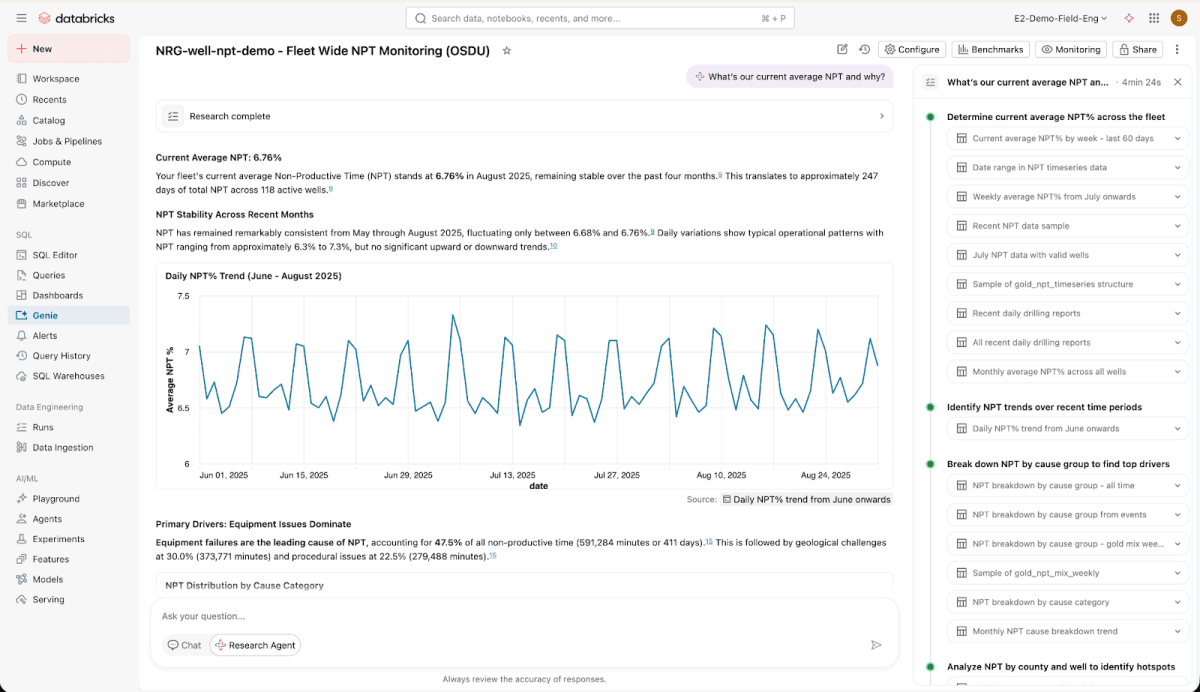
What Genie Does Behind the Scenes:
Genie doesn't execute a single query. Instead, it generates hypotheses, runs multiple analyses (see Fig. 1 in the right sidebar), and synthesizes findings:
- Fleet performance across all 118 active wells
- County-level NPT breakdown (Loving, Midland, Ector, Ward, Reeves)
- Formation-level assessment (Bone Spring, Spraberry, Delaware, Wolfcamp, Avalon)
- Root cause categorization: equipment, geological, procedural
This is where the architecture becomes truly transformative. The operations manager's questions don't return simple query results, they trigger comprehensive multi-step analysis that correlates data across the entire unified platform.
The Response:
DeepCore Energy's 118-well Texas fleet is operating with stable baseline performance (6.88% average NPT). Performance is remarkably uniform, county-level NPT ranges from 6.33% to 7.21%, less than 1 percentage point variation.
The root cause breakdown of NPT reveals that equipment issues, especially related to mud pumps, are the dominant constraint on fleet efficiency, accounting for almost half (47.52%) of all NPT minutes.
Question 2: "Why are my mud pumps failing so often?"
Traditionally, reliability engineers and subsurface teams would each run separate analyses, then try to reconcile findings manually. With all the data unified on Databricks and exposed through Genie, the system correlates failure modes, MTBF, formation exposure, mud properties, and maintenance history in a single multi-step analysis.
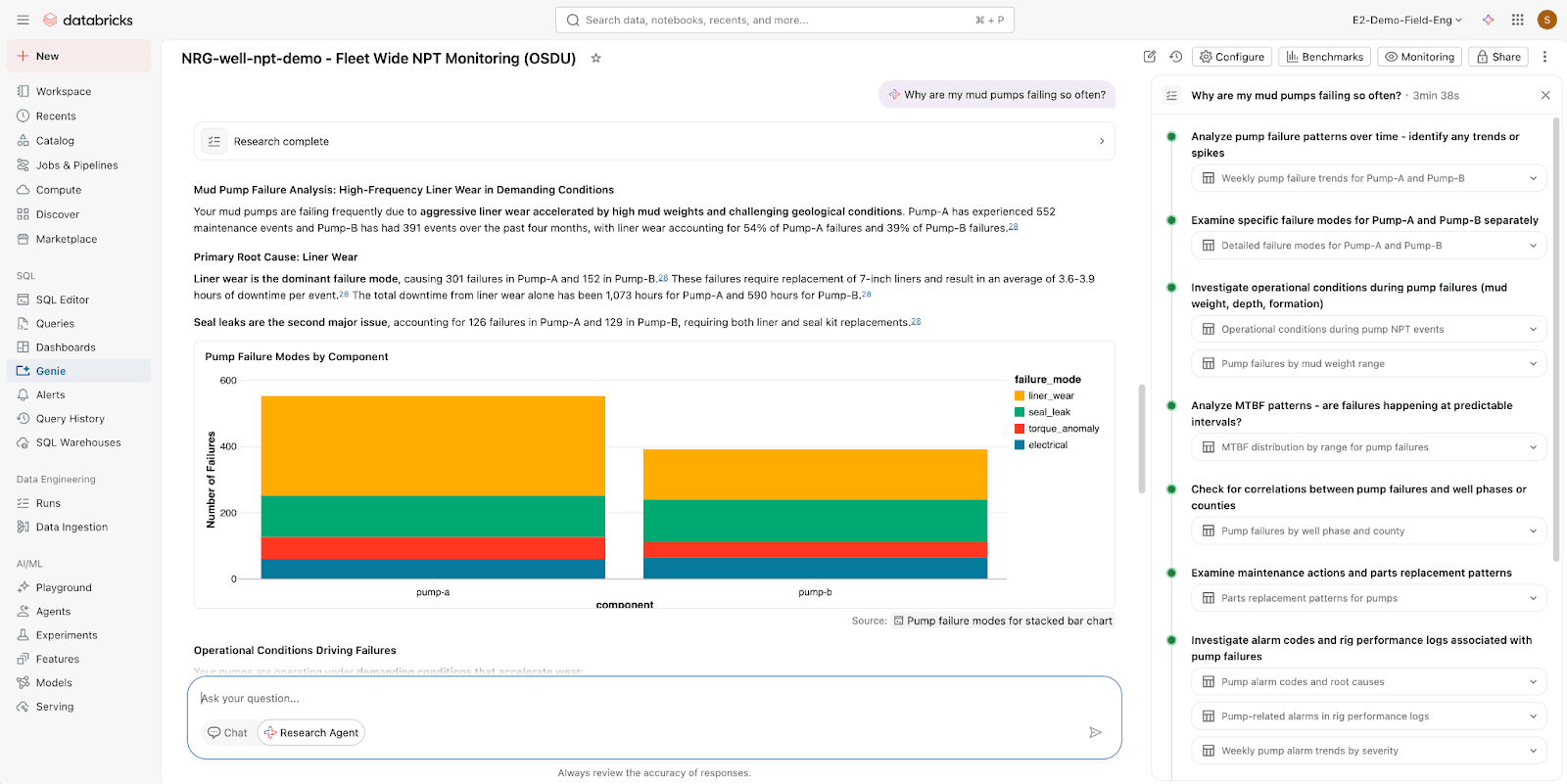
What Genie Analyzes:
- Failure mode distributions across pump units and component types
- Mean time between failure (MTBF) patterns
- Correlation with operational parameters (depth, mud weight, flow rate)
- Equipment alarms and their relationship to geological formations
- Work order patterns and maintenance sustainability
The Response:
The analysis reveals a systemic reliability crisis: mud pumps are failing at 8.5 work orders per day (765 total in 90 days), affecting all 118 wells. Genie lists three primary failure modes: Liner Wear, Seal Leaks, and Bearing Failures, indicating simultaneous degradation across multiple components, not isolated part failures.
An analysis correlating pump failures with OSDU geological data revealed that the Travis Peak formation, which requires a 6% heavier mud weight, accounts for 50% of pump alarm events due to increased hydraulic pressure and abrasive forces accelerating mechanical wear.
Question 3: "Tell me about the formation causing these issues"
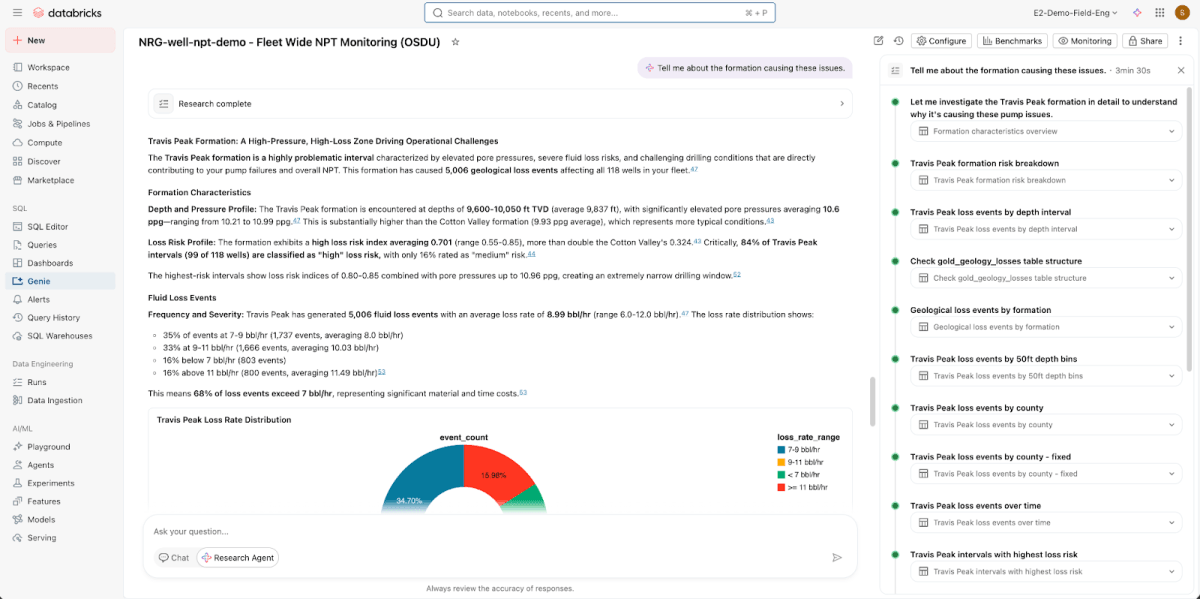
The Response:
Travis Peak is a fractured, vuggy carbonate reservoir spanning 9,600-10,049 ft TVD with geological characteristics that create the conditions driving mud pump failures. It presents significant drilling challenges due to highly elevated average pore pressures (up to 10.62 PPG) and a high risk of fluid loss, indicated by a Loss Risk Index of 0.70 and affecting 84% of wells.
Question 4: "What can I do to reduce NPT?"
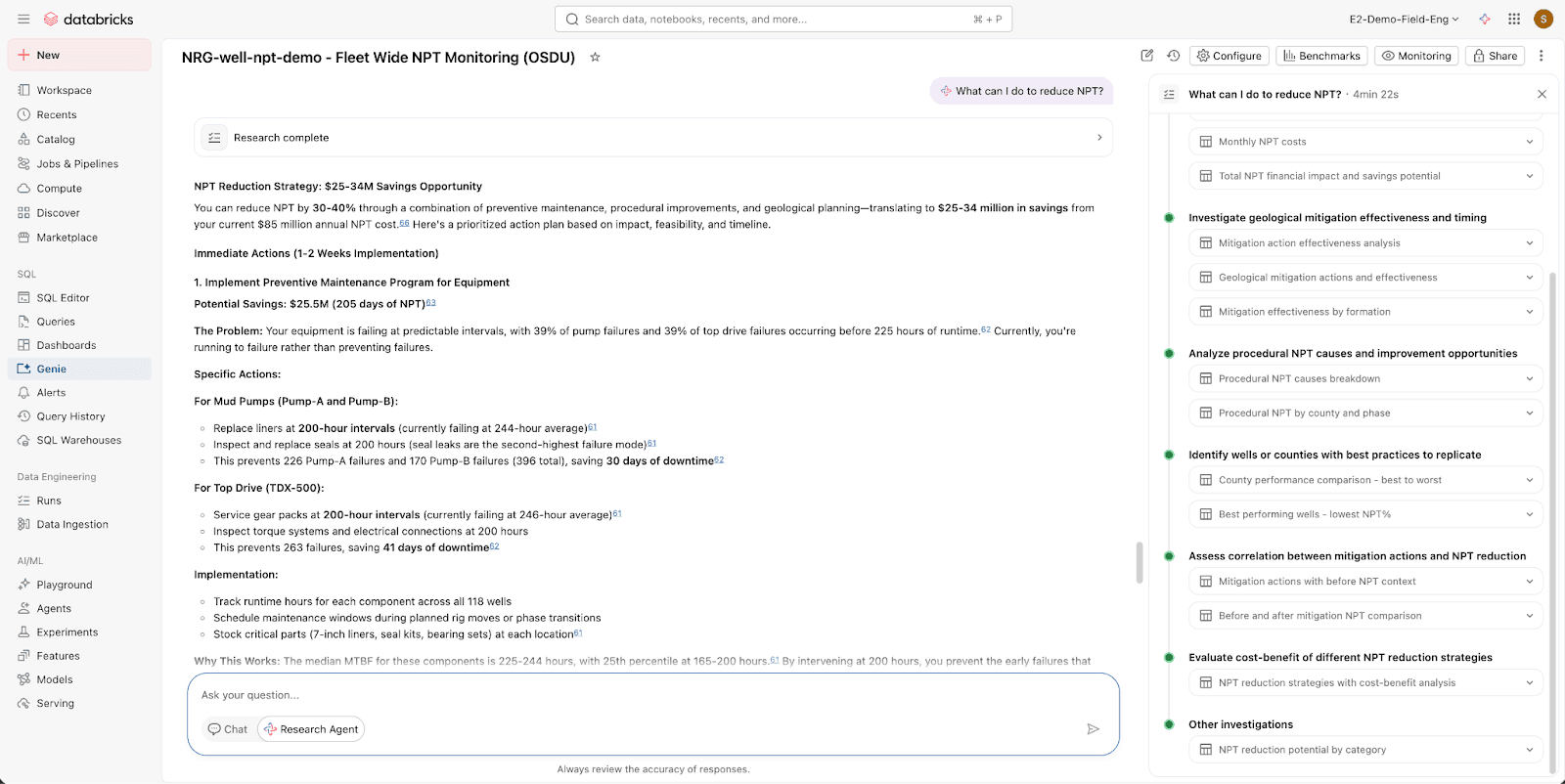
The Response:
The Genie Agent mode offers a dual approach to well optimization. Immediate actions (1-2 weeks), such as specific mud pump maintenance like liner replacement intervals, are provided alongside a set of long-term strategies (6-month horizon). These long-term initiatives include automated torque limiting, mud weight optimization, and other related actions.
Because the action plan is driven by the same unified dataset and modeling, operations managers can see not just what to do, but how much NPT and cost each intervention is likely to recover, helping prioritize work across rigs and partners.
Well Path Reference Architecture on Databricks

What Does the Architecture Look Like?
The Databricks Lakehouse, structured as a Medallion architecture, is ideal for analytics, organizing data across three layers. The Bronze layer contains raw data like OSDU well logs, IoT streams, and ERP records. This data is cleaned and enriched in the Silver layer with standardization, formation metadata, and equipment ID mapping. The Medallion architecture replaces scattered integrations with a unified foundation. Instead of each team building its own NPT or MTBF logic, the Gold layer standardizes these metrics and makes them accessible to Genie, BI tools, and predictive models.
Data Sources & Integration
| Source Type | Examples | Ingestion Method |
|---|---|---|
| OSDU Platform | Gamma ray, resistivity, porosity, lithology | REST API Note: a Lakeflow Custom Connector or Federated Lakehouse (zero-copy) solution are expected to be available soon |
| IoT Sensors/OT | Drilling parameters, pump metrics, equipment health | Auto Loader streaming or Zerobus |
| ERP Systems | Maintenance records, supply chain, financials | Lakeflow SAP/Oracle connectors |
The new solution significantly boosts business value by delivering faster insights in minutes using natural language queries instead of weeks of manual analysis, correlating root causes across previously siloed data (operations, equipment, and geology), enabling proactive and predictive actions, and democratizing data access for all stakeholders through simple queries, eliminating the need for specialized SQL.
What Are the Quantifiable Business Outcomes?
Unified data platforms with AI-powered analytics drive significant improvements for organizations, including:
- Reduced NPT: By proactively addressing formation-specific obstacles, organizations minimize NPT before issues escalate.
- Minimized Equipment Downtime: Predictive maintenance, which correlates potential failures with geological conditions, leads to reduced equipment downtime.
- Accelerated Decision-Making: Critical insights are delivered in minutes instead of weeks, enabling faster decisions.
- Optimized Capital Allocation: Data-driven prioritization, based on quantified Return on Investment (ROI), ensures capital is allocated more effectively.
For a personalized demo and discussion on transforming your drilling operations with AI-powered natural language analytics, contact your Databricks representative.
Get the latest posts in your inbox
Subscribe to our blog and get the latest posts delivered to your inbox.