Turning insight into impact with Databricks and Global Orphan Project
How Databricks helped Global Orphan Project modernize business intelligence and expand personalized donor engagement
by Andrea Tardif and Josh Bae
- Global Orphan (GO) Project partnered with Databricks Field Engineering resources to become more data-driven.
- GO Project consolidated multiple data sources and varied reporting locations to a centralized Lakehouse architecture.
- Together, the team developed a Databricks AI/BI dashboard for monitoring internal KPIs and metrics and a GenAI-powered market reports to drive engagement with prospective donors focused on their local community.
Databricks has partnered with Global Orphan (GO) Project, a nonprofit organization that connects families with resources and communities that can prevent children from falling into systemic tragedies.
Through Databricks for Good, an initiative delivering pro bono professional services for social impact, the Databricks Team helped GO Project strengthen its data foundation and accelerate its mission and impact.
Data Challenges and Limitations
In 2025, GO Project local partners served almost 122K children across 43 U.S. states and internationally 53K children across 6 countries. With more than 1,600 active partner agencies in the U.S. submitting requests and 8,200 response teams responding in near real time, data was housed across systems, making reporting a challenge. As a result, critical questions, such as “What does it cost (i.e. finance data) to facilitate each request (i.e. platform data)?" were often calculated outside of automated reporting systems in spreadsheets, making data availability and consistency not as efficient as it could be.
GO Project needed a tool that could easily pull data from numerous sources into one trusted data layer to drive reporting and increase overall data consistency and availability. While consolidating data into a unified data platform, it also needed to ensure data governance, access, and permissions were tightly integrated so that all user types from internal staff to agency partners to church volunteers had access to appropriate subsets of data for their purposes.
To address these challenges, GO Project selected Databricks for its ease of setup with serverless workspaces, seamless integration with cloud platforms, Unity Catalog governance capabilities, and ability to unify data engineering, analytics, and AI on a single platform.
Modernizing A Data Architecture with Databricks
During the Databricks for Good engagement, GO Project partnered with two Databricks Delivery Solutions Architects (DSAs) and a Databricks Project Manager over a three-month period to design and implement a modern data architecture depicted below.
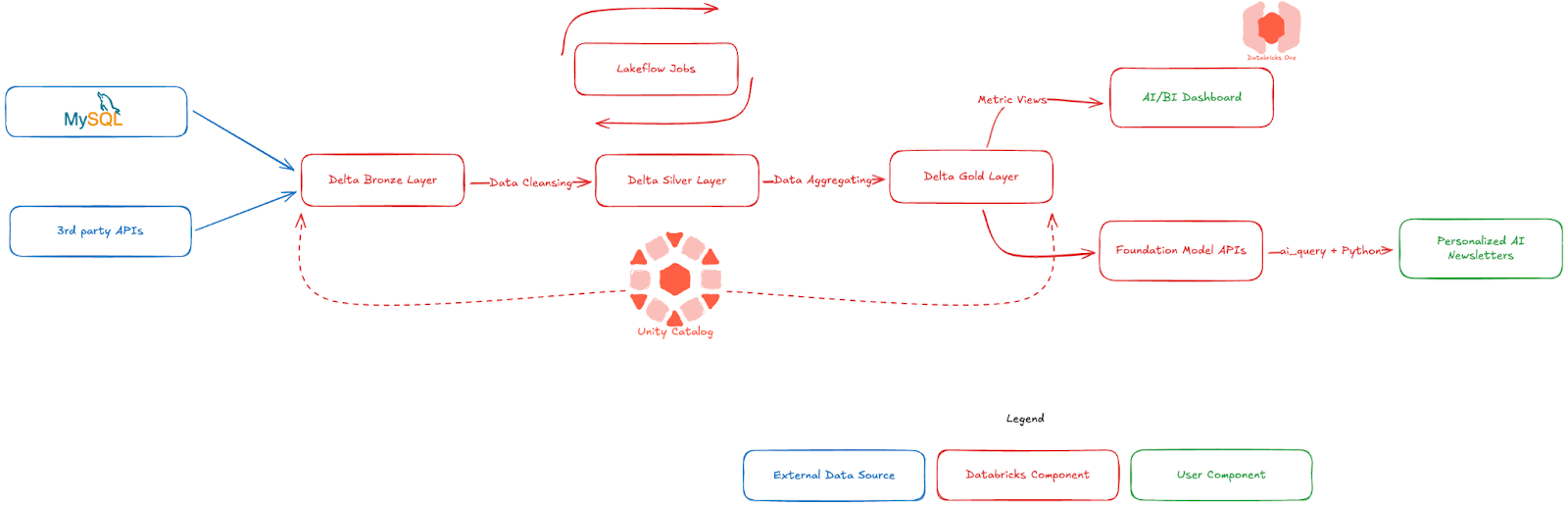
The solution was designed around a medallion architecture (bronze, silver, gold) to provide a scalable and trustworthy foundation for both analytics and AI-driven use cases. Raw data from third-party APIs and AWS RDS MySQL were ingested efficiently through both open source and Databricks-managed features, enabling rapid onboarding of new data sources while keeping pipelines resilient as volumes grew. Data quality and reliability in the silver layer were enforced through pipeline expectations (using Spark Declarative Pipelines), enabling early identification of downstream data issues and establishing a standardized data quality framework.
Finally, the data was aggregated into the gold layer, which served as the trusted source for downstream consumption. Metric views powered centralized dashboards that democratized access to insights for different teams, eliminating reliance on manual reporting or specialized technical support. At the same time, these curated datasets enabled personalized, AI-generated newsletters without redefining core business metrics or creating parallel data silos.
Underlying all of this, Unity Catalog served as a unified governance layer across all data and AI assets, enabling GO Project to confidently scale self-service analytics and AI projects.
Solutions and Outcomes
The following sections highlight the solutions delivered through the Databricks for Good engagement and the measurable outcomes they achieved for GO Project.
Centralized KPI Dashboard
A primary challenge facing GO Project was the lack of a single, accessible view of organizational performance across its network of partners. Key metrics were stored across multiple data sources, requiring teams to manually collect and interpret the information. This process was both time-consuming and prone to inconsistency.
Through the Databricks for Good program, Databricks partnered with GO Project to transform this fragmented reporting model into a centralized, automated KPI dashboard built on a data lakehouse architecture.
Instead of relying on static exports or manual updates, new data was automatically ingested and processed, enabling dashboards to reflect changes much closer to real time. This ensured leadership and field teams were always working from the most current information available. The end result was a unified source of truth that brings together operational data from across the organization into an up-to-date dashboard.
This dashboard leverages the following key Databricks features:
- Metric Views to standardize KPI definitions and ensure consistent calculations across all reports and dashboards. GO Project no longer needs to send around SQL snippets, hoping to get the WHERE clause correct.
- AI/BI Dashboards to enable the creation of intuitive, drag-and-drop visualizations tailored to GO Project’s operational needs.
- Databricks One to allow business users to securely consume and interact with AI/BI dashboards without requiring direct access to the Databricks workspace or underlying datasets.
As a result, GO Project accomplished the following business and technical outcomes:
- Operational efficiency: Reduced reporting cycles from days to minutes, allowing users to monitor the health of regional metrics on demand rather than waiting for email reports.
- Rapid productivity and learning: Enabled team members to quickly author and iterate on complex analytical queries using the Data Science Agent, accelerating insight generation without requiring deep SQL expertise.
- Scalable reporting foundation: Reduced reliance on one-off, ad hoc reports by establishing a standardized reporting foundation directly within the Databricks Data + AI Platform.
Overall, the consolidated KPI dashboard provided GO Project with timely, actionable insights into outreach performance. With near real-time visibility into key metrics, the organization can respond faster, allocate resources more effectively, and ultimately strengthen its ability to prevent more children from falling into systemic tragedies.
Personalized AI-Generated Donor Outreach
With a data-driven view of performance in place through the centralized KPI dashboard, GO Project turned its focus to activating those insights through more effective stakeholder engagement. GO Project sought to produce timely and personalized content at scale in an effort to appeal to donors using data personalized to their local community.
Previously, GO Project relied on a largely manual process. Data had to be individually extracted from a MySQL database for each stakeholder, then formatted and woven into communications by hand making it difficult to frequently tailor messaging for all prospects.
Through the Databricks for Good initiative, the team designed and implemented an automated system to generate personalized, AI-powered newsletters directly from curated datasets on the Databricks Data + AI Platform. By combining governed data with built-in GenAI capabilities, the solution transformed operational metrics into stakeholder-ready narratives with minimal human intervention.
For this deliverable, the following key Databricks features were used:
- Databricks Notebooks and Databricks AI Functions (ai_query) to dynamically generate stakeholder-specific narrative summaries based on notebook widgets (to drive segmentation logic), avoiding manual configuration and custom scripts.
- Foundation Model APIs to integrate GenAI directly from the data platform, enabling content generation alongside data preparation and transformation.
- Unity Catalog Volumes to securely store unstructured, AI-generated newsletter outputs as PDFs in cloud storage, simplifying downstream distribution and access.
This resulted in the following business and technical outcomes for GO Project:
- Accelerated content creation: Personalized donor market snapshot draft generation now occurs in seconds instead of days, allowing GO Project’s marketing team to focus on refinement and storytelling rather than manual content creation.
- Eliminated manual data aggregation: The team no longer needs to pull monthly impact data from multiple systems. Instead, users can select a stakeholder, and pre-configured widgets automatically filter the relevant data and generate personalized content using the ai_query function.
- Scalable, data-driven donor marketing: Tight integration of notebooks, the Data Science Agent, and trusted data pipelines allowed GO Project to rapidly build donor marketing products tailored to local markets. Fundraising teams can now generate customized, data-backed reports on demand across all U.S. geographies in a fraction of the time previously required to produce a single report.
Together, these capabilities enable GO Project to move beyond static reporting and into personalized, AI-driven storytelling, thereby strengthening stakeholder relationships while amplifying the visibility and impact of its mission.
In this initial phase, the solution relied on Databricks AI Functions to generate newsletter content. Looking ahead, GO Project plans to leverage Agent Bricks to introduce domain-specific agents responsible for different sections of the newsletters. This approach will further reduce prompt tuning overhead, improve consistency across outputs, and enable more scalable optimization of the underlying large language model (LLM).
Impact and Outcomes
Through the Databricks for Good program, GO Project transformed its data capabilities from disparate reporting into a modern, scalable data and AI foundation built on the Databricks Data + AI Platform.
Corey Vaudo, Chief Data and Information Officer of the Global Orphan Project, shared the following perspective on the partnership:
“The all-in-one nature of Databricks is great for a small team of our size. Instead of spending time learning and chaining various tools together, we're focused on the problems at hand and are confident that the features we need already exist in the tool we've selected. We look forward to working with Databricks on more projects in the future.”
If you are a nonprofit organization or work closely with nonprofits and are interested in learning how Databricks can serve as a force multiplier for social impact, please reach out to us at databricksforgood@databricks.com.
Get the latest posts in your inbox
Subscribe to our blog and get the latest posts delivered to your inbox.