

As the third-largest convenience store chain in the U.S. and one of the country’s largest pizza brands, Casey’s runs a business where timing matters. With nearly 3,000 stores—many in small communities where Casey’s is the only option—field teams start early, travel long distances, and rely on fresh, accurate data to decide where to focus each day.
To support that pace, Casey’s data and analytics organization set out to modernize its legacy on-premises warehouse, eliminate performance bottlenecks, and deliver reliable insights to operators before 6:00 a.m. The result is a simplified, cloud-native lakehouse architecture with Databricks at the center—and Databricks SQL as the analytics and serving layer.
Simplifying the Architecture Through a Phased Migration to Databricks SQL
Casey’s journey began with a hard constraint: a fixed, on-premises data warehouse running mixed workloads. Ingestion, transformations, and BI queries all competed for the same compute, leading to frequent collisions, inconsistent performance, and missed SLAs for business users.
“We just weren’t fast enough,” said Ryan Fye, Director of Data Strategy at Casey’s. “As data volumes grew and insights became more critical, that wasn’t acceptable anymore.”
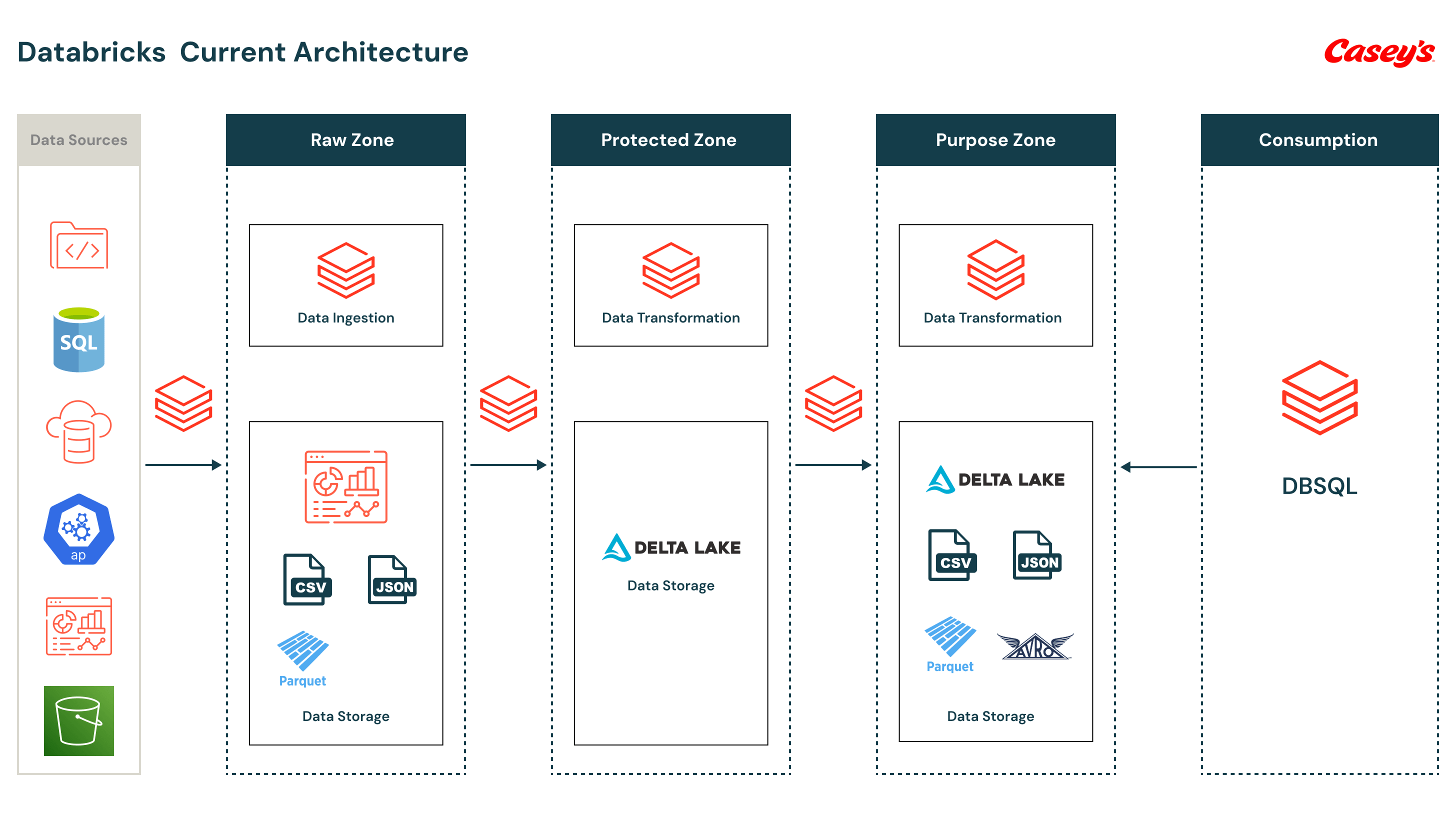
The team took a pragmatic, phased approach. They first lifted their on-premises warehouse into the cloud to gain immediate elasticity, then completed a second migration from Azure Synapse to Databricks SQL once it became production-ready. By that point, most ingestion and transformation pipelines were already running in Databricks, following a medallion architecture—so the migration largely meant eliminating the extra copy and placing Databricks SQL directly on top of the existing gold layer.
What they expected to take close to a year was completed in less than half the time. The key was focus: migrating the low-friction workloads first, saving the most complex edge cases for last, and changing only what actually needed to change.
From the business perspective, the transition was almost invisible—except for one thing: better performance.
Delivering Insights Before 6:00 a.m. With Predictable Performance
For Casey’s field operators, analytics are only useful if they arrive early enough to shape the day. Many operators begin their mornings well before sunrise, reviewing the day before and driving for hours to visit stores.
That created a non-negotiable requirement: all transactional data from every store had to be processed, validated, and queryable before 6:00 a.m.—every day.
With Databricks SQL, Casey’s separated ingestion and transformation workloads from analytics queries, eliminating the resource contention that plagued the legacy environment. The platform consistently meets internal SLAs for data freshness and response time, even as volumes continue to grow. Casey’s reduced the time to deliver daily operational data from 8 hours to 4 hours.
“From the business partner perspective, we didn’t want them to notice anything different,” Fye explained. “Other than better performance.”
That reliability has turned analytics into a trusted part of daily operations, rather than a best-effort reporting system that users learn to work around.
Boosting Team Productivity With One Unified, Serverless Platform
Beyond performance, the biggest internal shift was simplicity.
Today, Casey’s data engineers, analysts, and data scientists all work on the same platform. There’s no need to move data between systems or train new hires on multiple toolchains. New team members onboard faster because they only need to learn one environment.
Serverless compute has amplified those gains. Casey’s teams no longer manage clusters, patch infrastructure, or manually scale resources. Capacity expands and contracts automatically, including lower costs during lighter weekend workloads—without any intervention from the team.
Even advanced SQL work has become more accessible. Analysts and engineers regularly use Databricks’ built-in AI assistance to generate and refine complex queries, lowering the barrier for sophisticated analysis and freeing senior engineers to focus on higher-value work.
The net effect is a small, efficient team that spends its time solving business problems—not maintaining platforms. As a result, Casey’s has enabled over a dozen analysts across business units to self-serve directly in Databricks.
Turning Cost Savings Into Momentum, Not Trade-offs
While cost wasn’t the primary driver at the start, it became impossible to ignore after the migration was complete. By moving from Synapse to Databricks SQL, Casey’s saw significant savings.
But the bigger story isn’t just lower spend. It’s what Casey’s does with those savings.
“Anytime we find efficiencies, we reinvest them,” Fye said. “We put that back into the team and the platform to go do something else new.”
That reinvestment mindset has enabled Casey’s to expand analytics across business units, stand up a dedicated data science team, and begin exploring AI-driven use cases—all on a single, governed lakehouse architecture. In fact, Casey’s reinvested 100% of infrastructure savings to support growing data volumes driven by new analytics and data science initiatives.
For Casey’s, Databricks SQL isn’t just a faster warehouse. It’s the foundation that lets analytics scale quietly, reliably, and ahead of the business—day after day.