The AI scaling gap hiding in digital native companies
“Making AI deliver: A benchmarking framework on how leading companies operationalise AI for impact," Economist Enterprise report 2026. Survey of 1,220+ global executives across eight industries, including 150 digital native company leaders.
New Economist data shows digital natives lead on AI ambition but lag traditional industries in scaling it. What's behind the gap and why it matters.
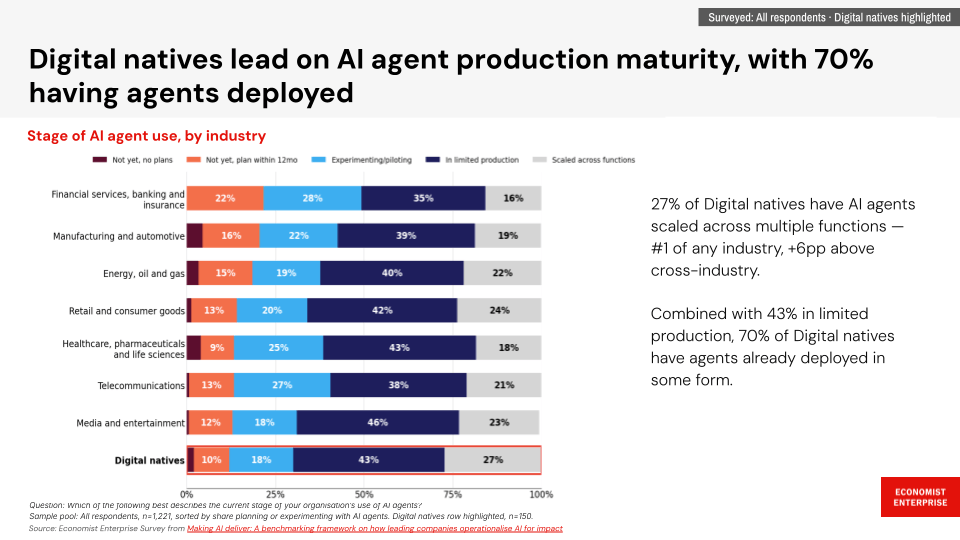
Digital native companies were born on data. They hire engineers the way banks hire analysts. They ship software for a living. So when 1,200+ executives were surveyed for a new report from The Economist, you might expect digital natives to be the furthest along in making AI operational. The data suggests something more useful: digital natives are ahead in AI ambition and breadth of deployment, but they are not uniformly ahead in full operational maturity.
Scaling is the priority. Full stop.
Among the eight industries surveyed, digital native executives are the most likely to name “embed AI across core business processes at scale” as their single highest investment priority over the next two years. At 18%, digital natives lead every other industry. That is nearly 2x the cross-industry average of 9.8%, 2.5x the rate in financial services, banking and insurance, and nearly 3x the rate in retail and consumer goods. The next closest industry is energy, oil and gas, at 12.6%.
This tracks. AI is increasingly part of the product, the customer experience, the operating model, and the margin structure. This isn't about cost reduction or compliance. Cost reduction and compliance matter, but they are not the strategic center of gravity. For tech companies, the priority is architectural: embed AI deeply enough across the business that it compounds. No other industry prioritizes scaling AI this explicitly.
Prioritizing scale does not create a maturity lead
Here's where the data gets more interesting. When you look at how AI is actually being used across business functions, digital natives are clearly ahead on breadth of scaled adoption. Across every function measured, they are above the cross-industry average when “at scale” is defined as either deploying AI across workflows or fully embedding AI at scale. The gap appears when the bar moves from deployment to full embedding. In the survey, “fully embedded at scale” means AI is not just being tested or deployed in workflows. It means AI is being used by 100+ users, backed by SLAs, and monitored for performance and impact.

On that measure, digital natives lead in only one of eight business functions: R&D/product development. Outside the technical core, the story changes. They rank fifth or lower on fully embedded AI in HR, legal and compliance, finance, marketing, and operations and supply chain. Finance is the clearest example. Digital natives have one of the broadest AI footprints in finance, but rank seventh out of eight industries on full embedding. Media and entertainment leads them by nearly 13 percentage points. Telecom leads them by 11 points. Operations and supply chain show the same pattern. Digital natives have the highest rate of AI deployed across operational workflows, but rank sixth on full embedding. Telecom leads by more than eight points, with media and entertainment and manufacturing also ahead. That is the scaling gap.
And it is not just a function-by-function quirk. Telecom is the clearest counterexample to the idea that stated ambition equals maturity. Only 7.9% of telecom executives rank embedding AI at scale as their top investment priority, less than half the share of digital natives at 18.0%. Yet telecom is ahead of digital natives on fully embedded AI in five of the eight functions measured: IT, legal and compliance, finance, sales and customer service, and operations and supply chain. Media and entertainment and manufacturing widen the pattern. These are not the industries most people would assume are outpacing tech companies on AI embedding, but both are further ahead than digital natives in several core business functions where AI has to fit into established operating rhythms.
The takeaway is not that traditional industries have pulled ahead overall. Digital natives appear to have the clearest mandate for AI at scale and one of the broadest deployment footprints. The next competitive frontier is not launching more AI initiatives. It is improving the conversion rate from deployed AI to fully embedded AI.
Why the gap matters
For a CTO or CPO at a high-growth tech company, this data should be both validating and uncomfortable. It is validating because digital natives are already seeing value. Nearly 92% of digital native executives report their AI ROI is ahead of plan, compared with 84% overall. This is not a story about AI failing to deliver. But it is uncomfortable because ROI momentum does not automatically translate into operating maturity. Digital natives have the strongest AI-scaling mandate of any industry surveyed, and they are pushing AI broadly across the business. Yet they lead on fully embedded AI in only one of eight business functions. That means some of the industries digital natives might not expect to learn from, telecom, media and entertainment, manufacturing and energy, are further ahead in fully embedding AI into specific parts of the business.
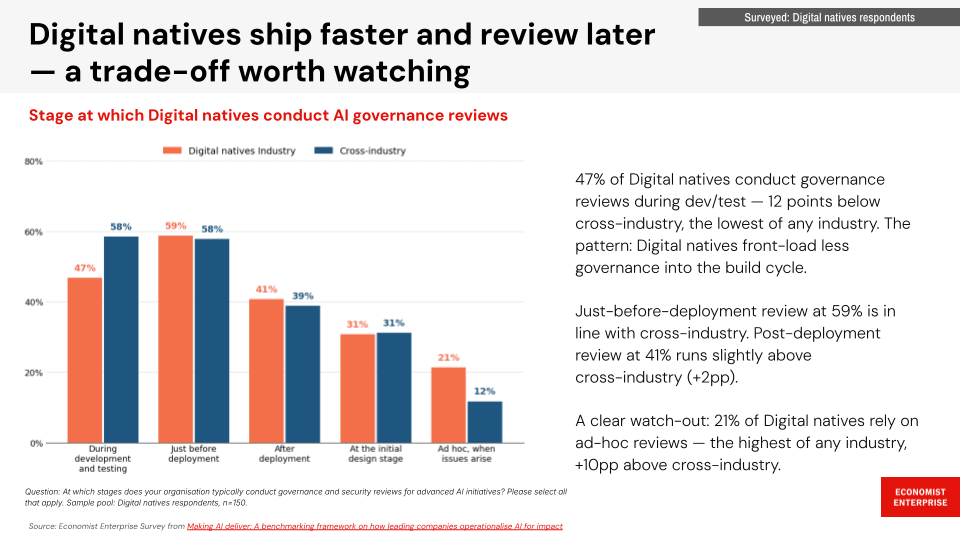
The difference likely shows up in the architecture. Fully embedded AI requires governed data access, reliable pipelines, observability, evaluation, SLAs, cost controls, security, lineage, and feedback loops. It requires AI systems that can be reused across teams, monitored in production, and trusted inside business-critical workflows. Without that foundation, digital native companies pay a builder’s tax. Engineering teams spend time maintaining pipelines, reconciling fragmented governance, duplicating work across teams, and keeping AI systems alive instead of improving products and customer experiences.
The survey does not prove why digital natives show this gap. But it raises the right questions. Are digital natives managing higher data variety and velocity across more complex architectures? Are their AI initiatives scaling faster than their governance models? Are teams deploying quickly inside individual functions, but without a unified foundation for reuse, monitoring, and operational accountability? Whatever the cause, the leadership question is clear: do you have an AI operating foundation, or just a growing portfolio of AI deployments?
What to do about this
The gap points to a structural issue, not a value or ambition problem. Digital natives are already seeing strong ROI, so the answer is not simply to run more pilots or hire more ML engineers. The next challenge is converting that momentum into repeatable, governed, production-grade operations. That starts with architecture. Data pipelines, governance, AI workloads, models, agents, and applications need to operate together. Security, lineage, monitoring, and performance measurement must be shared capabilities, not reinvented within every business function. The companies that close this gap will not be the ones with the most AI experiments. They will be the ones that turn AI into repeatable infrastructure.
For digital natives, the mandate is already clear. They have named AI at scale as the priority more explicitly than any other industry. Now the work is to make the scale real: not by layering more AI on top of the business, but by building it into how the business runs. The full Economist report covers the benchmarks, executive interviews, and cross-industry data behind these findings.
Source: “Making AI deliver: A benchmarking framework on how leading companies operationalise AI for impact," Economist Enterprise report 2026. Survey of 1,220+ global executives across eight industries, including 150 digital native company leaders.
Get the latest posts in your inbox
Subscribe to our blog and get the latest posts delivered to your inbox.