Announcing first-class support of Iceberg format in Databricks Delta Sharing
Data recipients can now consume Delta Shares in any Iceberg-compatible client; and data providers can Delta Share any Iceberg table from external catalogs
by Tia Chang, Qinghao Wu and Harish Gaur
- Iceberg customers can now benefit from Delta Sharing advanced sharing functionalities, including View sharing and secretless authentication.
- Securely share from Databricks to any client supporting the Apache Iceberg REST Catalog API, including Snowflake, Trino, Flink, Spark, and more.
- See how Navitaire, an Amadeus company, uses sharing with Iceberg clients to deliver new data products to its airline customers.
With more than 300% year-on-year usage growth for 2 consecutive years, Delta Sharing is the most widely adopted open protocol for Data and AI sharing. Major data providers including SAP, Walmart, Navitaire (an Amadeus Company), Atlassian, and LSEG use Delta Sharing to share data with their partners and customers across clouds and platforms. Today, we are excited to announce that Databricks Delta Sharing has first-class support for the Apache Iceberg format.
Data providers can now share data securely and live from Databricks to any client that supports the Apache Iceberg REST Catalog API. Recipients on platforms such as Snowflake, Trino, Flink, and Spark on all clouds can all use this capability - adding to Delta Sharing’s open ecosystem.
Furthermore, we are launching a Private Preview that enables data providers to use Delta Sharing to share Iceberg tables managed by catalogs outside Databricks - including AWS Glue, Hive Metastore, Snowflake Horizon, and more.
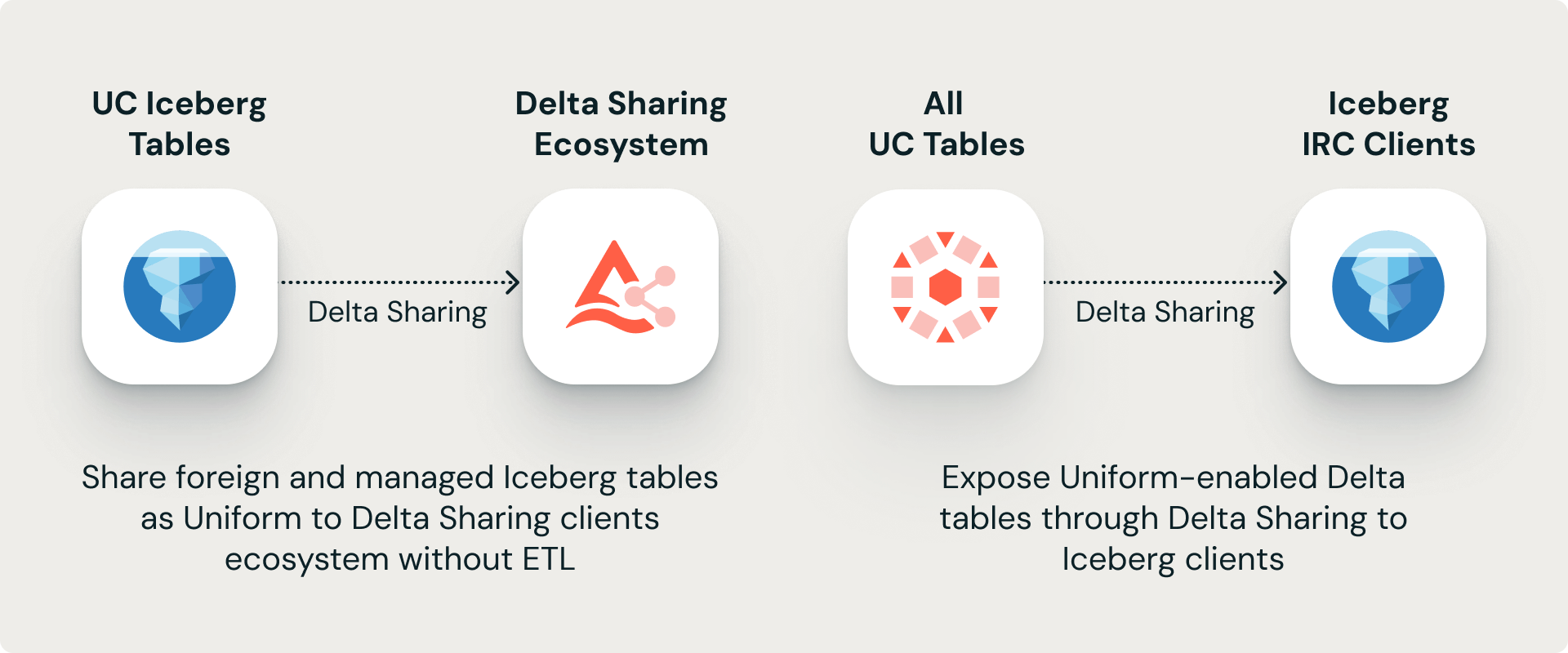
Together, you can share any new or existing tables (Delta or Iceberg, managed or foreign). This builds towards complete open interoperability. You can bring in Iceberg tables from any external catalog, manage them through Databricks and Unity Catalog, and then share them out to any recipient—whether they are on Databricks, an Iceberg client, or a Delta client. This enables you to leverage Unity Catalog as your unified data governance layer, giving you one place for all sharing.
In this blog post, we will explain why open data sharing is important. We will also dive into how Delta Sharing to Iceberg clients work through a hands-on demo.
Why This Matters: Open vs. Closed Sharing
Most data sharing solutions are not really sharing—they're trapping. They are fundamentally closed and engineered to ensure vendor lock-in, so you only get to share with others who are already inside their closed ecosystems. This limits your options, stifles innovation, and drives massive, pointless data replication.
Delta Sharing is the most widely adopted open standard for secure data sharing. Used by category-leading data providers, it is built to support different clouds and platforms. Delta Sharing operates on three core principles:
- Share any asset.
- Share with anyone.
- Share without any friction.
Adding Iceberg client support strengthens this commitment. It lets you share a Delta table while recipients experience it as a native Iceberg table. Sharing happens over the Iceberg REST API, so recipients can connect from any Iceberg-compatible platform. This allows you to get the best of both worlds: Data providers benefit from advanced Delta Sharing features such as View sharing, while recipients receive native Iceberg tables via the Iceberg REST API.
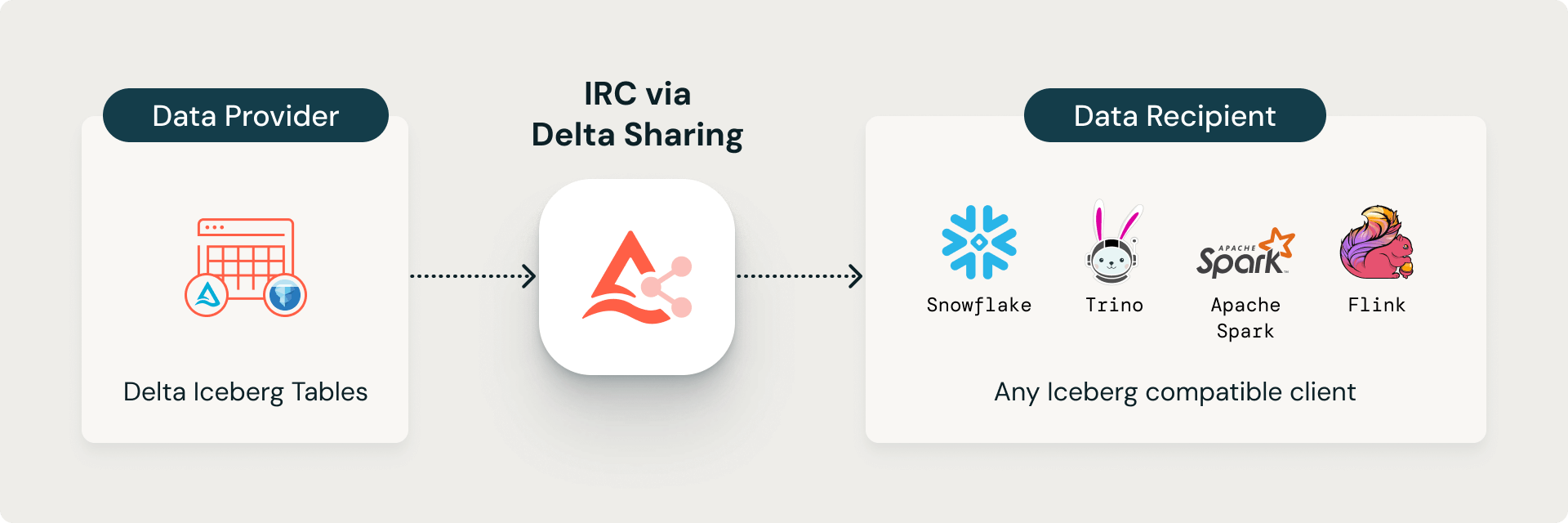
Recipients get secure, live access to the source data. This eliminates silos and lets you share data openly with anyone.
This feature is ideal for organizations that need to share data externally with partners and customers using Iceberg clients, such as those operating on Snowflake or integrating with platforms like Trino, Flink, or Spark. Companies with multiple business units operating across multiple platforms also benefit by unblocking seamless, bi-directional data exchange in multi-cloud or hybrid environments. Industries already leveraging these patterns include healthcare, retail, finance, ad-tech, and more.
Interoperability: Both Source and Destination
Because we believe in full open data access, we don't stop at sharing data to Iceberg clients. We are now developing the next evolution: sharing foreign Iceberg tables that reside in external catalogs such as AWS Glue or Snowflake Horizon. We are excited to announce the Private Preview of Delta Sharing support of foreign Iceberg tables.
You might ask: Why share an Iceberg table through Delta Sharing if it resides in AWS Glue or Snowflake? Why not share directly from within that platform?
First, by cataloging your external Iceberg data in Unity Catalog, you get a unified governance layer in Unity Catalog, allowing you to get full visibility and governance across your data estate. Furthermore, using Delta Sharing allows you to get the best of both worlds: You benefit from Delta Sharing best-in-class sharing functionalities, while keeping your data in Iceberg format. This includes for example, the ability to Delta Share Views for fine-grained access control, which isn’t supported natively by the Iceberg IRC API.
With this Private Preview, the Databricks Lakehouse is open in both directions. Your Lakehouse can share data to and receive data from the growing Iceberg ecosystem.
This dual ability gives you:
- Simple Collaboration: Work together no matter which open table format you use (Delta or Iceberg).
- Governed Sharing: Unity Catalog controls access and provides audit logs.
- Broadest Reach: Share data as both a provider and a recipient, breaking platform walls.
How Does It Work?
Imagine your company, Provider Corp, uses Databricks and Delta Lake to manage customer data. You need to securely share a daily list of product sales with Partner Inc, which uses Snowflake and prefers the Iceberg format.
Before this feature: Provider Corp would have to manually export the data, transform it into a Snowflake-readable format, upload it to the partner's cloud storage, and set up a complex synchronization job. This is slow, costly, involves significant admin overhead, and risks data becoming outdated.
With Delta Sharing to Iceberg Clients:
- Provider Corp enables Iceberg reads on sales data via UniForm (this can include managed and external Delta tables, views, materialized views, and streaming tables), and shares it via Delta Sharing. This provides live access with no duplication or re-ingestion required.
- Partner Inc sets up a simple connection in Snowflake using the provided credentials for secure authentication via short-lived bearer tokens.
- Partner Inc's analysts can immediately query the shared table using standard SQL, treating it like a native Iceberg table in their Snowflake environment.
- The data they see is always live (zero-copy), and Provider Corp maintains full security and governance with auditing and monitoring using Unity Catalog.
This makes data sharing instant, safe, and entirely format-agnostic.
Demo
Check out this demo that walks through the steps to share a table and read it in Snowflake.
- Share the table via Delta Sharing, generating credentials for the recipient.
- The recipient downloads the credential file, uploads it to the activation link page, and generates the SQL. The generated SQL will include all necessary credentials, as well as the catalog and table references required by their Iceberg client (e.g., Snowflake).
- Once completed, the recipient can immediately run queries on the live shared data as if it were native to their platform—no manual ingestion or copies required.
How Navitaire, an Amadeus company, is Delta Sharing to Airlines Across Data Platforms
Amadeus is a global leader in travel technology, focused on making travel better for everyone by providing the technology that connects airlines, travel agencies, airports, hotels and other industry players across the global travel ecosystem. Its reservation platforms process very large data volumes, including over 200 TB of Passenger Name Records (PNR) which feature high cardinality fields, nested structures, and personally identifiable information. These characteristics require robust data governance mechanisms to enable efficient, controlled access or use across the travel ecosystem.
Navitaire, an Amadeus company, uses Unity Catalog & Delta Sharing to deliver new data products to its airline customers. Unity Catalog enables the creation of governed views that remain compliant and securely managed. The Delta Sharing to Iceberg Clients feature allows Navitaire to support airlines that wish to integrate this information directly within their own platforms, by providing governed views as UniForm Iceberg tables. This approach allows the company to distribute data securely and efficiently across platforms like Snowflake without creating redundant copies. Airlines can then consume traveler insights and demographic data directly within their systems—for campaign optimization, route planning, or customer segmentation—without replicating or compromising sensitive information.
Our ability to share governed Delta tables as Iceberg tables transforms how airlines consume information. Thanks to Delta Sharing, we can now provide a single source of truth–securely and seamlessly–on the platform our customers choose, instead of managing multiple copies across systems. This is a game-changer for efficiency and trust. —Matthew Kimber, Director of Platform Product at Navitaire, an Amadeus company.
Next Steps
- Try the Public Preview of Delta Sharing to Iceberg Clients directly in the product now—see the Databricks documentation and your workspace UI for guides and resources.
- If you are interested in participating in the Private Preview of Sharing Foreign Iceberg Tables or to learn more about full Iceberg interoperability, contact your Databricks account team.
Get started
- Read the Delta Sharing documentation to start with Delta Sharing
- Watch the Delta Sharing in Action: Architecture and Best Practices from Data and AI Summit 2025
- Watch the Securing Data Collaboration: A Deep Dive Into Security, Frameworks, and Use Cases from Data and AI Summit 2025 to learn more about the Delta Sharing Security, Framework and Use Cases
Get the latest posts in your inbox
Subscribe to our blog and get the latest posts delivered to your inbox.