The Collaboration Advantage: How Modern Retailers and CPG Brands Win Together
Why leading executives are replacing data silos with real-time intelligence across merchandising, supply chain, and go-to-market
- Retail and CPG growth is often derailed by delayed, siloed data, turning strong demand into stockouts, lost revenue, and customer churn.
- Legacy data-sharing approaches rely on brittle integrations and slow ETL pipelines that can’t keep up with modern retail scale or speed.
- Real-time data collaboration with Delta Sharing enables faster decisions, fewer stockouts, and materially higher promotion and sales performance.
The Launch That Had Everything... Except Stock
Picture this: A major CPG brand launches a premium organic product line at a national retailer. Week one? Sales exploded 37% above forecast. Week four? They're crushing projections by $2.8M. Social media is buzzing, customers are loving it, and the partnership looks like a home run.
Then week ten hits. Out-of-stock rates spike to 34%. Two-thirds of flagship stores run empty. Customers switch to competitors. By week sixteen, the brand has lost $4.2M in sales and 28% of those customers say they won't come back.
What happened?
The CPG manufacturer planned production decisions using data that lagged demand by two to three weeks, while actual sales were running 40% higher. The retailer could see real-time POS signals such as regional demand spikes, promotional lift, store-level inventory, but that data never reached the manufacturer’s planning systems. By the time weekly reports surfaced the issue, production cycles couldn’t catch up.
The data existed. The infrastructure existed. What was missing was a way to securely share that data and act on it together.
The $2 Trillion Problem Too Many Firms Underestimate
This isn’t an isolated incident. Variations of it play out every day across Retail and CPG supply chains, and the financial impact is staggering:
- $1.75 trillion in lost sales annually from out-of-stocks (representing 8.3% of total retail sales) Source: ToolsGroup, "Transforming Retail Operations with Stock Availability Optimization," September 2024
- 20-30% of total inventory value consumed by carrying costs annually, with specialized storage pushing this to 35% Source: NetSuite, E2open 2024-2025
- Only 47% of excess inventory gets sold, with the average wholesale discount at 71% off cost, and 30% ending up in landfills
- 91% of consumers are less likely to shop with a retailer again after experiencing a stockout Source: ToolsGroup, "Transforming Retail Operations," 2024
- 43% of shoppers will immediately switch to a competing brand when their preferred product is out-of-stock Source: Repsly, "Optimizing Retail Execution," July 2025
Without a shared, end-to-end view of demand and inventory, most organizations compensate by holding excess safety stock and making decisions on delayed data.
Why Data Collaboration Is Harder Than It Should Be
Data sharing should be straightforward in 2025. In practice, it rarely is. Here’s what typically happens when a retailer tries to share supply chain data with hundreds of CPG partners:
The Provider Challenge of Supporting Diverse Partner Requirements
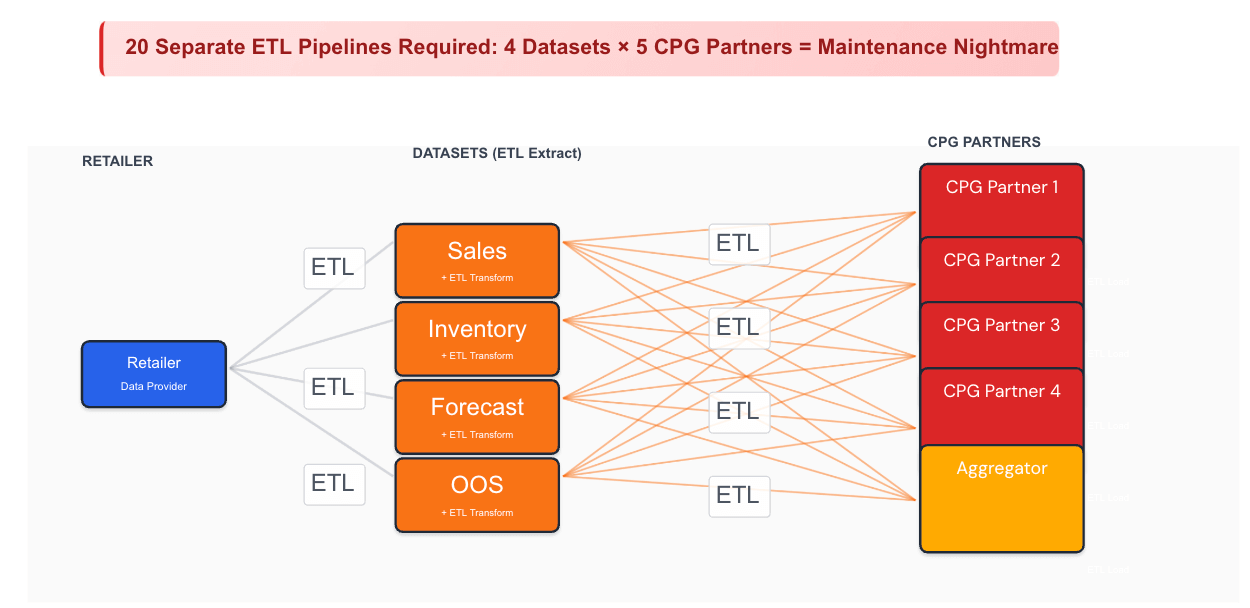
Retailers face a scaling problem when sharing data across large CPG ecosystems. Each partner arrives with different tools, formats, and access requirements—ranging from SFTP file drops, to APIs, to proprietary data sharing, and to spreadsheets. These proprietary systems all introduce technical limitations and increase financial costs to develop and maintain them, making them infeasible for all but the largest of companies.
To accommodate that diversity, retailers build point-to-point integrations for each partner. Every new connection becomes a long-term maintenance commitment, and even small schema changes require coordinating across dozens or hundreds of downstream consumers. Over time, data sharing infrastructure grows brittle, expensive, and difficult to evolve.
The Receiver's Trap: The Other Side
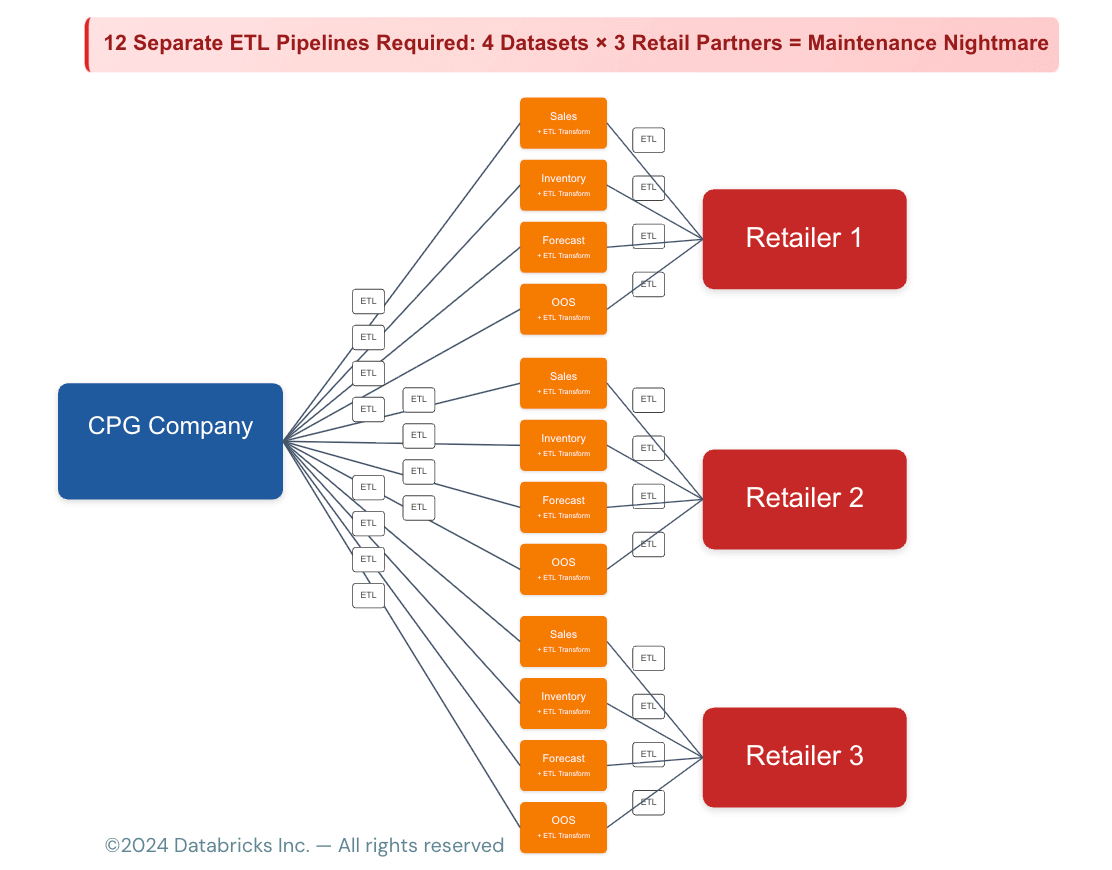
CPG manufacturers experience the same challenge from the opposite direction. They ingest supply chain data from multiple retailers, each delivered in different formats, schemas, and update cadences.
To make that data usable, they build and maintain complex ETL (Extract, Transform, Load) pipelines. —custom extraction logic, transformation layers to standardize fields, mapping tables for product codes, and quality checks to handle inconsistencies. By the time data is standardized and ready for analysis, it is often several days old.
Beyond the technical hurdles, these traditional methods introduce significant security risks: every manual file drop or spreadsheet shared creates a static, 'floating' copy of sensitive data that exists outside of your corporate governance, making it impossible to track, audit, or revoke access once the data has left your environment.
So what would 'good' actually look like?
It would be built on open-source technologies to reduce costs, improve security and maximize flexibility. And it would look like a live data connection between retailers and CPGs, where new records and updates flow automatically across platforms and tools. No matter where the data lives or how partners analyze it whether on Databricks, BigQuery, Snowflake, or in Excel—changes propagate in real time, costs stay predictable, and integrations don’t multiply with every new partner.
No custom code. No complex ETLs. No months-long projects.
That world already exists. It’s called Delta Sharing.
Enter Delta Sharing: Data Collaboration Without the Infrastructure Nightmare
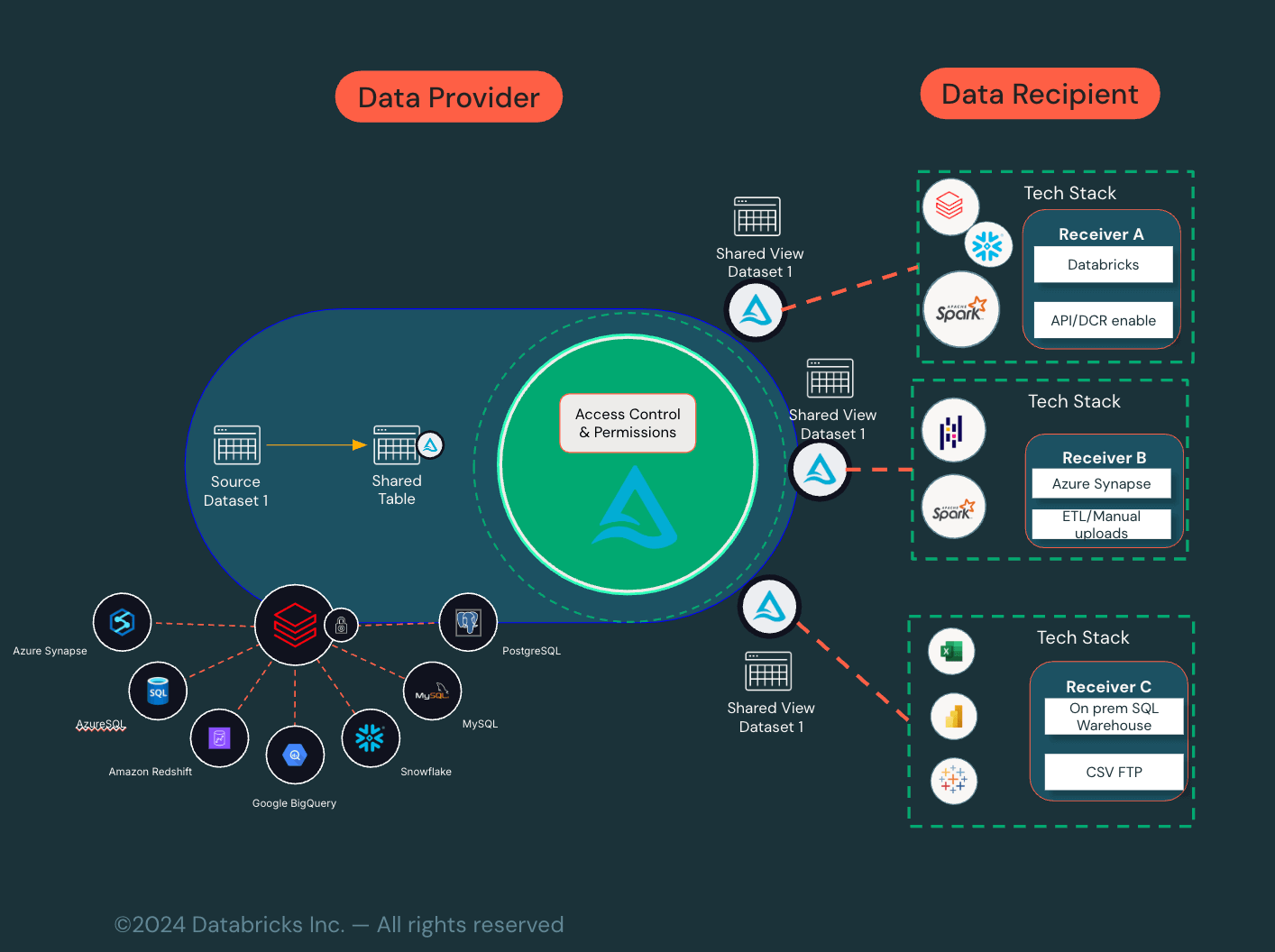
Delta Sharing flips the model. Instead of moving data around, it provides secure access for all stakeholders to live data exactly where it lives. Think of it as the difference between mailing someone a copy of a document versus sharing a live Doc link. Delta Sharing is the most widely adopted open protocol for secure data sharing. It lets organizations exchange live data and AI assets across platforms and clouds.
Proven in retail & CPG:
- Crisp - Connects 4,000+ CPG brands with 40+ retailers and distributors for real-time POS and supply chain data exchange
- Zalando - Europe's leading fashion platform eliminated 1.5 FTE per partner per month in manual data wrangling, enabling partners to access insights in minutes instead of days
- Large Retailer - Featured at Data + AI Summit: Shares SKU-level KPIs with 100+ partners across cloud platforms, powering data monetization while replacing unmanageable homegrown SFTP and APIs with Delta Sharing for easy management and partitioned data access
- Cox Automotive - Shares data across business units and subsidiaries without copying
Why Delta Sharing Works at Retail and CPG Scale
- Real-time, live data, not stale snapshots: Updates cascade to partners as soon as your source data changes—whether that's real-time POS transactions, hourly inventory refreshes, or daily replenishment signals. No batch windows, no export delays, no wondering if partners are working with yesterday's numbers or last week's trends.
- Unified governance with complete visibility: Unity Catalog provides granular access controls so you can share product performance with Vendor A, competitive benchmarks with Vendor B, and aggregated insights with Vendor C—all from the same underlying data. It automatically captures user-level audit logs showing who accessed what and when, with end-to-end lineage tracking down to the column level for compliance and troubleshooting.
- Works everywhere, no platform lock-in: Open-sourced based Delta Sharing allows partners to consume shared data using whatever tools or clouds they already have- No costly software licenses, forced migrations, no proprietary formats, no vendor dependencies.
Delta Sharing in Action
From Months to Minutes: How Modern Data Sharing Works
Picture this: A national retailer wants to share sales performance, product details, and store information with their top CPG partner. The CPG needs to analyze their 350 SKUs across 2,000 stores to optimize promotions and prevent stockouts. In the old world, this would mean months of integration work, custom APIs, and endless data format negotiations. With Delta Sharing, it takes one afternoon.
The retailer's experience is refreshingly simple. They select the data they want to share, create a view that surfaces the right insights, set permissions to control what each partner can access, and click 'Share.' That's it. No custom development, no middleware platforms, no data engineering bottlenecks.
On the receiving end, the CPG partner's experience is equally frictionless. They receive a secure credential, connect using the analytics tools they already have, and immediately start querying live data—or create a local cached copy if they prefer. They can set up automated jobs that efficiently pull only the changes since their last update, keeping their local data fresh without redundant full refreshes.
The result? No ETL pipelines to build. No infrastructure to deploy. No weeks of engineering effort. Just instant access to the data both parties need, with the security and governance controls business leaders demand.
How Granular Data Enables Faster, More Precise Supply Chain Decisions
Legacy data sharing systems couldn't handle the volume needed for truly granular insights. Delta Sharing changes that equation completely.
Consider a CPG manufacturer with 350 SKUs sold across a retailer's 2,000 stores:
Old way - Weekly item totals: 350 SKUs × 2,000 stores × 52 weeks = 36.4 million records/year
Delta Sharing - D-1 hourly by channel: 350 SKUs × 2,000 stores × 365 days × 24 hours × 3 channels = 18.4 billion records/year
That's a 505x increase in data granularity.
In the old model, both the retailer and the CPG brand paid to store the same massive dataset. With Delta Sharing, the data stays in the retailer's cloud storage. The CPG partner queries it directly, eliminating a 100% redundant storage bill.
What does this unlock?
- Channel-time optimization: Online pickup orders placed between 0600-0800 for same-day pickup drive 45% of weekday volume, enabling precise fulfillment center staffing and inventory staging
- Flash stockout prevention: Hour-by-hour tracking reveals when fast-moving items go out of stock mid-day, triggering immediate replenishment from backroom or nearby stores before end-of-day reports would catch it
Promotional precision: Understanding that promotional lift occurs primarily 1000-1400 on launch day allows the CPG to time digital campaigns and ensure inventory is positioned for peak demand hours
Legacy systems would choke on 18.4 billion records. Even moving this data would take days. Delta Sharing handles it seamlessly.
The Revenue Impact of Scaled Data Collaboration in Retail and CPG
When retailers and CPG partners actually share data effectively, the revenue impact is dramatic, but most companies aren't capturing it:
- 45% higher promotion ROI: Enhanced data sharing between retailers and CPG partners increased promotion ROI by more than 45% through better targeting and execution
Source: Retail Velocity, "Strengthening Retailer Partnerships Through Enhanced Data and Insights"
- 10% sales boost from granular POS data: A global brewer partnered with retailers to acquire granular point-of-sale data broken down by product and geography to rapidly optimize campaigns, resulting in over 10% sales increase
Source: BCG, "Maximizing the Value of Data for CPG Marketers," February 2021
The competitive gap is clear: leading companies treat data collaboration as a strategic capability, not a technical challenge.
The Bottom Line
The old model of data sharing—complex ETL, stale snapshots, full-table reprocessing, endless maintenance—isn't just expensive. It's actively preventing retailers and CPGs from building the responsive, efficient supply chains that modern commerce demands.
Delta Sharing eliminates the technical friction. Real-time visibility replaces week-old data. Incremental updates replace full data transfers. Governed access replaces data duplication.
The organizations that modernize their data collaboration infrastructure will slash costs, improve service levels, and outmaneuver competitors still trapped in the old model.
With billions at stake and leading retailers already operating in real time, the question is no longer whether to modernize data collaboration—but how long legacy friction can be allowed to persist.
Get the latest posts in your inbox
Subscribe to our blog and get the latest posts delivered to your inbox.