How to improve patient outcomes with next best actions using a Composable CDP on Databricks
Decoupling data and outreach to drive smarter, HIPAA-compliant healthcare journeys
by Michael Sanky, Aaron Zavora and Nate Wardwell
- Secure Data Architecture: By layering a Composable CDP (like Hightouch) directly onto Databricks, organizations can activate patient data from a single, HIPAA-compliant source of truth without creating data silos or compromising security governance.
- Empowered Engagement: The solution decouples data storage from outreach, allowing non-technical teams to use AI tools to self-serve, create complex patient segments, and coordinate personalized, omnichannel campaigns (email, SMS, ads) without engineering bottlenecks.
- Improved Health Outcomes: Beyond standard marketing, this approach enables critical care journeys—such as chronic disease management, preventative screening nudges, and appointment reminders—that directly improve patient wellness and organizational performance metrics (HEDIS, eCQMs).
Whether your organization directly delivers healthcare, or supports patients and providers in the larger medical and insurance ecosystem, the rapid expansion of patient data and new technologies (including AI) that leverage it creates an unprecedented opportunity to serve patients and optimize outcomes.
What makes data-driven healthcare journeys challenging and important
Patient-centered care is the concept of meeting an individual where they are and performing the appropriate activities to achieve the best possible outcomes for that person. The ability to personalize care is backed by data-driven decisions—but these efforts all too often fall short due to a few predominant challenges in healthcare.
The first is that although there has been a huge emphasis on interoperability from CMS (e.g. CMS Health Tech Ecosystem and Interoperability & Patient Access Rule), the systems of record do not contain all the information relevant to the patient, creating a gap in data-informed decision-making. Further complicating interoperability are specific HIPAA regulations around PHI and the need for tools regulated by BAAs to collaborate.
More nuanced than data interoperability are the practical challenges of reaching the right members with the right message at the right time. Unlike marketing in other industries, which might be focused on selling specific products, healthcare outreach is all about using information intelligently to directly address a member's health and wellness. The opportunity exists to connect more deeply with patients and members and partner with them to live healthier lives. This engagement also helps health plans and providers improve key performance metrics, such as HEDIS, STARS, and eCQMs.
Activating the right message at the right time presents another challenge. What channels of communication should you use, and how should you measure responsiveness and effectiveness? For most healthcare organizations, a single platform does not solve every permutation of outreach, so non-technical teams often need to coordinate across multiple systems.
How a Composable CDP for healthcare works
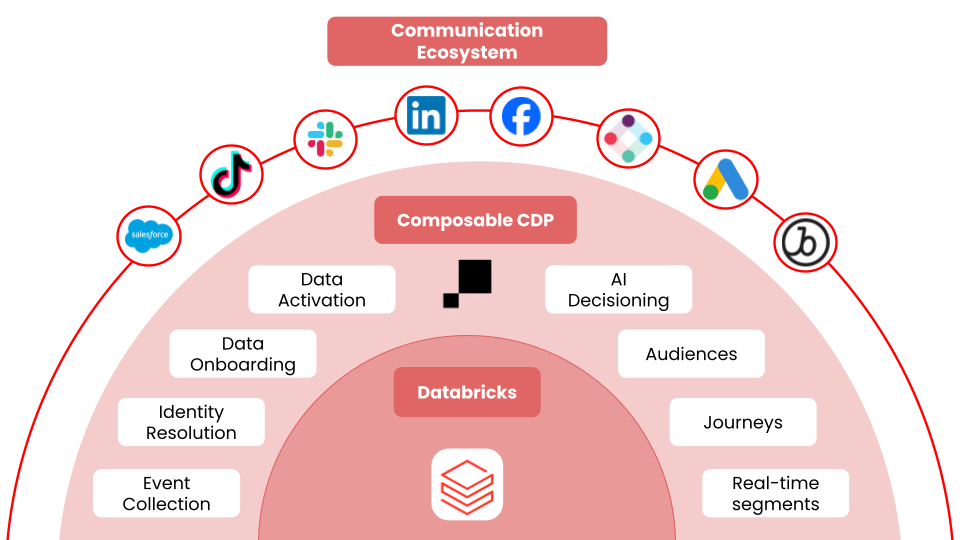
A Composable CDP (Customer Data Platform) is a common approach to create data-driven decisions that power action. It is designed to solve the aforementioned challenges by leveraging your data as the primary driver and foundation for insights and decision-making, and operates upstream from the points of interaction and activation with customers. This allows organizations to take full advantage of the strengths of their data foundation to power all of their downstream customer interactions.
For many healthcare organizations, Databricks serves as the enterprise data platform of choice. Built on the Lakehouse architecture, it unifies the capabilities of a traditional data warehouse and business intelligence with the advanced AI, machine learning, and real-time processing of a data lake under a single platform. Data is stored within the organization’s cloud tenant, with governance enforced through enterprise security groups to support HIPAA compliance and secure, role-based access. Capabilities such as dynamic row- and column-level masking enable teams to operate from a single source of truth while safeguarding sensitive PHI and PII.
With data secured and appropriate role-based access controls in place, Composable CDPs like Hightouch run on Databricks to enable business users to self-serve data access and usage through AI/BI Genie. These teams can create (and measure, and then adjust) cohorts and evergreen journeys based on specific signals from the member journey. Then, they can trigger actual customer communications in downstream tools based on those customer signals. Lifecycle marketing teams can create key cohorts, such as “patients who are due for an annual physical,” and trigger communications across channels like email, phone, and SMS. Paid media teams can upload cohorts to advertising platforms to launch new ad campaigns or suppress ads for existing members. Digital teams can use their Composable CDP to personalize websites and mobile apps in real-time, showing relevant offers or messages to each visitor. And, most importantly, these teams can build a single cohort or journey that spans all these channels to ensure members have a consistent experience across every touchpoint.
And of course, AI can accelerate all of these marketing workflows, but it’s critically important that it’s appropriately governed to prevent negative (or even dangerous, in the case of health misinformation) member experiences. Hightouch’s Agentic Marketing Platform starts by enabling marketers to analyze their data in Databricks, come up with suggestions, and create segments and journeys faster than ever before with a simple workflow. It goes further to create content for advertising and lifecycle marketing campaigns that operate with complete context of each brand’s style and requirements, while ensuring that humans are the ultimate approvers before anything reaches members. And AI Decisioning can automatically choose which message, channel, and timing to deliver to each member to maximize business-defined outcomes while operating within their guardrails.
Example use cases for data-driven customer engagements
Your organization can get started with simple, automated communications that have a positive impact on patients, like appointment reminders, medication pickup or refill notifications, and screening checkpoints. Use cases like these help lay the foundation for more complex workflows and potentially greater impact down the road.
Where a Composable CDP clearly provides an advantageous approach is in more complex workflows for episodes of care, such as pregnancies, and for managing chronic conditions like diabetes and hypertension, as well as for programs like behavioral health and weight management. These programs require a more sophisticated approach with higher levels of personalization and flexibility that account for the nuances of each patient’s medical history and preferences. These programs merit special focus due to the critical nature of the care required and the limited resources available from health plans and providers to support them. Using your data and AI, and empowering outreach teams with self-service data access, helps them maximize impact.
Conclusion
Many organizations are active in engaging with patients outside the clinical setting. A Composable CDP enhances these capabilities by giving organizations self-serve capabilities to access and leverage their data across channels, from their central source-of-truth patient data in Databricks. This approach allows organizations to move faster, to more flexibly tailor communications across multiple channels, and to better engage patients and members based on their preferences and history. Explore more today by reaching out.
Get the latest posts in your inbox
Subscribe to our blog and get the latest posts delivered to your inbox.