Ship Enterprise Apps Faster with Databricks AppKit and Replit
Quickly and Securely Vibe-code Production-grade Applications
by Cong Xu and Evan Pandya
- Quickly and securely build your enterprise data & AI applications in Databricks with Databricks Apps
- Databricks Apps now offers a streamlined development workflow powered by the new Databricks AppKit
- Developers can now build data-aware applications in Replit using natural language and deploy them directly to Databricks
Accelerating Innovation with Databricks Apps
Databricks Apps allows you to securely build, deploy, and scale data and AI-powered applications natively on Databricks. Since its launch in public preview in October of 2024, our customers have built tens of thousands of apps in Databricks, with use cases ranging from interactive dashboards, to business process and data workflow automations, to custom sales companion agents and more. Take Comcast, for example, who has bridged the gap between data science and business strategy by transforming complex forecasting models into interactive apps. This allows their sales and strategy teams to explore revenue scenarios in real time and speed up campaign decisions. Alpura, a leading dairy producer in Mexico, has built a suite of over 10 production apps in just days. Their use cases span from real-time IoT monitoring for factory operations to commercial apps that enable teams to run predictive 'what-if' scenarios for retail partnerships.
Our partners are seeing similar success in rolling out Databricks Apps in highly regulated industries. Hiflylabs used Databricks Apps to build a production grade, audit-ready AI healthcare application in just weeks. This solution automates hours of manual administrative work by providing doctors with trustworthy AI tools for patient data summarization and risk assessment, all within a governed and secure environment.

Databricks Apps has unlocked a whole set of new use cases from a range of enterprise personas by hosting the applications alongside governed data and AI assets. But building a truly production-ready data & AI app still requires significant engineering effort.
Because unlike traditional CRUD applications, data & AI applications are stateful and capable of reasoning over extended periods of time on large volumes of historical and real-time data. This requires complex workflow orchestration, asynchronous execution, and support for long-running processes, while coordinating across multiple data systems, AI models and external services. In addition, factors such as authentication, caching, and error handling are amplified for these data & AI applications. This is challenging to build for even experienced developers, let alone other personas inside the enterprise that want to leverage the power of data & AI for their business needs.
Improving the Developer Experience: Databricks AppKit
To provide a developer experience that minimizes this toil, we created the Databricks AppKit.
AppKit is a TypeScript framework for building production-ready applications with a plugin-based architecture. It provides opinionated defaults, built-in observability, and seamless integration with Databricks services like SQL warehouses, model serving endpoints and Lakebase, delivering an optimized developer experience that is purpose-built for AI-assisted development.
AppKit is built with a layered architecture:
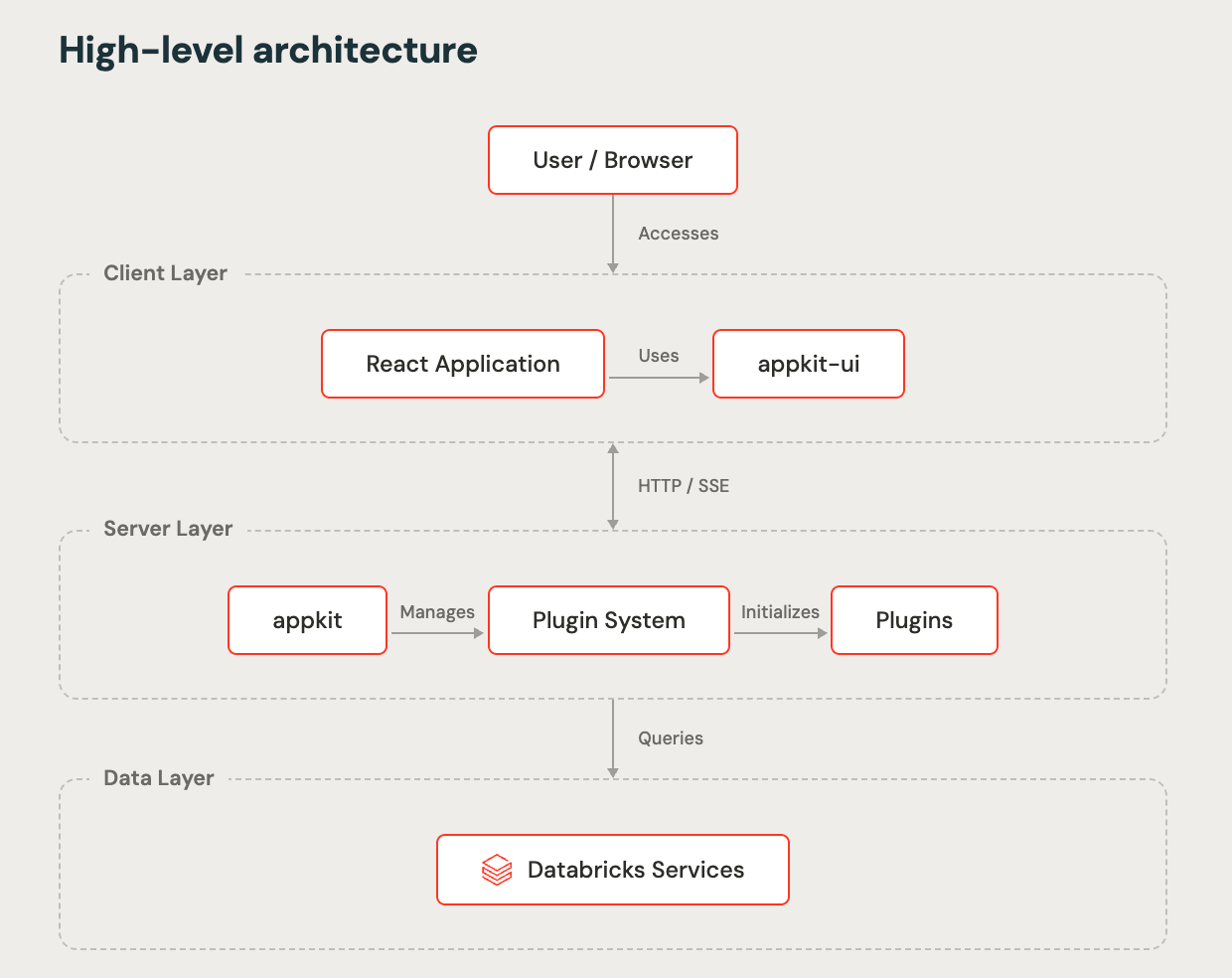
Data Layer: Integrates with existing governed Databricks services that will be critical for modern enterprise applications, including structured / unstructured data, SQL warehouse, Lakebase postgres database, model serving endpoints, agents etc.
Server Layer: The Node.js backend layer that includes different use case plugins, the building blocks of AppKit. These plugins combine capabilities such as authentication, caching, streaming, and telemetry with standardized operational handling of timeouts, retries, and rate limits.
Analytic dashboard app server example
Client Layer: The React frontend layer that renders UI components and visualizations, manages client state and user interactions and provides type-safe query execution hooks.
UI components example
The result of AppKit is less code, fewer bugs, and faster time to production for both human developers and AI coding assistants.
Using Databricks Apps and Replit Together
We are also excited to announce that you can now leverage AppKit inside a world-class development environment through our new integration with Replit, a leader in collaborative, agentic app development.

This integration allows app developers to develop in Replit and deploy on Databricks. You can now start in Replit and develop an application that is aware of your data using natural language prompts. The Replit agent can examine the kind of data you have access to without that data ever leaving Databricks. Once ready, the app can be deployed from Replit directly into Databricks. The running app is hosted entirely in Databricks and inherits Databricks authentication, Unity Catalog-enforced data governance and existing networking restrictions.
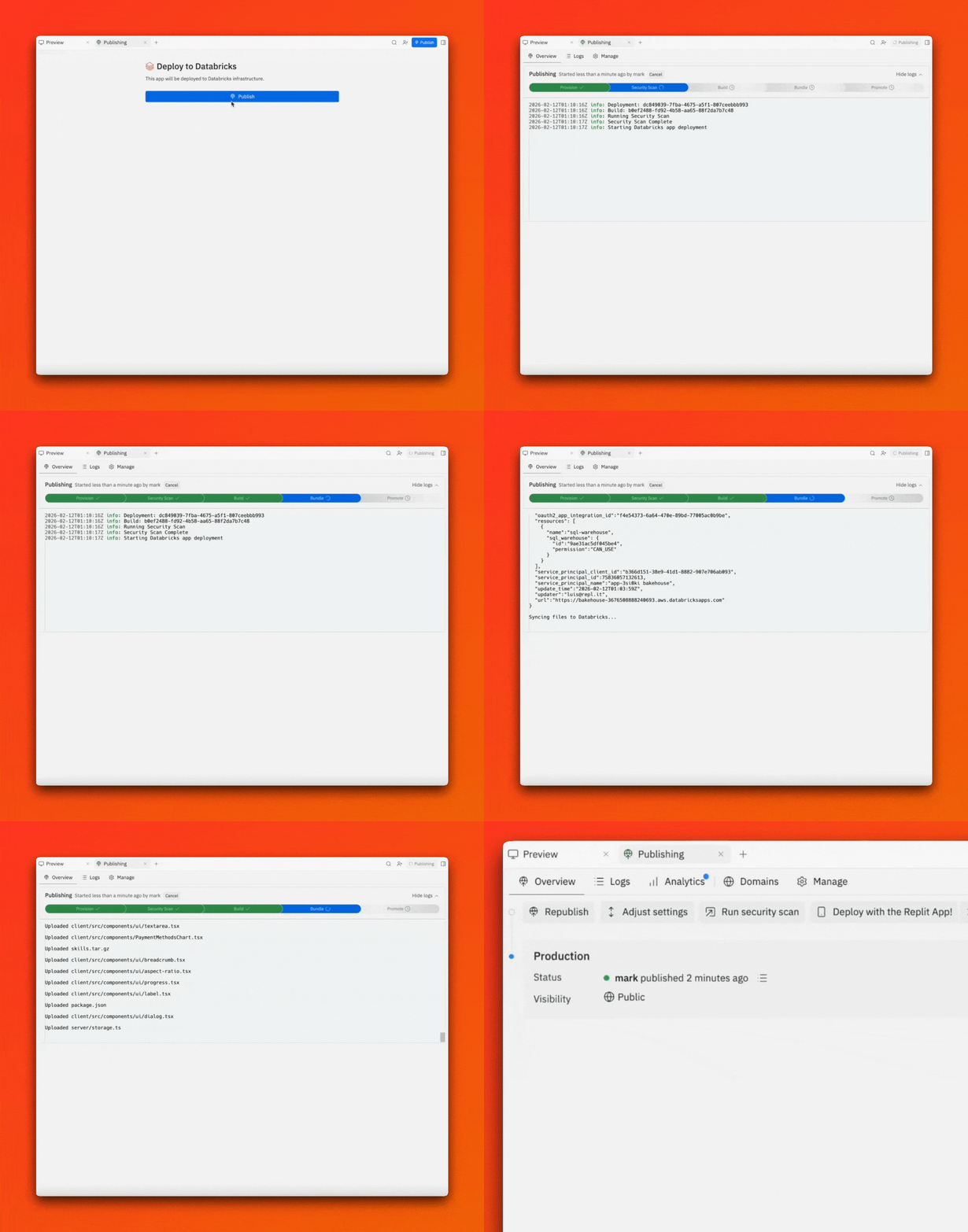
Together, this Databricks + Replit integration bridges the gap between rapid vibe coding and the rigorous backend requirements of the modern enterprise, allowing teams to build sophisticated, production-grade applications leveraging governed data in record speed.
We’re showcasing the power of AppKit and our Replit integration at AI Dev World (part of DevWeek) in San Jose, CA. Stop by the Databricks booth from February 19–20, 2026, at the San Jose Convention Center to see live demos and chat with our team.
Ready to start building? Check out the Replit x Databricks partner page to join the waitlist and get early access to the Replit integration. If you’re not using Databricks yet, you can sign up for Databricks Free edition to create your first Databricks App.
Get the latest posts in your inbox
Subscribe to our blog and get the latest posts delivered to your inbox.