What is AIOps?
AIOps combines AI and machine learning with observability to automate IT operations. Explore its core components, benefits, use cases, and challenges.
- AIOps (Artificial Intelligence for IT Operations) applies AI, machine learning, and operational data to detect anomalies, correlate events, identify root causes, and automate incident response.
- It helps IT and platform engineering teams reduce downtime risk, cut alert fatigue, accelerate decision speed, and lower mean time to resolution (MTTR).
- AIOps complements observability and DevOps practices by converting raw system signals into actionable operational intelligence while retaining human-in-the-loop oversight for higher-risk actions.
Artificial Intelligence for IT Operations (AIOps) applies AI and machine learning to IT operations to detect anomalies, correlate events, identify root causes, and trigger responses faster than any manual process can.
Gartner coined the term in 2017. So why are you reading about it now?
Because the infrastructure running your applications in 2026 looks nothing like what traditional monitoring was built for. You are managing hundreds of microservices, multi-cloud dependencies, AI workloads, and agent-driven systems that generate more operational signals in an hour than an on-call engineer can read in a week.
That gap is what AIOps is now positioned to close. This guide explains how it works, where it fits, and what to evaluate before choosing a platform.
- AIOps applies AI and machine learning to IT operations to detect anomalies, correlate events, identify likely root causes, and enable faster incident response.
- AIOps helps teams reduce downtime risk, cut alert fatigue, improve decision speed, and accelerate incident response by turning operational data into actionable insights.
- AIOps complements observability and DevOps rather than replacing them, augmenting AI and platform engineers with operational intelligence while keeping human oversight for higher-risk actions.
What AIOps does and does not do
AIOps analyzes data from logs, traces, events, and network topology to detect issues and predict failures before they surface as incidents.
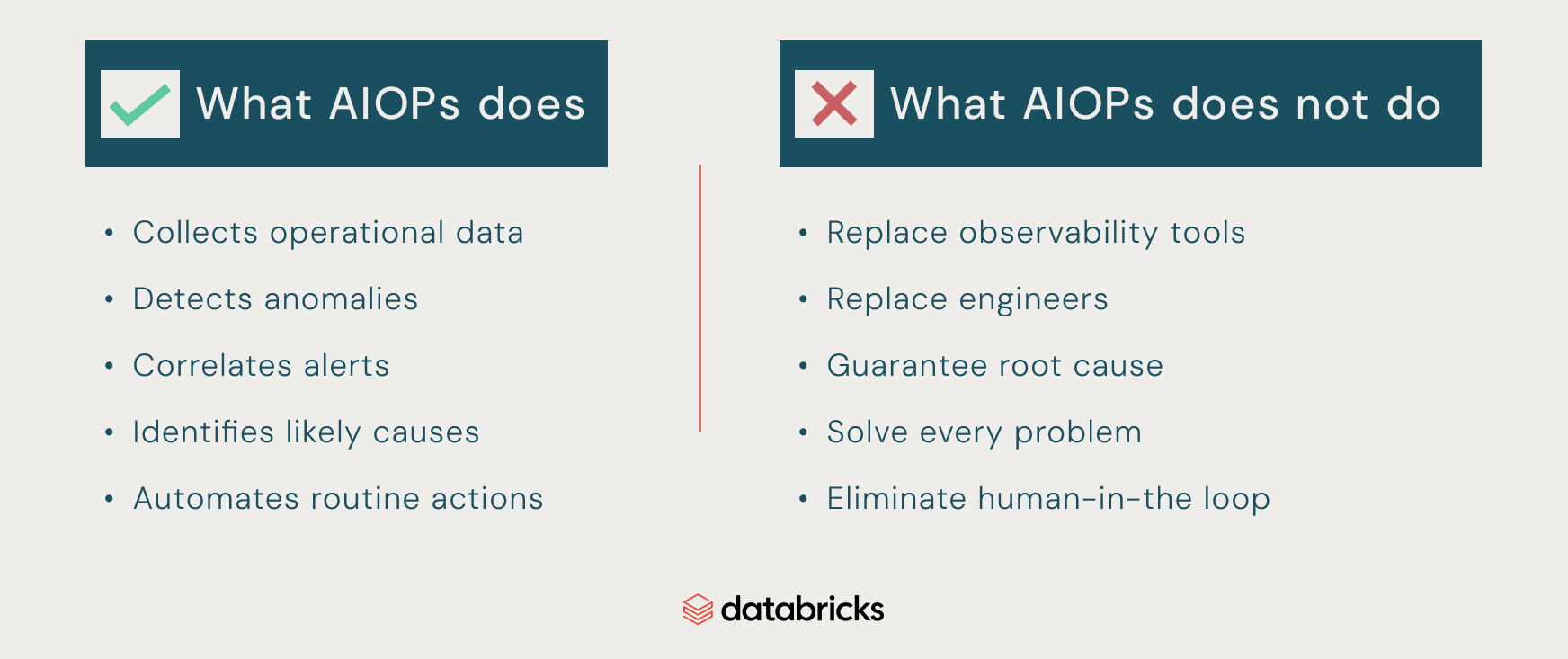
It sits between observability and action. Observability tells what is happening across systems. AIOps takes that signal, reduces the noise, connects related events, and helps platform engineers decide what to do next. It does not replace observability, DevOps, or human judgment. It makes all three faster.
Why now?
As infrastructure becomes more distributed, the volume of operational data, the complexity of dependencies, and the speed of change all increase. Traditional monitoring tools don't meet the growing demands and often generate excessive noise, lacking clear context to prioritize threats. As a result, data teams struggle to identify the signals that matter before incidents affect users.
When teams leverage AI and machine learning in IT operations, they optimize to:
- Reduce downtime risk: AIOps can detect anomalies and correlate related events to identify potential failures earlier, helping resolve issues before they disrupt major services and cause downtime.
- Cut alert fatigue: Machine learning can filter out repetitive or low-value alerts and surface events more likely to require human attention.
- Improve decision speed: By adding context to operational events and identifying likely root causes, AIOps helps engineers determine what is happening and what to investigate next.
- Accelerate incident response: When the appropriate remediation is known, AIOps can recommend or automate actions such as restarting services, scaling resources, or triggering predefined workflows.
These factors specifically lean towards earlier threat detection and faster recovery. They are not meant to conclude that AIOps solves all automation bottlenecks or removes the need for engineers.
What are the core components of AIOps?
While evaluating an AIOps platform, it's important to understand the main building blocks and how they work in their domains:
- Data ingestion: Here, AIOps platforms collect and consolidate data from metrics, logs, traces, events, and alerts from infrastructure, applications, and network devices into a data lake, data warehouse, or lakehouse. Broad and reliable data ingestion gives AIOps the visibility it needs to detect issues across IT environments.
- Data normalization and enrichment: After AIOps collects data from various sources, analytics processes the raw data to highlight trends, predict environments' capacity needs, and detect unusual system behavior before it causes disruptions. This gives downstream analytics a consistent view of what is happening and where it matters.
- Anomaly detection. To detect unusual activity in systems, traditional methods rely on static thresholds, CPU limits, and similar measures to trigger alerts. No context whatsoever. AIOps learns what normal behavior looks like for each metric, by hour, day, and season. Then, it only alerts when that behavior deviates from the baseline. This gives AI engineers more time to investigate potential problems before they affect users.
- Event correlation. When 10 different servers show high CPU usage, AIOps connects the related alerts rather than treating each alert as an isolated incident. This reduces alert fatigue and helps focus on the underlying issue rather than hundreds of individual events.
- Root cause analysis. The old method, where 70 alerts go off and you follow each one, is unsustainable. AIOps understands system topology, examines dependent services during alerts, and surfaces the root cause of the problem. From the alerts, AIOps determines that service C is degraded, while services A and B are only downstream. This accelerates troubleshooting, minimizes business downtime, and saves time by avoiding per-incident investigation.
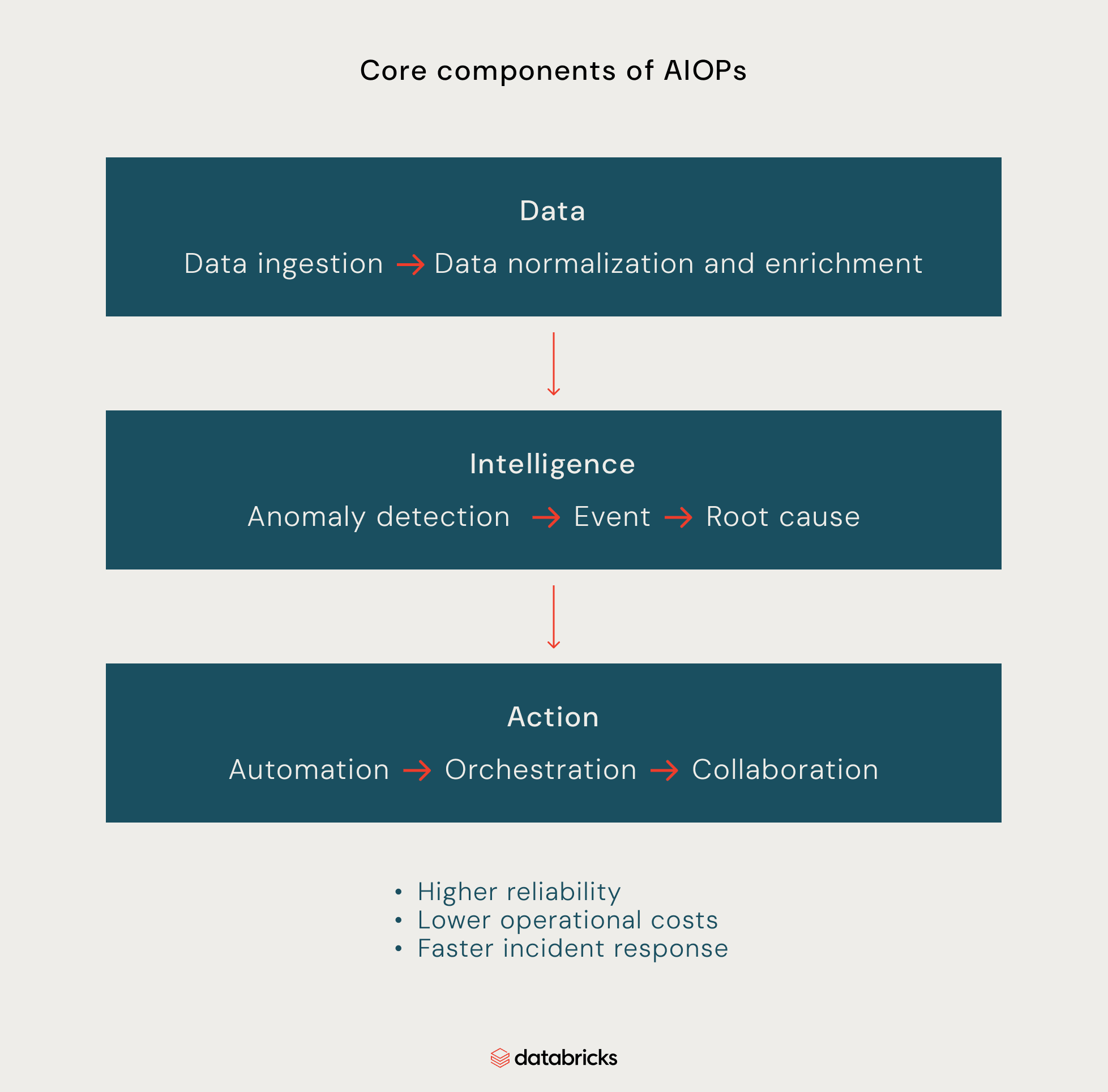
- Automation and orchestration. Once a root cause is identified, AIOps turns these insights into action by recommending or executing predefined responses, such as restarting a service, scaling infrastructure, rolling back a deployment, or opening a ticket. This component reduces manual intervention, accelerates incident resolution, and helps control operational costs. For more advanced operational workflows, Agent Bricks can help teams build and deploy AI agents that use enterprise data and tools to perform multi-step tasks.
- Collaboration workflows. Connects AIOps insights to the people and processes responsible for resolving incidents. This can include routing alerts, assigning ownership, escalating incidents, and providing engineers with the context they need to respond.
With these core components, let's see how they come together in the following section.
How does AIOps work?
The AIOps process starts with collecting signals from applications, infrastructure, networks, and cloud services. The data then undergoes cleanup, in which duplicate, incomplete, or inconsistent signals are organized into a format that AIOps can analyze.
For instance, your system detects that your application suddenly starts returning a high number of Application Programming Interface (API) errors. AIOps compares your application's current behavior with previous patterns and flags an increase in errors as unusual.
With event correlation, the AIOps platform connects the API errors to other signals, such as a sudden increase in database load or a recent deployment. Likely-cause analysis then examines these connected signals to determine probable causes. Instead of treating the API errors, database load, and deployment as separate events, AIOps identifies the recent deployment as the likely source of the incident.
The final stage is guided or automated response. Depending on the workflow, AIOps can recommend a remediation action, open a ticket, notify the appropriate team, or automatically execute a predefined response such as rolling back the deployment.
Higher-risk actions should require human-in-the-loop to allow engineers to review and approve the response before it affects production.
What are the main types of AIOps?
The types of AIOps depend on what best fits the organization, the scope of its operations, the systems to manage, and the level of interconnection in infrastructure.
Domain-centric and domain-agnostic approaches are the two main types of AIOps. Neither is a direct substitute for the other; they have their strengths and trade-offs:
Domain-centric AIOps focuses on a specific area, such as cloud management, network performance, or application monitoring. A domain-centric approach is a go-to for troubleshooting issues with a specific domain; it provides deeper context and more specialized analysis within that environment.
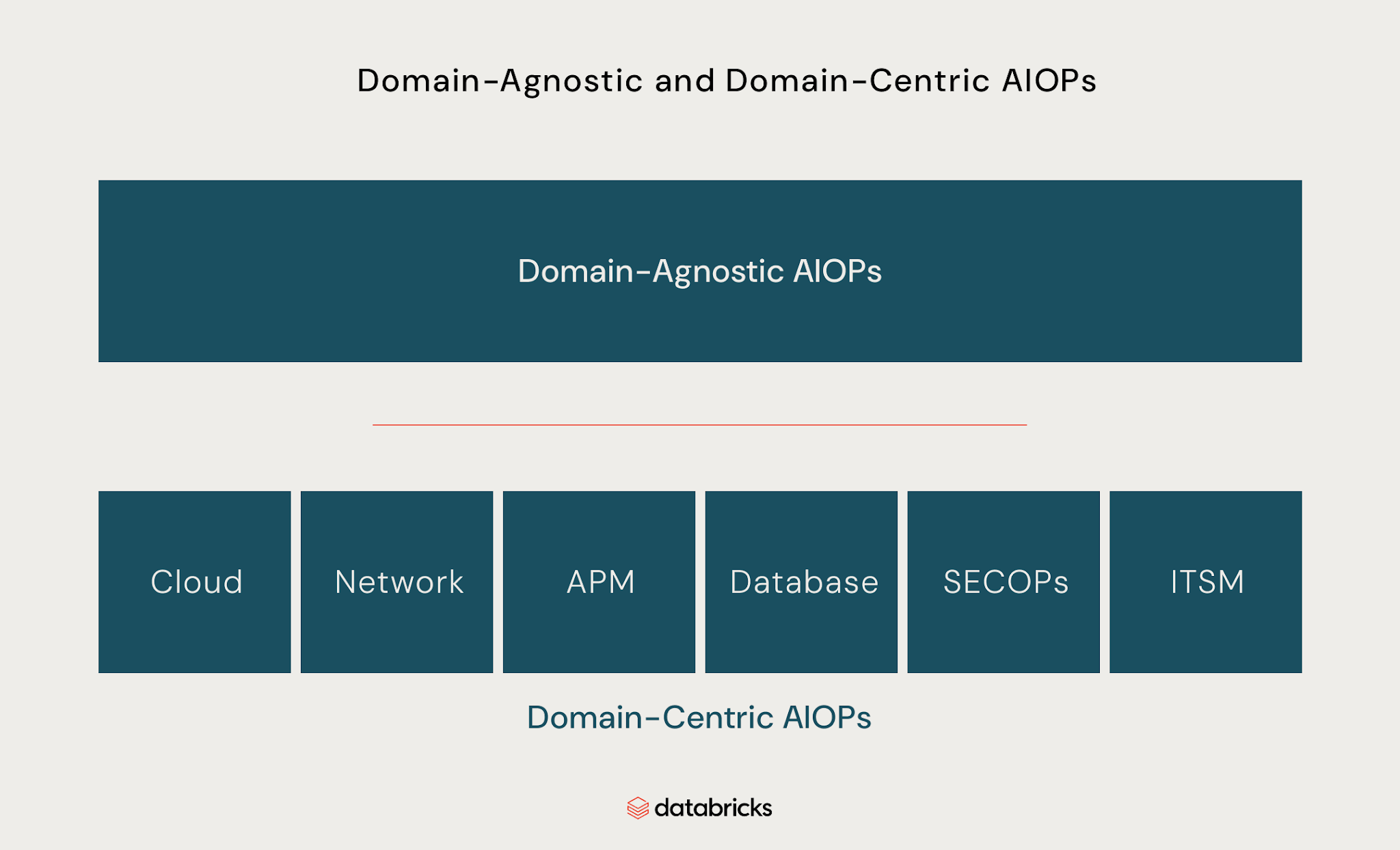
Domain-agnostic AIOps operates across multiple IT environments, collecting and analyzing data from systems such as applications, networks, cloud infrastructure, and storage. In contrast to the domain-centric approach, domain-agnostic AIOps platforms are best suited to solving broader issues. This makes it more suitable for organizations managing complex, interconnected infrastructure where incidents often cross operational boundaries.
Domain-centric AIOps can provide greater depth and more specialized intelligence within a single domain, while domain-agnostic AIOps provides greater breadth and broader visibility across systems and tools.
Common AIOps use cases
AIOps use cases span many areas of IT operations; some of the most common applications include:
Root cause analysis
AIOps helps pinpoint the likely cause of an outage, error, or performance issue. Instead of treating a spike in API errors as an isolated incident, AIOps can correlate it with a recent deployment, a database failure, or a network configuration change.
Anomaly detection
AIOps continuously scans system data to establish a baseline and detect deviations that might lead to incidents and failures.
Performance monitoring
AIOps can monitor IT environments across cloud, on-premises, and hybrid environments with interconnected services and dependencies. This helps to identify trends and prioritize issues through constant monitoring and performance correlation.
Cloud adoption and migration
Cloud migrations introduce new dependencies across workloads, APIs, services, and infrastructure. AIOps maps these relationships, monitors changes in system behavior, and identifies potential bottlenecks before they disrupt critical services. AIOps provides clearer visibility into hybrid and multicloud environments during migration.
DevOps adoption
DevOps increases the speed of development and deployment, but also introduces operational risks and issues that can go undetected by humans. AIOps monitors deployment activity, analyzes its impact on production, and can trigger predefined responses when issues occur.
AIOps and DevOps address different parts of the software delivery and operations lifecycle and are more effective when integrated.
The agentic AI playbook for the enterprise

AIOps vs. DevOps: what's the difference?
It's not a conversation of AIOps or DevOps, but AIOps and DevOps. The two approaches complement each other rather than compete. DevOps provides the operating model for building, testing, and deploying software, while AIOps applies operational intelligence to the systems that run it.
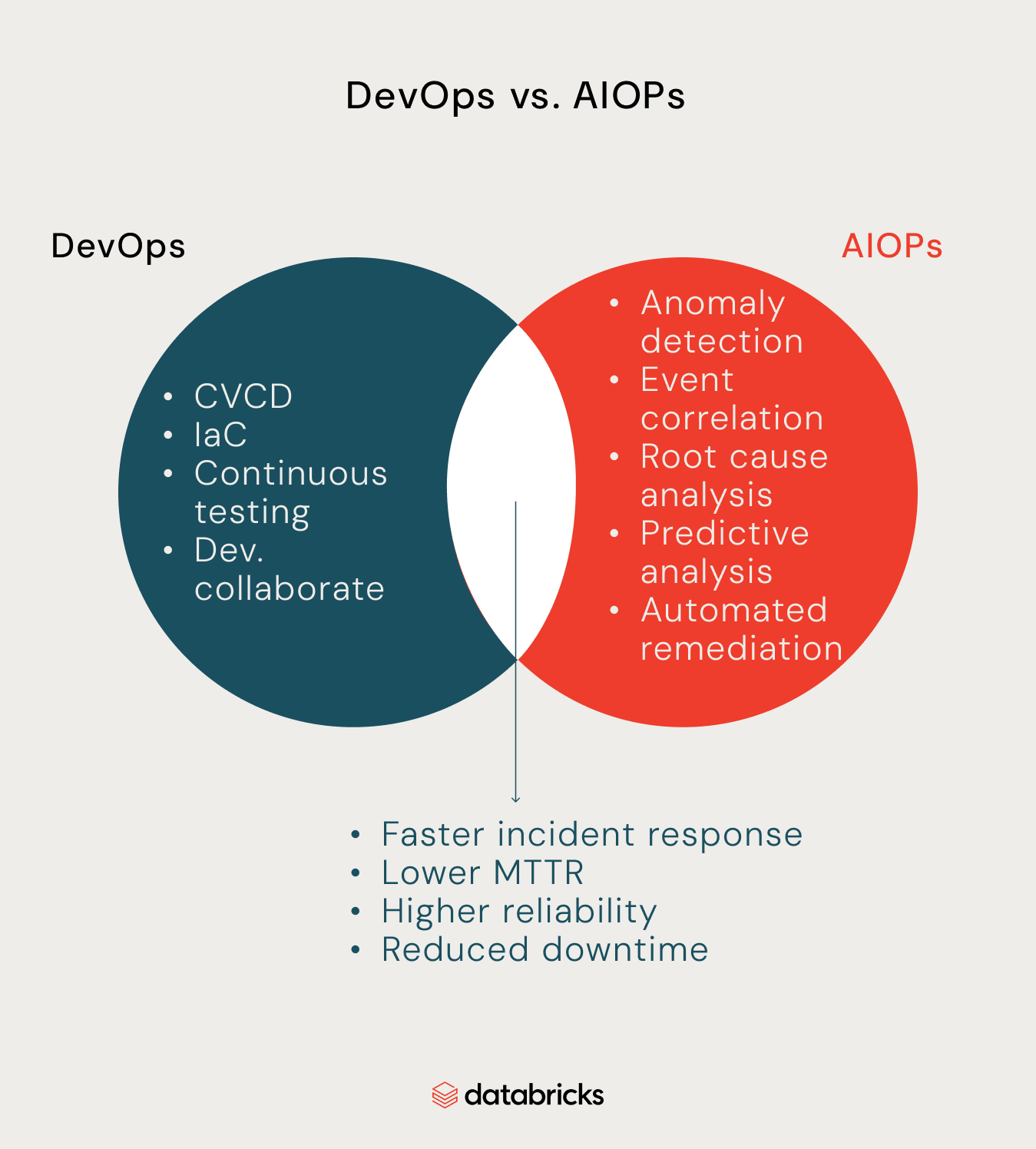
DevOps links development and operations by automating software delivery while enabling developers to release changes faster. AIOps extends that operational model by analyzing data from infrastructure, applications, and other systems to detect anomalies, correlate events, identify likely causes, and support faster remediation.
| DevOps | AIOps | |
|---|---|---|
| Primary focus | Software delivery and collaboration | IT operations and operational intelligence |
| Role | Operating model and engineering practices | AI-driven analysis and automation |
| What it analyzes | Code, builds, tests, deployments | Metrics, logs, traces, events, and alerts |
| Key outcomes | Faster and more reliable releases | Faster detection, response, and recovery |
| How they work together | Delivers changes into production | Monitors and responds to their operational impact |
DevOps can deploy a new application version while AIOps monitors its impact on production. If the deployment exhibits unusual behavior, AIOps can correlate signals, identify the likely cause, and either trigger a predefined response or alert the appropriate engineer. In tandem, they help to move faster with clear visibility.
What are the benefits of AIOps?
The primary benefits of AIOps are faster MTTR, lower operational costs, better observability and collaboration, and more predictive ITOps management. Each benefit connects directly to how platform engineers detect, understand, and resolve incidents.
- Faster MTTR: AIOps can correlate events, identify likely root causes, and recommend next actions faster than manual investigation. This reduces the time engineers spend tracing incidents and helps restore affected services sooner.
- Lower operational costs: AIOps automates repetitive detection, investigation, and remediation tasks, reducing the manual effort required to manage growing IT environments. It can also help prevent costly downtime by identifying issues before they escalate.
- Better observability and collaboration: AIOps brings signals from infrastructure, applications, and other operational systems into a shared view of system health. This gives development, security, and IT operations teams better context when investigating incidents and coordinating responses.
- Predictive ITOps management: AIOps uses historical and real-time operational data to identify patterns that may indicate future failures or capacity issues. Data teams can prioritize these risks and take action before they become major incidents.
These outcomes depend on the quality of the signals the AIOps platform receives, clear ownership of operational processes, and integration with existing workflows. Without these in place, AIOps can add more noise and automation without improving incident response.
Despite these reasons for integrating AIOps into organizations, there are still some constraints to consider.
What are the limitations of AIOps?
AIOps falls short in several respects; its effectiveness depends on the quality of the data, the context available to its models, and how AI engineers integrate its recommendations into existing workflows.
- Data quality gaps: Incomplete, inconsistent, or noisy data from logs, metrics, traces, events, and other sources can produce inaccurate correlations, missed anomalies, or unnecessary alerts.
- Missing context: Operational signals, without prior information about dependencies, recent deployments, configurations, or business impact, can lead AIOps to identify an anomaly without correctly understanding its cause or severity.
- Model drift: Models trained on historical patterns can become less accurate as systems, workloads, and operational baselines change, requiring continuous monitoring and adjustment.
- Over-automation risk: Teams can't fully automate a complex remediation step without appropriate safeguards in place. Doing so can turn a small incident into a larger one. Higher-risk actions should retain human oversight.
- Tool sprawl: Adding another AIOps platform to a fragmented monitoring and observability stack can create more complexity.
- Weak trust or adoption: Engineers are less likely to rely on recommendations they cannot understand or verify. Data teams need clear ownership, explainable recommendations, and measurable outcomes before expanding AIOps across critical operations.
Data teams and AI engineers need to know about these limitations because they set expectations and help them prepare more effectively for their governance and risk management strategies.
Unity Catalog provides these governance strategies and access to data and AI assets in a single catalog, helping teams control access to sensitive and regulated data.
How can organizations implement AIOps?
For organizations to implement AIOps in their IT operations, it is important to note that it is a gradual process rather than a big-bang transformation. This means focusing on sequencing by introducing it in stages, validating its value, and expanding to build confidence in the system.
Start with a high-impact operational problem where AIOps can deliver measurable benefits, such as reducing alert fatigue or improving incident response.
Unify the relevant operational signals, add context about dependencies and system behavior, and begin with recommendations before allowing AIOps to automate higher-risk actions. Teams building agentic operational workflows on Databricks can use Agent Bricks to build and deploy agents, MLflow for tracing and evaluation, Unity Catalog for governed access, and Unity Gateway for model and tool traffic controls..
Teams start to trust the recommendations, operationalize the workflows, and define metrics such as MTTR, alert volume, and incident frequency to measure the impact. From there, organizations can expand AIOps across additional systems while managing changes to existing tools, processes, and ownership.
See how Mosaic AI helps organizations manage and govern AI across their operations.
What are the different approaches to AIOps?
To determine whether a domain-centric or domain-agnostic AIOps approach is better for your organization's infrastructure and processes, consider coverage, depth, integrations, setup effort, and fit.
- Coverage: Do you need AIOps for one operational domain or across multiple teams, systems, and environments?
- Depth: Does your team need specialized intelligence for a specific domain, or broader analysis across interconnected systems?
- Integrations: Can the approach connect with your existing monitoring, observability, cloud, and IT operations tools?
- Setup effort: How much time and operational effort will it take to deploy, configure, and maintain?
- Organizational fit: Does it align with your team's skills, existing workflows, ownership model, and operational goals?
Carefully reviewing and answering these questions gives teams a better decision model on what approach to take. The right choice is the one that fits your operational requirements.
What to do next
AIOps applies AI and machine learning to operational data to detect issues earlier, understand their impact, and respond faster. It works best as an intelligence layer that augments engineers and existing observability and IT operations processes, rather than replacing them.
Start by identifying where AIOps can provide the most value, whether anomaly detection, root cause analysis, incident response, or performance monitoring. Then evaluate the available data and integrations, introduce recommendations before implementing higher-risk automation, and measure the impact on key metrics such as alert volume and operational costs.
For building and managing agentic and Large Language Model (LLM )applications, explore MLflow to see how it can support your application lifecycle and operational workflows.
Frequently asked questions
What does AIOps stand for?
AIOps stands for Artificial Intelligence for IT Operations. It uses AI, machine learning, and operational data to detect, investigate, and respond to IT issues.
What data does AIOps use?
AIOps can analyze operational data, including logs, metrics, traces, events, alerts, configuration data, and other signals from IT systems.
How is AIOps different from observability?
Observability collects and understands what is happening across systems. AIOps builds on these operational signals by applying AI and machine learning to correlate events, detect anomalies, identify likely causes, and support or automate responses.
How is AIOps different from MLOps?
AIOps applies AI and machine learning to IT operations, while MLOps focuses on developing, deploying, monitoring, and managing machine learning models and their lifecycle. They solve different operational problems, though they can overlap in organizations operating ML systems at scale.
Is AIOps a tool or a practice?
AIOps is both a practice and a category of tools. The practice involves applying AI and machine learning to IT operations, while AIOps platforms provide the data processing, analysis, correlation, and automation capabilities needed to support that practice.
Get the latest posts in your inbox
Subscribe to our blog and get the latest posts delivered to your inbox.