What is Retrieval Augmented Generation (RAG)?
Technique enhancing LLM responses by retrieving relevant info from external knowledge bases before generation, grounding outputs in facts
- Retrieval augmented generation is an AI pattern that improves large language model answers by first retrieving relevant documents from external data sources and then feeding that context into the model.
- RAG helps reduce hallucinations, keep responses up to date and tailor outputs to an organization's own content without retraining the underlying model.
- Common RAG use cases include customer support chatbots, internal knowledge search and augmented search experiences that answer questions directly from company documents.
What is retrieval augmented generation, or RAG?
Retrieval augmented generation (RAG) is a hybrid AI framework that bolsters large language models (LLMs) by combining them with external, up-to-date data sources. Instead of relying solely on static training data, RAG retrieves relevant documents at query time and feeds them into the model as context. By incorporating new and context-aware data, AI can generate more accurate, current and domain-specific responses.
RAG is quickly becoming the go-to architecture for building enterprise-grade AI applications. According to recent surveys, over 60% of organizations are developing AI-powered retrieval tools to improve reliability, reduce hallucinations and personalize outputs using internal data.
As generative AI expands into business functions like customer service, internal knowledge management and compliance, RAG’s ability to bridge the gap between general AI and specific organizational knowledge makes it an essential foundation for trustworthy, real-world deployments.
How RAG works
RAG enhances a language model’s output by injecting it with context-aware and real-time information retrieved from an external data source. When a user submits a query, the system first engages the retrieval model, which uses a vector database to identify and “retrieve” semantically similar documents, databases or other sources for relevant information. Once identified, it then combines those results with the original input prompt and sends it to a generative AI model, which synthesizes the new information into its own model.
This allows the LLM to produce more accurate, context-aware answers grounded in enterprise-specific or up-to-date data, rather than simply relying upon the model it was trained on.
RAG pipelines typically involve four steps: document preparation and chunking, vector indexing, retrieval and prompt augmentation. This process flow helps developers update data sources without retraining the model and makes RAG a scalable and cost-effective solution for building LLM applications in domains like customer support, knowledge bases and internal search.
What challenges does the retrieval augmented generation approach solve?
Problem 1: LLM models do not know your data
LLMs use deep learning models and train on massive datasets to understand, summarize and generate novel content. Most LLMs are trained on a wide range of public data so one model can respond to many types of tasks or questions. Once trained, many LLMs do not have the ability to access data beyond their training data cutoff point. This makes LLMs static and may cause them to respond incorrectly, give out-of-date answers or hallucinate when asked questions about data they have not been trained on.
Problem 2: AI applications must leverage custom data to be effective
For LLMs to give relevant and specific responses, organizations need the model to understand their domain and provide answers from their data vs. giving broad and generalized responses. For example, organizations build customer support bots with LLMs, and those solutions must give company-specific answers to customer questions. Others are building internal Q&A bots that should answer employees' questions on internal HR data. How do companies build such solutions without retraining those models?
Solution: Retrieval augmentation is now an industry standard
An easy and popular way to use your own data is to provide it as part of the prompt with which you query the LLM model. This is called retrieval augmented generation (RAG), as you would retrieve the relevant data and use it as augmented context for the LLM. Instead of relying solely on knowledge derived from the training data, a RAG workflow pulls relevant information and connects static LLMs with real-time data retrieval.
With RAG architecture, organizations can deploy any LLM model and augment it to return relevant results for their organization by giving it a small amount of their data without the costs and time of fine-tuning or pretraining the model.
What are the use cases for RAG?
There are many different use cases for RAG. The most common ones are:
Question-and-answer chatbots: Incorporating LLMs with chatbots allows them to automatically derive more accurate answers from company documents and knowledge bases. Chatbots are used to automate customer support and website lead follow-up to answer questions and resolve issues quickly.
For instance, Experian, a multinational data broker and consumer credit reporting company, wanted to build a chatbot to serve internal and customer-facing needs. They quickly realized that their current chatbot technologies struggled to scale to meet demand. By building their GenAI chatbot — Latte — on the Databricks Data + AI Platform, Experian was able to improve prompt handling and model accuracy, which gave their teams greater flexibility to experiment with different prompts, refine outputs and adapt quickly to evolutions in GenAI technology.
- Search augmentation: Incorporating LLMs with search engines that augment search results with LLM-generated answers can better answer informational queries and make it easier for users to find the information they need to do their jobs.
Knowledge engine: Ask questions on your data (e.g., HR, compliance documents): Company data can be used as context for LLMs and allow employees to get answers to their questions easily, including HR questions related to benefits and policies and security and compliance questions.
One way this is being deployed is at Cycle & Carriage, a leading automotive group in Southeast Asia. They turned to Databricks to develop a RAG chatbot that improves productivity and customer engagement by tapping into their proprietary knowledge bases, such as technical manuals, customer support transcripts and business process documents. This made it easier for employees to search for information via natural language queries that deliver contextual, real-time answers.
What are the benefits of RAG?
The RAG approach has a number of key benefits, including:
- Providing up-to-date and accurate responses: RAG ensures that the response of an LLM is not based solely on static, stale training data. Rather, the model uses up-to-date external data sources to provide responses.
- Reducing inaccurate responses, or hallucinations: By grounding the LLM model's output on relevant, external knowledge, RAG attempts to mitigate the risk of responding with incorrect or fabricated information (also known as hallucinations). Outputs can include citations of original sources, allowing human verification.
- Providing domain-specific, relevant responses: Using RAG, the LLM will be able to provide contextually relevant responses tailored to an organization's proprietary or domain-specific data.
- Being efficient and cost-effective: Compared to other approaches to customizing LLMs with domain-specific data, RAG is simple and cost-effective. Organizations can deploy RAG without needing to customize the model. This is especially beneficial when models need to be updated frequently with new data.
When should I use RAG and when should I fine-tune the model?
RAG is the right place to start, being easy and possibly entirely sufficient for some use cases. Fine-tuning is most appropriate in a different situation, when one wants the LLM's behavior to change, or to learn a different "language." These are not mutually exclusive. As a future step, it's possible to consider fine-tuning a model to better understand domain language and the desired output form — and also use RAG to improve the quality and relevance of the response.
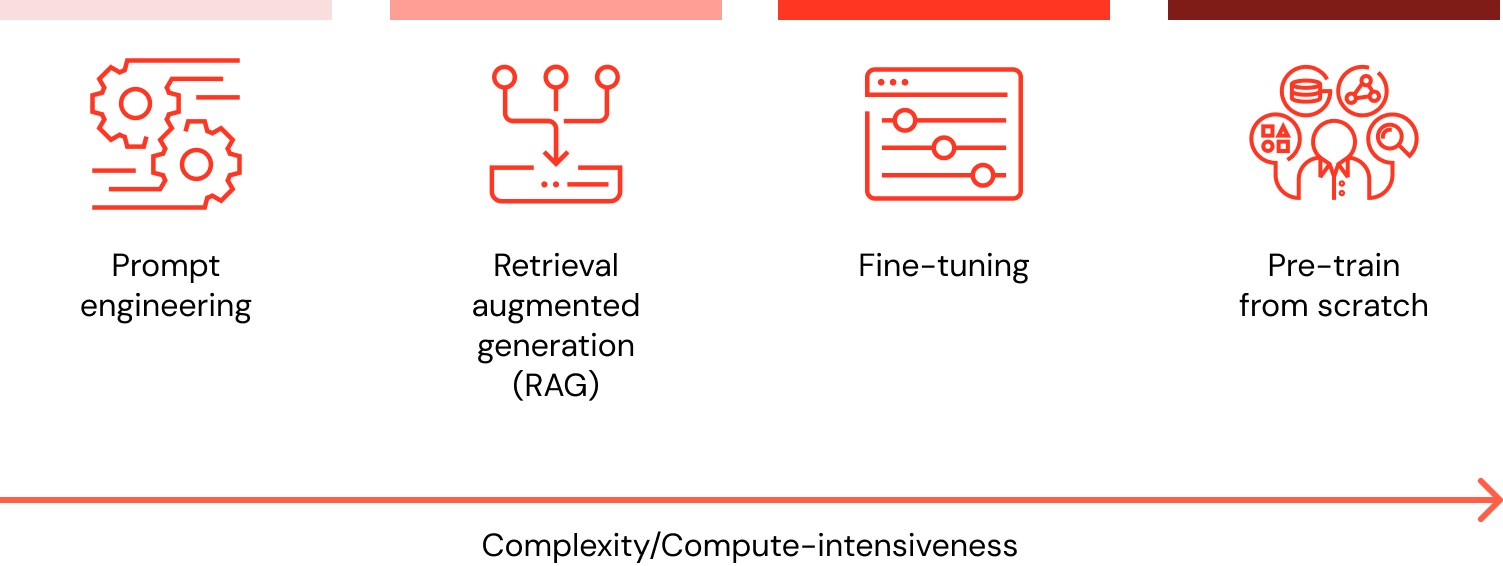
When I want to customize my LLM with data, what are all the options and which method is the best (prompt engineering vs. RAG vs. fine-tune vs. pretrain)?
There are four architectural patterns to consider when customizing an LLM application with your organization's data. These techniques are outlined below and are not mutually exclusive. Rather, they can (and should) be combined to take advantage of the strengths of each.
| Method | Definition | Primary use case | Data requirements | Advantages | Considerations |
|---|---|---|---|---|---|
Prompt engineering | Crafting specialized prompts to guide LLM behavior | Quick, on-the-fly model guidance | None | Fast, cost-effective, no training required | Less control than fine-tuning |
Retrieval augmented generation (RAG) | Combining an LLM with external knowledge retrieval | Dynamic datasets and external knowledge | External knowledge base or database (e.g., vector database) | Dynamically updated context, enhanced accuracy | Increases prompt length and inference computation |
Fine-tuning | Adapting a pretrained LLM to specific datasets or domains | Domain or task specialization | Thousands of domain-specific or instruction examples | Granular control, high specialization | Requires labeled data, computational cost |
Pretraining | Training an LLM from scratch | Unique tasks or domain-specific corporation | Large datasets (billions to trillions of tokens) | Maximum control, tailored for specific needs | Extremely resource-intensive |


Regardless of the technique selected, building a solution in a well-structured, modularized manner ensures organizations will be prepared to iterate and adapt. Learn more about this approach and more in The Big Book of MLOps.
Common challenges in RAG implementation
Implementing RAG at scale introduces several technical and operational challenges.
- Retrieval quality. Even the most powerful LLMs can generate poor answers if they retrieve irrelevant or low-quality documents. Therefore, it is crucial to develop an effective retrieval pipeline that includes careful selection of embedding models, similarity metrics and ranking strategies.
- Context window limitations. With the entirety of the world’s documentation at its fingertips, the risks can be injecting too much content into the model, leading to truncated sources or diluted responses. Chunking strategies should weight semantic coherence with token efficiency.
- Data freshness. The benefit of RAG is in its ability to cull up-to-date information. However, document indexes can quickly go stale without scheduled ingestion jobs or automated updates. By ensuring your data is fresh, you can avoid hallucinations or outdated answers.
- Latency. When dealing with large datasets or external APIs, latency can interfere with retrieval, ranking and generation.
- RAG evaluation. Because of RAG’s hybrid nature, traditional AI evaluation models fall short. Evaluating the accuracy of outputs requires a combination of human judgment, relevance scoring and groundedness checks to assess response quality.
What is a reference architecture for RAG applications?
There are many ways to implement a retrieval augmented generation system, depending on specific needs and data nuances. Below is one commonly adopted workflow to provide a foundational understanding of the process.
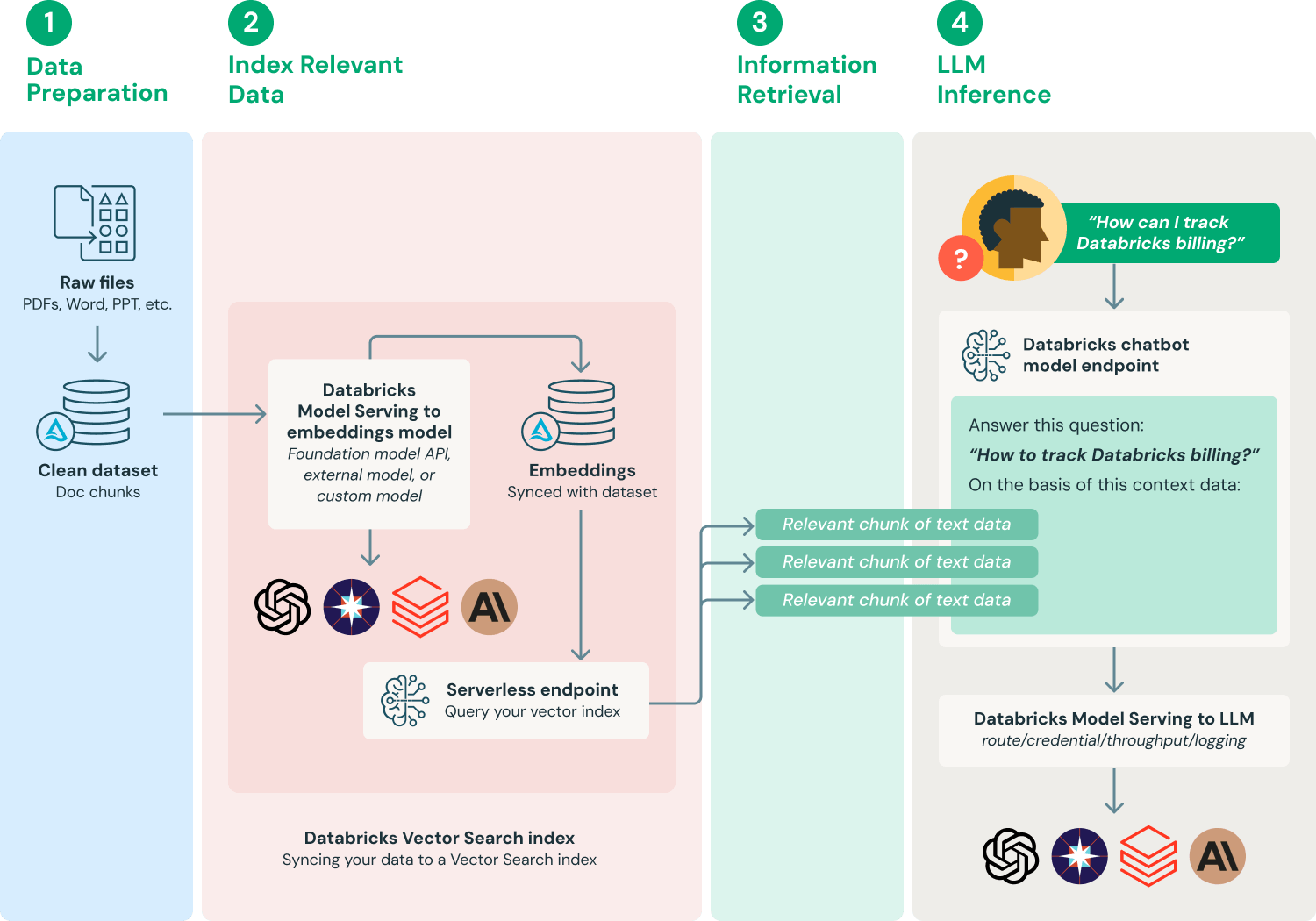
- Prepare data: Document data is gathered alongside metadata and subjected to initial preprocessing — for example, PII handling (detection, filtering, redaction, substitution). To be used in RAG applications, documents need to be chunked into appropriate lengths based on the choice of embedding model and the downstream LLM application that uses these documents as context.
- Index relevant data: Produce document embeddings and hydrate a AI Search index with this data.
- Retrieve relevant data: Retrieving parts of your data that are relevant to a user's query. That text data is then provided as part of the prompt that is used for the LLM.
- Build LLM applications: Wrap the components of prompt augmentation and query the LLM into an endpoint. This endpoint can then be exposed to applications such as Q&A chatbots via a simple REST API.
Databricks also recommends some key architectural elements of a RAG architecture:
- Vector database: Some (but not all) LLM applications use vector databases for fast similarity searches, most often to provide context or domain knowledge in LLM queries. To ensure that the deployed language model has access to up-to-date information, regular vector database updates can be scheduled as a job. Note that the logic to retrieve from the vector database and inject information into the LLM context can be packaged in the model artifact logged to MLflow using MLflow LangChain or PyFunc model flavors.
- MLflow LLM Deployments or Model Serving: In LLM-based applications where a third-party LLM API is used, the MLflow LLM Deployments or Model Serving support for external models can be used as a standardized interface to route request from vendors such as OpenAI and Anthropic. In addition to providing an enterprise-grade API gateway, the MLflow LLM Deployments or Model Serving centralizes API key management and provides the ability to enforce cost controls.
- Model Serving: In the case of RAG using a third-party API, one key architectural change is that the LLM pipeline will make external API calls, from the Model Serving endpoint to internal or third-party LLM APIs. It should be noted that this adds complexity, potential latency and another layer of credential management. By contrast, in the fine-tuned model example, the model and its model environment will be deployed.
Resources
- Databricks blog posts
- Databricks Demo
- Databricks eBook — The Big Book of MLOps
Databricks customers using RAG
JetBlue
JetBlue has deployed "BlueBot," a chatbot that uses open source generative AI models complemented by corporate data, powered by Databricks. This chatbot can be used by all teams at JetBlue to get access to data that is governed by role. For example, the finance team can see data from SAP and regulatory filings, but the operations team will only see maintenance information.
Also read this article.
Chevron Phillips
Chevron Phillips Chemical uses Databricks to support their generative AI initiatives, including document process automation.
Thrivent Financial
Thrivent Financial is looking at generative AI to make search better, produce better summarized and more accessible insights, and improve the productivity of engineering.
Where can I find more information about retrieval augmented generation?
There are many resources available to find more information on RAG, including:
Blogs
- Creating High-Quality RAG Applications With Databricks
- Databricks AI Search Public Preview
- Improve RAG Application Response Quality With Real-Time Structured Data
- Build Gen AI Apps Faster With New Foundation Model Capabilities
- Best Practices for LLM Evaluation of RAG Applications
- Using MLflow AI Gateway and Llama 2 to Build Generative AI Apps (Achieve greater accuracy using retrieval augmented generation (RAG) with your own data)
E-books
Demos
Contact Databricks to schedule a demo and talk to someone about your LLM and retrieval augmented generation (RAG) projects
The agentic AI playbook for the enterprise

How is RAG technology evolving?
RAG is rapidly evolving from a jerry-rigged workaround into a foundational component of enterprise AI architecture. As LLMs grow more capable, RAG’s role is shifting. It is moving from simply filling gaps in knowledge to systems that are structured, modular and more intelligent.
One way RAG is developing is through hybrid architectures, where RAG is combined with tools, structured databases and function-calling agents. In these systems, RAG provides unstructured grounding while structured data or APIs handle more precice tasks. These multimodal architectures give organizations more reliable end-to-end automation.
Another major development is retriever-generator co-training. This is a model where the RAG retriever and the generator are trained jointly to optimize each other’s answer quality. This may reduce the need for manual prompt engineering or fine-tuning and leads to things like adaptive learning, reduced hallucinations and better overall performance of retrievers and generators.
As LLM architectures mature, RAG will likely become more seamless and contextual. Moving past finite stores of memory and information, these new systems will be capable of handling real-time data flows, multi-document reasoning and persistent memory, making them knowledgeable and trustworthy assistants.
Frequently Asked Questions
What's the difference between RAG and prompt engineering?
Prompt engineering involves crafting specialized prompts to guide an LLM's behavior without any external data or training, making it a fast and cost-effective way to steer the model on the fly. RAG goes further by combining the LLM with an external knowledge retrieval step, pulling in dynamic datasets or documents so the model's context reflects current, organization-specific information. Because RAG retrieves and injects data automatically, it requires an external knowledge base, such as a vector database, and increases prompt length and inference computation compared with plain prompt engineering.
Does RAG reduce hallucinations in LLMs?
Yes, grounding an LLM's response in retrieved, up-to-date content reduces the likelihood of hallucinations. This is especially valuable in domains that require high accuracy, such as healthcare, legal work or enterprise support. RAG outputs can also include citations to the original sources, allowing for human verification of the information provided.
What kind of data does RAG need?
RAG typically works with unstructured text data — such as PDFs, emails and internal documents — stored in a retrievable format. This data is commonly held in a vector database, where it must be chunked, indexed and regularly updated to maintain relevance and avoid stale or incomplete retrieval. Preparing documents well, including chunking them based on the embedding model and downstream application, is a key first step in a RAG reference architecture.
How do you evaluate a RAG system?
RAG systems are evaluated using a combination of relevance scoring, groundedness checks, human evaluations and task-specific performance metrics. Because RAG combines retrieval and generation, traditional AI evaluation methods alone fall short of capturing both the quality of retrieved context and the accuracy of the final response. As retriever-generator co-training matures, some of this evaluation burden may ease, since retrievers and generators trained jointly learn from and refine one another.
Can RAG and fine-tuning be used together?
Yes, RAG and fine-tuning are not mutually exclusive and can be combined for better results. Fine-tuning can teach a model domain-specific language and a desired output format, while RAG supplies up-to-date, contextually relevant information at query time. Combining both approaches lets an organization first shape a model's behavior through fine-tuning and then ground its answers in retrieved data through RAG for improved quality and relevance.
Get the latest posts in your inbox
Subscribe to our blog and get the latest posts delivered to your inbox.