From Zero to Millions in Savings: Ströer Transforms Advertising Success with Databricks
by Simon Salmeri and Florian Maldoner
- Ströer unified fragmented campaign data on the Databricks Data + AI Platform, enabling standardized, real-time access to trusted insights across all business units.
- Integrated AI, no/low-code tools, and scalable analytics empowered 500+ users to diagnose issues faster, benchmark performance, and eliminate manual reporting—driving significant efficiency gains.
- The transformation delivered €3.5M in annual savings, 25% faster reporting, and higher campaign quality, giving Ströer a long-term competitive advantage in advertising performance and innovation.
Ströer, a leader in out-of-home and online advertising in Germany, reaches millions of daily users across public video, online and mobile. With multiple brands and business units, consistent, fast, and trusted data is mission-critical. By adopting the Databricks Data + AI Platform, Ströer has revolutionized campaign delivery performance and efficiency—turning fragmented data into a strategic advantage. This digital transformation journey highlights both the challenges of fragmented data in the advertising industry and the remarkable possibilities that a unified data platform unlocks.
Overcoming Data Fragmentation
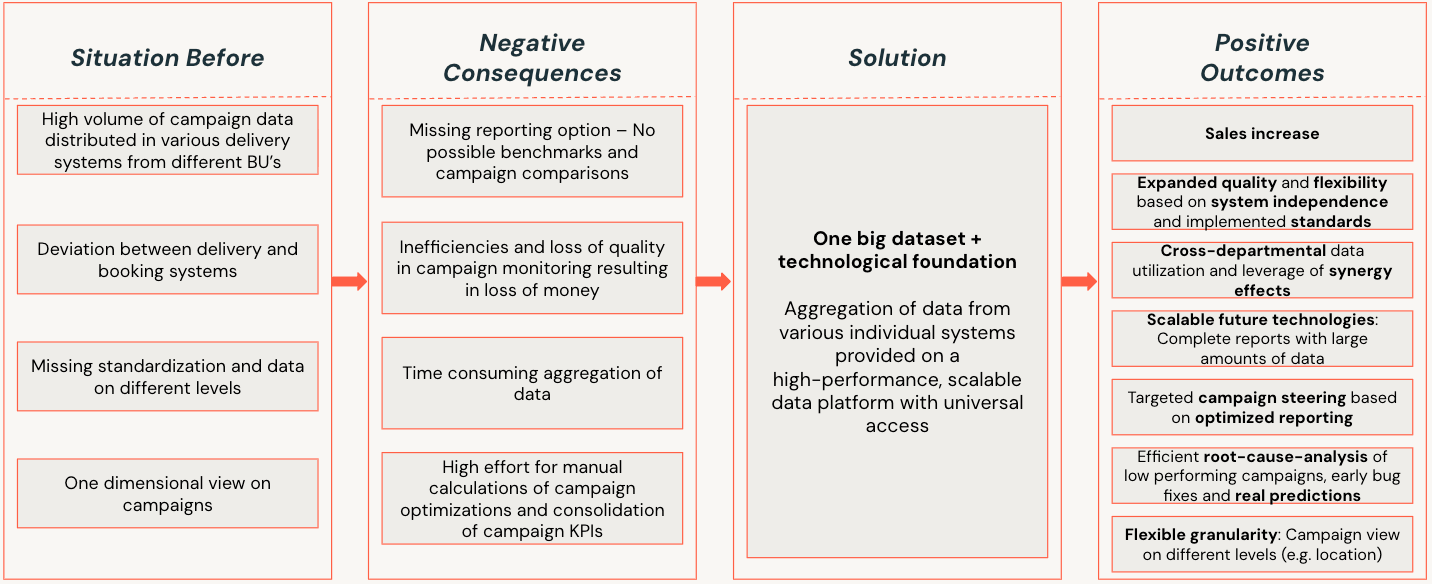
In the fast-paced world of digital advertising, success hinges on gaining rapid insights and delivering seamless campaigns. Ströer had been struggling with disparate campaign data, scattered across different systems. Data inconsistency, lack of standardized formats, and manual-heavy processes made it difficult to compare campaigns, generate performance reports, and optimize strategy. The absence of a central, standardized data foundation not only hindered operational flexibility but also limited the ability to drive sales growth and led to financial losses.
Campaign managers and analysts spent countless hours manually consolidating and monitoring key performance indicators (KPIs). This manual process contributed to delayed insights and missed opportunities for improving the value chain. Without streamlined access to complete and accurate data, Ströer’s teams couldn’t identify underperforming campaigns or act quickly on emerging trends.
Before adopting Databricks, Ströer relied on Amazon Redshift as its central data warehouse. As data volumes and query complexity grew, query latency increased, costs rose due to always-on clusters, and teams spent significant time on manual tuning. Because storage and compute were tightly coupled, scaling for new data or peak loads meant scaling the entire cluster. Ströer therefore decided to migrate both its ETL and BI reporting workloads from Redshift to Databricks SQL. The biggest value of this move was a modern, elastic warehouse with decoupled storage and compute, delivering faster and more predictable query performance at lower cost and with significantly less operational overhead. At the same time, it unified the user experience from previously separate systems onto Databricks, aligning technical and business users on the same page.
The Power of Databricks Data Intelligence
The partnership with Databricks marked a turning point. Ströer implemented a robust, high-performance data platform that aggregated information from multiple systems into a single, scalable foundation. Following data mesh principles, the new platform standardized how data was collected and accessed across the organization, promoting collaboration and supporting cross-departmental decision-making.
Features such as no/low-code access, with the help of integrated AI Assistants, real-time aggregation, and advanced reporting tools, enable campaign managers to dig deeper into the data than ever before. Before Databricks, the lack of unified analytics, high technical entry barriers, and lack of root-cause analysis all hindered campaign benchmarking. Now, data-driven insights empower even non-tech users at Ströer to identify gaps, fix issues rapidly, and make accurate performance predictions. With over 500 employees using this integrated dataset, a culture of data-driven innovation and collaboration has taken root throughout the company.
Real Impact: Sales, Savings, and Efficiency
Ströer reports an impressive €3.5 million in annual gross budget savings thanks to near real-time campaign optimization features. Thanks to Databricks’ integrated AI approach, teams have reduced the time required for report creation and data aggregation by 25%, freeing up the team to focus on strategic growth.
Productivity surged not only for the data and AI team but also for end users across Ströer.
Simon Salmeri, Head of Data Platform:
"Databricks turned our data platform from something people had to work around into something they actually enjoy using. That ease of use translates directly into higher productivity and faster decisions.”
The synergy effects of cross-departmental data sharing have elevated campaign quality and expanded operational flexibility. Campaigns can now be analyzed at various levels of granularity, such as location or business unit, making targeted steering possible and enabling faster, more accurate reporting—even as data volumes grow.
Empowering the Future of Advertising
Ströer’s experience with Databricks demonstrates the immense value of a modern data intelligence platform. By breaking down silos and introducing standardized, scalable technology, Ströer has gained a competitive edge: elevated campaign performance, higher efficiency, substantial cost savings, and enhanced customer satisfaction. These advances enable Ströer to unlock the full potential of its data for analytics and AI initiatives—laying the foundation for continued innovation in the years ahead.
Dominik Theil, Vice President Corp. Dev, Infrastructure & Data Platform:
"The real value of Databricks for us is combining simplification and FinOps excellence. One platform, an elastic SQL warehouse and shared governance mean we can scale our business without scaling complexity and infrastructure spend at the same rate.”
This transformation demonstrates that investing in a unified data platform not only addresses today’s data fragmentation challenges but also positions companies to capitalize on future opportunities in a rapidly evolving digital landscape.
Want to learn more about Databricks solutions for marketing and advertising? Get started today with the Data + AI Platform for Marketing.
Solutions, Data Warehousing, Media & Entertainment, Insights and Customers
Get the latest posts in your inbox
Subscribe to our blog and get the latest posts delivered to your inbox.