Office of the CFO Reference Architecture for Manufacturing & Energy
This architecture helps finance professionals manage material financial risk due to external factors (e.g. tariffs, commodity prices), predict economic trends, analyze supplier data to assess creditworthiness, and identify transaction and spend anomalies
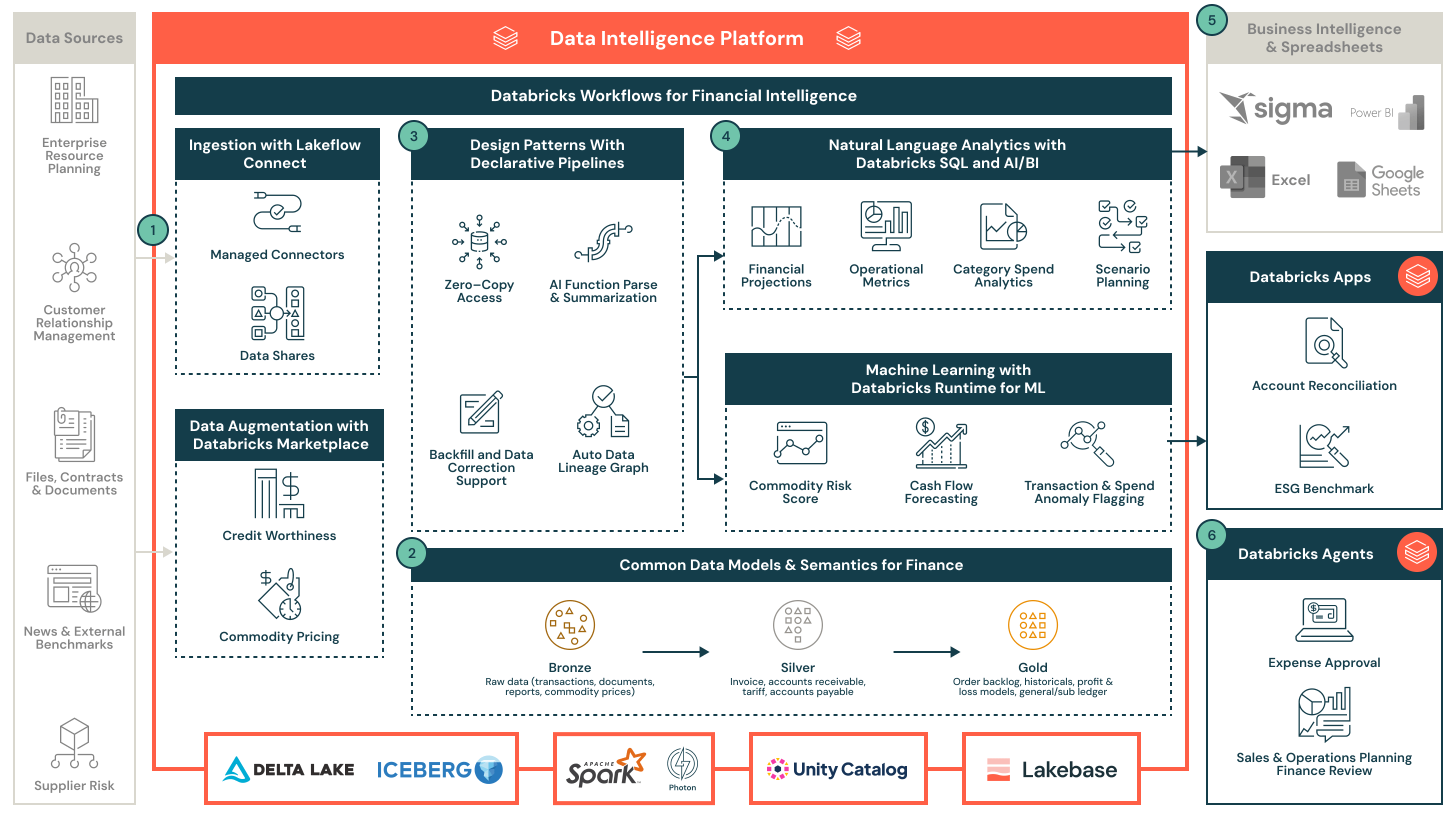
Data and platform flows
- Ingest data using managed connectors and data sharing for enterprise data systems like ERP (SAP), CRM (Salesforce), HR (Workday), document management (SharePoint) to unify purchase orders, contracts, supplier data, and news and external benchmarks.
- Your first party data can be easily supplemented with real-time commodity (S&P Global Energy), credit (Dun & Bradstreet, Moody’s), and benchmarks (S&P Global Market Intelligence) to augment historical models and gain a true understanding of financial risks.
- Data can be easily extracted from text-heavy documents using ai_parse_document and joined with transaction data and lakehouse native 3rd party data through a medallion architecture creating semantic models and ledgers for reporting and applications. All data is fully end-to-end governed providing a single source of truth for unified financial calculations throughout the enterprise.
- Analytics can be performed through natural language questioning with AI/BI Genie empowering every financial professional within your organization.
- Prevalent business intelligence software like Sigma, Microsoft Power BI, Microsoft Excel, and Google Sheets can be integrated with real-time data from the Databricks lakehouse.
- Agent Bricks enables AI agents to execute enterprise workflows for financial policies (expense approvals, S&OP) and simplify reporting for regulators (ESG, product passport) based on auditable and traceable AI agent reasoning, data access, and data lineage.
