Data Governance
A comprehensive guide to the processes, policies and tech that organizations use to manage and get the most from their data

What is data governance?
Data governance is a comprehensive approach that comprises the principles, practices and tools to manage an organization’s data assets throughout their lifecycle. By aligning data-related requirements with business strategy, data governance provides superior data management, quality, visibility, security and compliance capabilities across the organization. Implementing an effective data governance strategy allows companies to make data easily available for data-driven decision-making while safeguarding their data from unauthorized access, and ensuring compliance with regulatory requirements.
Here’s more to explore
What are the business benefits of data governance?
Data governance is essential for unlocking the value of data, which is a critical asset for organizations. By implementing a robust data governance approach, businesses can leverage their data assets, gain a competitive edge, and earn and maintain customer trust by ensuring sound data and privacy practices.
Increased operational efficiency and reduced costs
Effective data governance allows organizations to create a single source of truth for their data estate, preventing data sprawl and silos, and reducing duplication. This leads to increased efficiency, reduced costs and easier management of security and governance concepts across the data estate.
Improved productivity and faster decision-making
Data governance promotes data democratization by ensuring data accuracy, consistency, and trustworthiness. It helps data users find high-quality data quickly, promoting a better understanding of the data’s meaning and context, leading to increased productivity and faster decision-making.
Enhanced collaboration and value realization
A strong data governance program lays the foundation for enhanced data collaboration and sharing across teams, business units, and partners. This helps organizations promote knowledge sharing and build a better data culture, leading to increased innovation, better decision-making, and maximizing the value of their data.
Enhanced security and privacy
Data governance mitigates security and privacy risks by implementing controls and processes to prevent unauthorized access and misuse of sensitive data. It promotes a culture of trust and transparency with stakeholders.
Better compliance with regulations and standards
Effective data governance results in better compliance with regulatory requirements, such as HIPAA, FedRAMP, GDPR or CCPA. This protects the organization’s reputation, avoids potential financial and legal consequences, and increases stakeholder trust.
Key elements of data governance
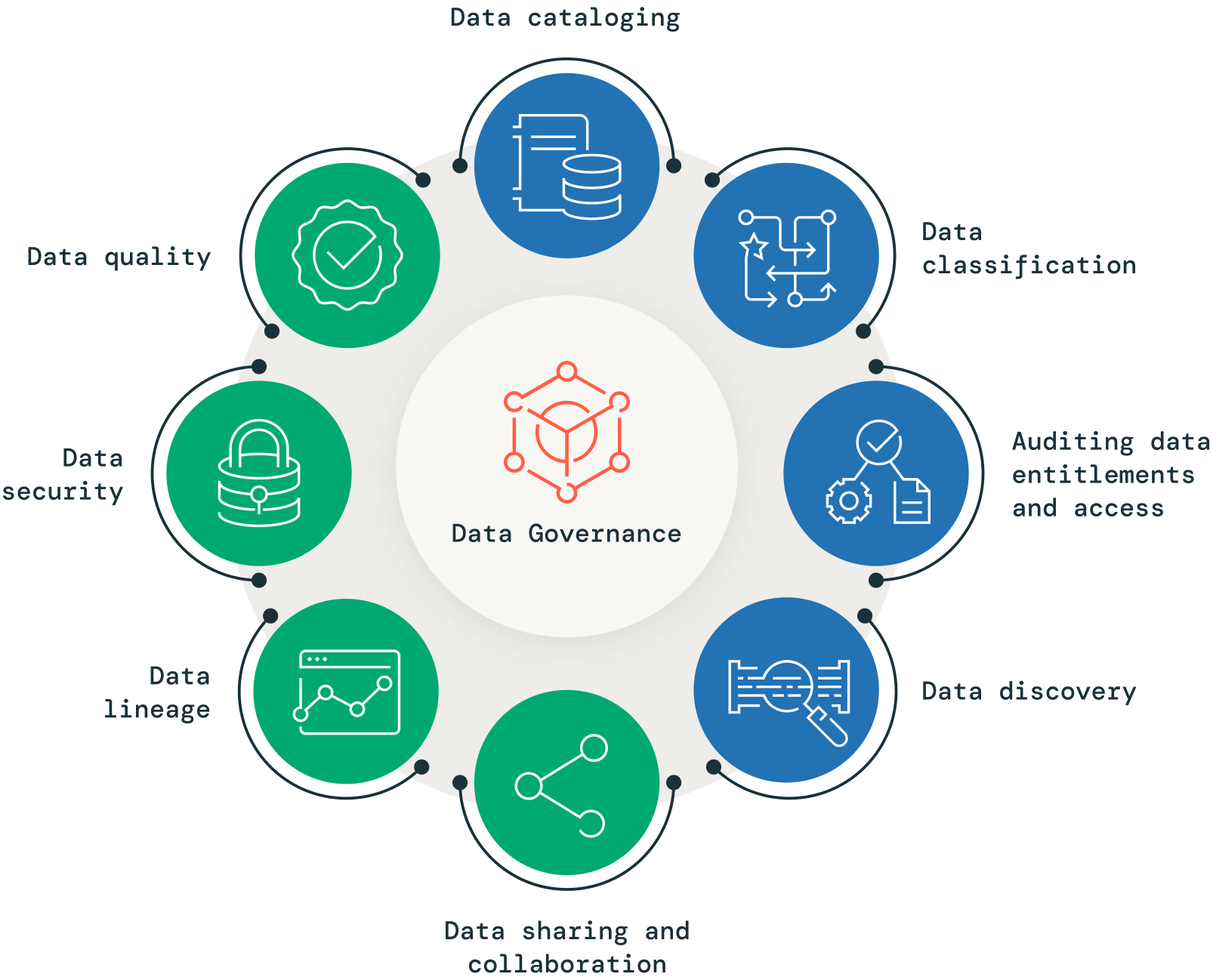
Data cataloging
Effective data governance requires knowledge of the data that exists within an organization. This is where a data catalog comes in, as it provides a centralized metadata repository for an organization’s data assets. A data catalog allows stakeholders to quickly discover, understand and access the data they need, improving data-related activities such as discovery, governance and analytics. It acts as a searchable index of all the data available, including information about its format, structure, location and usage, providing semantic value to an otherwise unidentifiable sea of information. Incorporating a data catalog into a governance program can help organizations improve their data management, enhance collaboration, reduce redundancy and ensure proper access controls and audit information retrieval.

Data quality
In today’s data-driven world, ensuring high data quality is crucial for accurate analytics, informed decision-making and cost-effectiveness. Data quality directly impacts the reliability of data-driven decisions and is a key aspect of data governance. To maintain effective data governance, organizations must prioritize the evaluation of key data quality attributes such as accuracy, completeness, freshness and compliance with data-quality rules. Therefore, a strong focus on data quality is essential in any data governance strategy, as it helps trace data lineage, enforce data quality rules, and track changes. Don’t let poor data quality compromise your business decisions and resource allocation — prioritize data quality as a critical part of your data governance efforts for better outcomes.

Data classification
Data classification is a crucial part of data governance that involves organizing and categorizing data based on its sensitivity, value and criticality. With the exponential growth of data, businesses are increasingly concerned about protecting sensitive data, mitigating risks and ensuring data quality. Classification allows organizations to identify and classify data based on its risk level and importance, allowing them to apply appropriate security measures and policies. A robust data classification system enhances data governance, reduces risks and ensures data quality and protection at scale.

Data security
Organizations understand the significance of granting high-quality data access to their teams to drive insights and business value, while prioritizing sensitive data protection against unauthorized access. Effective data access management is crucial for data security and governance, and a good data security governance program should include access controls that define which groups or individuals can access what data. These controls can be highly specific, down to the individual record or file. As data breaches and regulations such as GDPR and CCPA pose increased risks, businesses must establish clear governance policies that define who can access sensitive data sets and how to track any misuse. Unauthorized access to private or sensitive information should not occur, and implementing effective access management strategies is essential to safeguard data and maintain customer trust.
Auditing data entitlements and access
Effective data access auditing is a critical aspect of data governance and security governance programs, particularly in regulated industries. By understanding who has access to what data and tracking recent access, organizations can proactively identify overentitled users or groups and adjust their access accordingly, minimizing the risk of data misuse. Without proper audit mechanisms in place, an organization may not be fully aware of their risk surface area, leaving them vulnerable to data breaches and regulatory noncompliance. Therefore, a well-designed audit team within a data governance or security governance organization plays a key role in ensuring data security and compliance with regulations such as GDPR and CCPA. By implementing effective data access auditing strategies, organizations can maintain the trust of their customers and protect their data from unauthorized access or misuse.

Data lineage
Data lineage is a powerful tool that helps organizations ensure data quality and trustworthiness by providing a better understanding of data sources and consumption. It captures relevant metadata and events throughout the data’s lifecycle, providing an end-to-end view of how data flows across an organization’s data estate. As an essential pillar of a pragmatic data governance strategy, data lineage enables organizations to become compliant and audit-ready while reducing the operational overhead of creating audit trails manually, and providing trusted sources for audit reports. Additionally, data lineage empowers data consumers to perform better analyses, and helps data teams perform root cause analysis of any errors, significantly reducing debugging time.

Data discovery
As organizations continue to gather massive amounts of data from various sources, it’s becoming increasingly important to make this data easily discoverable for analytics, AI or ML use cases. This is critical to accelerate data democratization and unlock the true value of the data. Furthermore, with the emergence of modern data assets like dashboards, machine learning models, queries, libraries and notebooks, data discovery has become a key pillar of a robust data governance strategy. Organizations should view data discovery as a fundamental aspect of their data governance strategy. It enables data teams to easily locate data assets across the organization, collaborate on various projects, and innovate quickly and efficiently. This helps to prevent data duplication, which can be problematic as it costs money to persist them, and may lead to governance challenges at different security levels.

Data sharing and collaboration
Data sharing and collaboration are vital components in today’s business environment, with organizations exchanging data with internal teams, external partners, and customers across multiple clouds, data platforms and regions. As the demand for external data continues to grow, it is critical for organizations to securely exchange data while maintaining control and visibility over how their sensitive information is used. Data cleanrooms play a critical role in secure and controlled data collaboration, ensuring that data privacy regulations are upheld. It is essential for organizations to invest in open format, interoperable and multicloud data sharing technologies to meet their data-driven innovation needs. Moreover, data marketplaces serve as a bridge between data providers and consumers, facilitating the discovery and distribution of data sets. Therefore, it is crucial to recast data sharing as a business necessity and a crucial pillar of a robust data governance strategy.
What is a data governance framework?
A data governance framework is the structured blueprint that turns governance principles into practice. While data governance refers to the broader discipline of managing data as a strategic asset, a data governance framework defines the specific policies, roles, standards, and processes that bring that discipline to life across the organization.
Without a framework, even well-intentioned data governance initiatives tend to stall — ownership is unclear, data governance policies go unenforced, and maintaining data quality becomes reactive rather than systematic.
A strong data governance framework gives organizations the operational foundation to treat data as a critical asset, ensuring it remains accurate, trustworthy, and accessible to the right people at the right time.
The 4 pillars of a data governance framework
An effective data governance framework is built on four interdependent pillars. Together, they address both the human and technical dimensions of sound data management practices:
People: A governance program is only as strong as the people who run it. This includes data owners who are accountable for specific data domains, data stewards who handle day-to-day data stewardship responsibilities, data architects who design the structures that support consistent data definitions and data integration, and a data governance committee or data governance council that sets policy and resolves disputes.
Establishing clear roles eliminates ambiguity, prevents data silos from forming, and ensures accountability is distributed appropriately across the organization.
Policies: Data governance policies define the rules that govern how data is created, stored, used, and protected throughout its data lifecycle.
This includes data classification schemes that identify sensitive data, access controls that determine who can view or modify specific data assets, and compliance requirements tied to regulations such as GDPR, CCPA, or HIPAA.
Well-documented policies create a single source of truth for how data should be handled, reducing risk and building stakeholder trust.
Processes: Policies require repeatable processes to be effective. Core data governance processes include metadata management, data quality improvements, auditing data access and entitlements, and the ability to track data lineage from source to consumption.
These processes ensure that data governance is not a one-time initiative but a continuous function embedded into daily data management practices — one that scales as data volumes, data sources, and business complexity grow.
Technology: The right technology enforces the framework at scale. This includes data catalogs for discovery and metadata management, data lineage tools that provide end-to-end visibility into data flow, master data management systems that maintain consistent data definitions across business units, and unified governance platforms that apply access controls consistently across all data assets and clouds.
Technology transforms governance from a manual, document-driven exercise into an automated, auditable function.
Data governance framework models
Organizations implement data governance frameworks in different structural configurations depending on their size, industry, and the maturity of their existing data management practices. The three most common data governance framework models are:
Centralized: A single data governance council or governance function owns all decisions across the enterprise. This model works well for smaller organizations or those in heavily regulated industries where consistent data governance policies are non-negotiable, though it can create bottlenecks as data teams grow.
Federated: Individual business units manage their own data domains under a shared set of standards. This model supports greater agility and domain expertise but requires strong coordination to avoid data silos and maintain data integrity across the organization.
Hybrid: The most prevalent approach in large enterprises, hybrid governance combines centralized oversight — shared data governance policies, a centralized data catalog, and unified access controls — with federated data stewardship at the domain level. Business units retain flexibility while the organization maintains the consistent standards needed for regulatory compliance and high quality data.
Choosing the right model is less about picking the theoretically ideal structure and more about honest assessment: what data governance processes are already in place, how mature is data literacy across teams, and what compliance requirements apply to customer data and other critical data domains?
Governance principles and common challenges
Effective data governance frameworks — including guidance from standards bodies such as the Data Governance Institute and frameworks aligned with ISO data quality standards — share a common set of principles: accountability, transparency, data integrity, data accuracy, and stewardship. These principles ensure that data consumers can trust the data they rely on for analytics and decision-making, while data owners remain clearly responsible for the quality and security of the data assets in their domain.
Understanding these principles also clarifies where governance programs tend to fail. Common data governance challenges include fragmented ownership, inconsistent data definitions across business units, insufficient data literacy among end users, and the absence of technology capable of enforcing governance policies at scale. A robust data governance framework addresses these challenges not by adding bureaucratic overhead, but by embedding governance into data processes and tooling — making it easier to do the right thing than the wrong one.
Adhering to data governance best practices means treating the framework as a living program rather than a fixed policy document.
Organizations that maintain a robust data governance framework revisit their policies regularly, adapt their processes as new data sources are introduced, and invest in the technology needed to enforce governance across their entire data estate — from raw data in data lakes to curated data products consumed by analysts and business stakeholders alike.
What does a good data governance solution look like?
Data-forward organizations prioritize data, analytics and AI to drive business outcomes, and build their data strategies around a data lakehouse architecture, which unifies data, analytics and AI on a single platform. This architecture combines the best features of data warehouses and data lakes to handle all data, analytics and AI use cases. All data is stored in a cloud data lake and managed by a unified layer, allowing analytics to be performed directly on a single copy of the data. This approach simplifies data governance and security, reduces functional silos and makes collaboration easier. By instilling high trust in data, organizations can operate with confidence and better understand how data is acquired, changed, used and impacted across every analytics workload.
A data governance solution for a data lakehouse provides a number of key capabilities:
- Centralized data catalog: A centralized data catalog stores all your data, ML models and analytics artifacts as well as metadata for each object. The unified catalog also blends in data from other catalogs such as an existing Hive metastore.
- Unified data access controls: A single and unified permissions model across all assets and all clouds. This includes attribute-based access control (ABAC) for personally identifiable information (PII).
- Data auditing: Data access is centrally audited with alerts and monitoring capabilities to promote accountability and security
- Data quality management: Robust data quality management with built-in quality controls, testing, monitoring and enforcement to ensure accurate and useful data is available
- Data lineage: Data lineage to get end-to-end visibility into how data flows in the lakehouse, from source to consumption, down to the column level
- Data discovery: Easy data discovery to enable data scientists, analysts, engineers and stakeholders to quickly discover and reference relevant data and accelerate time to value
- Data sharing and collaboration: Data can be shared — with fine-grained access controls — across clouds, regions and platforms, preventing silos from forming
- Data cleanrooms for privacy-safe collaboration: Collaborate on sensitive data with internal or external stakeholders in a privacy preserving environment
- Open marketplace for data, analytics and AI: Discover, access and deploy data sets, as well as AI and analytical assets — such as ML models, notebooks, applications and dashboards — without proprietary platform dependencies, complicated ETL or expensive replication.
Who oversees data governance?
Chief Data Officer
Your Chief Data Officer (CDO) is the most senior executive on your governance team. Ultimately, they’re responsible for your data’s security, accessibility and usability.
A CDO’s role involves setting the system up, securing funding and staff for its operation (and for related aspects like tools to automate some processes), and performing regular checks on its overall status.
Data owners
Data owners are individuals or teams responsible for the technical administration of your data sets. They might make decisions on which team members should have access to which kinds of information. If their policies (or lack thereof) lead to a data breach, they could be held accountable.
To fulfill this role and its many responsibilities, data owners are typically also senior members of your organization.
Data stewards
To assist in the day-to-day running of your data governance workflows, data owners and CDOs will appoint data stewards. Data stewardship essentially involves implementing the program that has been set out for them, and ensuring both old and new data is managed appropriately. They’re responsible for monitoring compliance from both employees and customers, and escalating issues if they arise.
Data governance committees
This committee will be the main body that creates relevant policies in your organization.
Often, it will consist of senior executives and data owners, who have a keen interest in the security and usability of data. Once their policies have been approved, they may set out procedures for stewards to follow, and also resolve disputes between parties.
Learn more about data governance and data sharing on Databricks



FAQ
The principal steps required include:
- Identifying all sources of data
- Preparing metadata for the data and organizing a metadata storage option
- Setting up mechanisms to track data lineage for data flow and usage
- Scanning for sensitive data in your data estate
- Creating a governance framework, with set policies and procedures for the various overseers
- Checking the framework’s compliance with relevant regulatory instruments
- Performing data quality checks by creating a rules library that is centrally managed and versioned. Update the rules library periodically with new rules.
- Regularly audit data entitlements and access to ensure compliance
- Identifying further risks, such as lack of data security or excess access to sensitive data sets
- Securing the go-ahead from the senior executive team and data governance committee
- Hiring or training essential staff members, such as data stewards
- Establishing a means of data distribution, so everyone in your organization can locate the centralized data catalog
- Having regular reviews with senior executives (inviting team member feedback)
- Constantly adapting the governance model, such as when new data sets are introduced
Often, the CDO would begin creating a framework to follow these steps, with additional actors assisting them as the project grows in size.