Securing the Grid: A Practical Guide to Cyber Analytics for Energy & Utilities
- Combine and analyze IT, cloud, and OT/ICS security telemetry in Databricks to eliminate data silos and achieve 360-degree visibility.
- Deploy ML-powered analytics in Databricks for advanced threat detection and proactive defense against the emerging wave of OT ransomware attacks.
- Streamline NERC CIP and TSA compliance reporting in Databricks, while realizing up to 70% savings on long-term log storage and regulatory audit costs.
How Modern Data Platforms Are Transforming Cybersecurity Operations in Critical Infrastructure
The Energy & Utilities (E&U) sector faces unprecedented cybersecurity challenges as operational technology (OT) and information technology (IT) systems converge, creating new vulnerabilities that threat actors are aggressively exploiting. With ransomware attacks on OT/ICS systems surging by 87% in 2024 1 and third-party breaches driving 45% of all security incidents in the energy sector 2 , traditional SIEM solutions are proving inadequate for the scale and complexity of modern security operations.
The solution lies in adopting a unified data platform approach that can handle the massive volumes of security telemetry from both IT and OT environments while providing the analytical depth needed for advanced threat detection, compliance reporting, and long-term forensics. This comprehensive guide explores how data lakehouse platforms—particularly Databricks—are revolutionizing cybersecurity operations for energy and utility organizations.
Why E&U Cybersecurity Is Different (and Urgent)
The IT/OT Convergence Challenge
Energy and utility organizations operate in a unique cybersecurity landscape where traditional IT networks increasingly intersect with operational technology systems that control physical infrastructure. This convergence creates several critical challenges:
Expanding Attack Surface: Legacy OT systems, originally designed for isolation and reliability rather than security, are now connected to corporate networks and cloud services. 94% of organizations reported being at risk of OT cyber incidents in 2024 3, with 98% experiencing IT incidents that affected their OT environments.
Complex Regulatory Landscape: Energy organizations must navigate an intricate web of compliance requirements, including NERC CIP standards for electric utilities and TSA Pipeline Security Directives for pipeline operators. The May 29, 2024 update to TSA Pipeline Security Directive SD-2021-01D 4 emphasizes enhanced cybersecurity resilience through continuous monitoring and incident reporting.
High-Stakes Environment: Unlike traditional IT environments, security failures in energy and utilities can have cascading effects on public safety and national security. The Colonial Pipeline ransomware attack in 2021 5 demonstrated how a single cyber incident could disrupt fuel distribution across the East Coast, resulting in widespread operational and economic consequences.
Rising Threat Landscape
The threat environment facing energy and utilities has intensified dramatically:
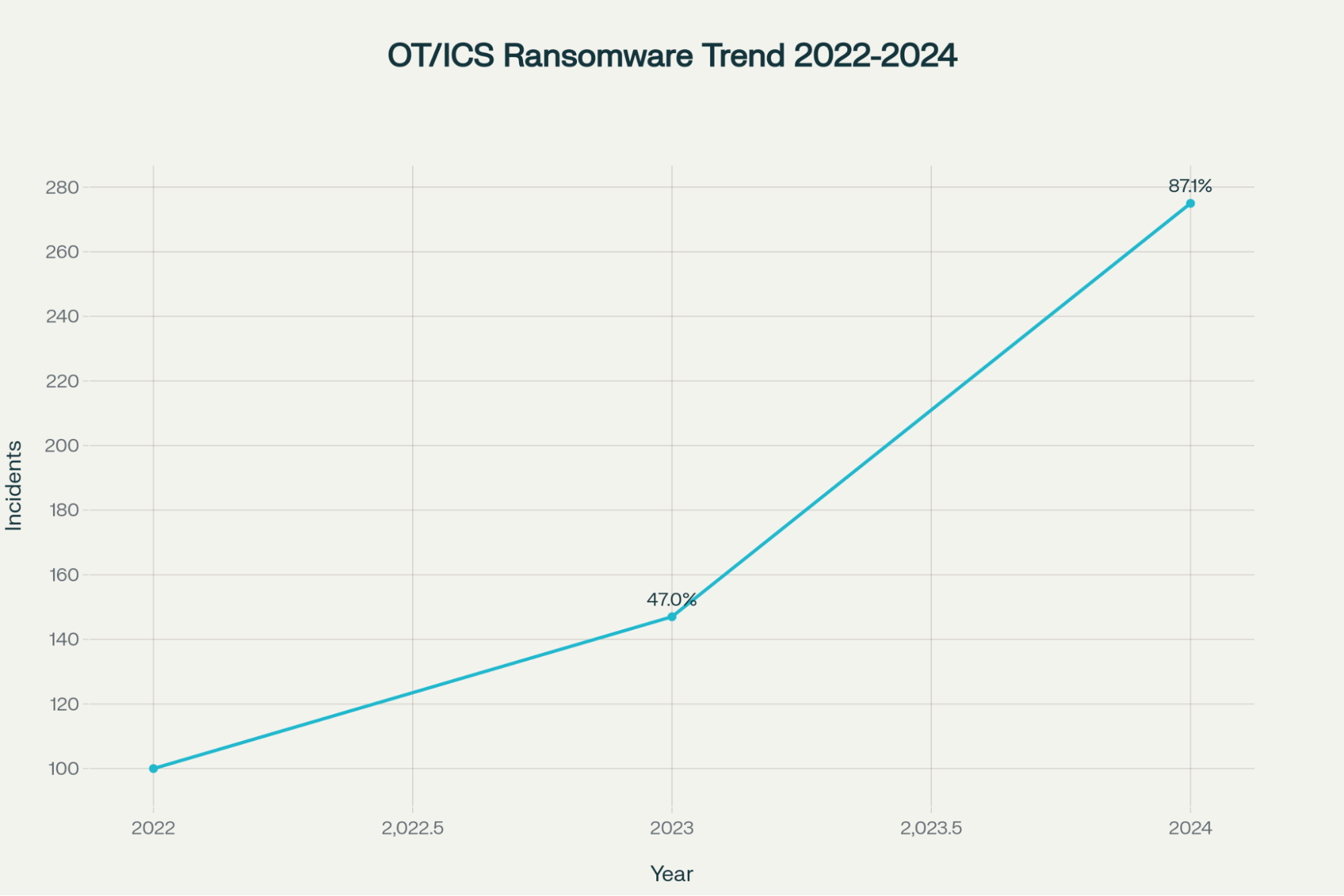
Rising OT/ICS Ransomware Incidents: 87% Increase in 2024 6.
Third-Party Risk Proliferation: Research shows that 67% of energy sector breaches involve software and IT vendors 7, highlighting the critical importance of supply chain security monitoring. The energy sector's third-party breach rate of 45% significantly exceeds the global average of 29% 8.
Nation-State and Advanced Persistent Threats: The 2024 SANS ICS/OT Cybersecurity Survey 9 identified increasing sophistication in attacks targeting critical infrastructure, with state-sponsored groups specifically focusing on OT environments for strategic advantage.
Financial Impact: The average cost of a data breach in the energy sector reached $4.78 million in 2023, while destructive cyberattacks averaged $5.24 million 10. These costs continue to rise as attacks become more sophisticated and widespread.
Top Use Cases Security Teams Need Now
1. Unified Security Data Lake Across IT, Cloud, and OT/ICS
Business Impact: Eliminates data silos and provides comprehensive visibility across hybrid environments, reducing mean time to detection (MTTD) by up to 60% through centralized on analytics.
Key Data Sources:
- IT Systems: Windows/Linux logs, Active Directory events, network flow data, endpoint detection telemetry
- Cloud Infrastructure: AWS CloudTrail, Azure Activity Logs, GCP Audit Logs, cloud security posture data
- OT/ICS Networks: Historian data, SCADA logs, HMI events, industrial protocol traffic (Modbus, DNP3, IEC 61850)
- Network Infrastructure: Firewall logs, IDS/IPS alerts, network device configurations
Key Metrics:
- Data retention: Hot (30-90 days), Warm (1-2 years), Cold (7-10 years)
- Ingestion rate: 16TB/day average across IT, cloud, and OT sources
- Query performance: Sub-second response for interactive hunting
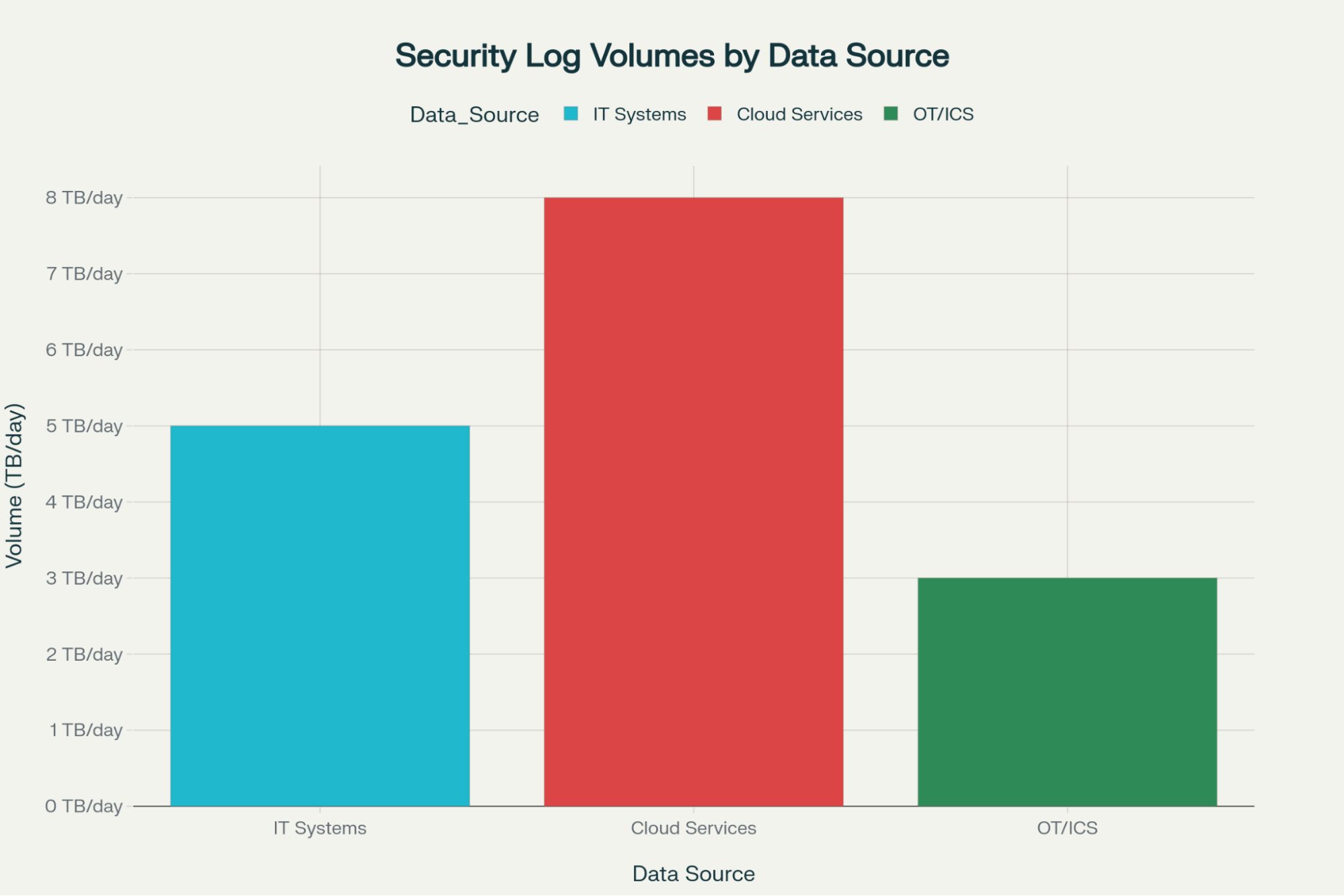
Daily Security Log Volumes by Source
2. Advanced Threat Detection & Hunting
Business Impact: Enables detection of sophisticated attacks that bypass traditional security controls, particularly those targeting OT environments where conventional SIEM rules may not apply.
Key Capabilities:
- OT-Aware Analytics: Behavioral analysis of historian data to detect anomalous process changes or unauthorized equipment modifications
- Cross-Domain Correlation: Linking IT credential theft to subsequent OT network reconnaissance
- Supply Chain Monitoring: Automated analysis of vendor access patterns and third-party software behavior
Key Metrics:
- Reduce false positive rates by 40-70% through ML-enhanced detection
- Improve threat hunting efficiency with 10x faster queries across historical data
- Detect lateral movement from IT to OT networks within 15 minutes
3. Incident Response & Forensics at Petabyte Scale
Business Impact: Accelerates incident response and forensic investigations, reducing mean time to recovery (MTTR) from weeks to days for complex multi-domain incidents.
Core Features:
- Timeline Reconstruction: Rapid correlation of events across IT and OT systems to build comprehensive attack timelines
- Evidence Preservation: Immutable data storage with cryptographic integrity verification for regulatory and legal requirements
- Collaborative Investigation: Shared notebooks and workflows enabling distributed security teams to collaborate on complex incidents
Key Metrics:
- Query petabytes of historical data in seconds
- Reduce forensic investigation time by 80%
- Maintain legally-defensible evidence chains with full audit trails
4. Regulatory Reporting & Control Evidence
Business Impact: Automates compliance reporting for NERC CIP, TSA Security Directives, and other regulatory frameworks, reducing manual effort by 90% while improving accuracy and consistency.
Compliance Frameworks Supported:
- NERC CIP-011-4: Information protection program evidence and cyber asset inventory reporting 11
- CIP-015-1: Internal network security monitoring and logging requirements 12
- TSA Pipeline Security Directives: Continuous monitoring and incident reporting for critical pipeline infrastructure 13
Key Features:
- Automated data lineage tracking for audit requirements
- Real-time compliance dashboards with exception alerting
- Pre-built report templates for regulatory submissions
5. Third-Party/Supply-Chain Risk Analytics
Business Impact: Provides continuous monitoring of vendor security posture and supply chain risks, critical given that third-party breaches account for nearly half of all energy sector incidents.
Risk Assessment Capabilities:
- Vendor Security Scoring: Automated assessment of third-party security posture using external and internal telemetry
- Access Pattern Analysis: Monitoring of vendor network access and data interactions for anomaly detection
- Supply Chain Mapping: Visualization of interdependencies and cascading risk scenarios
Key Metrics:
- 360-degree visibility into vendor access and activity
- Real-time risk scoring updates based on threat intelligence feeds
- Automated alerts for high-risk vendor activities or policy violations
How Databricks Helps: Concrete Capabilities
Lakehouse Architecture for Security
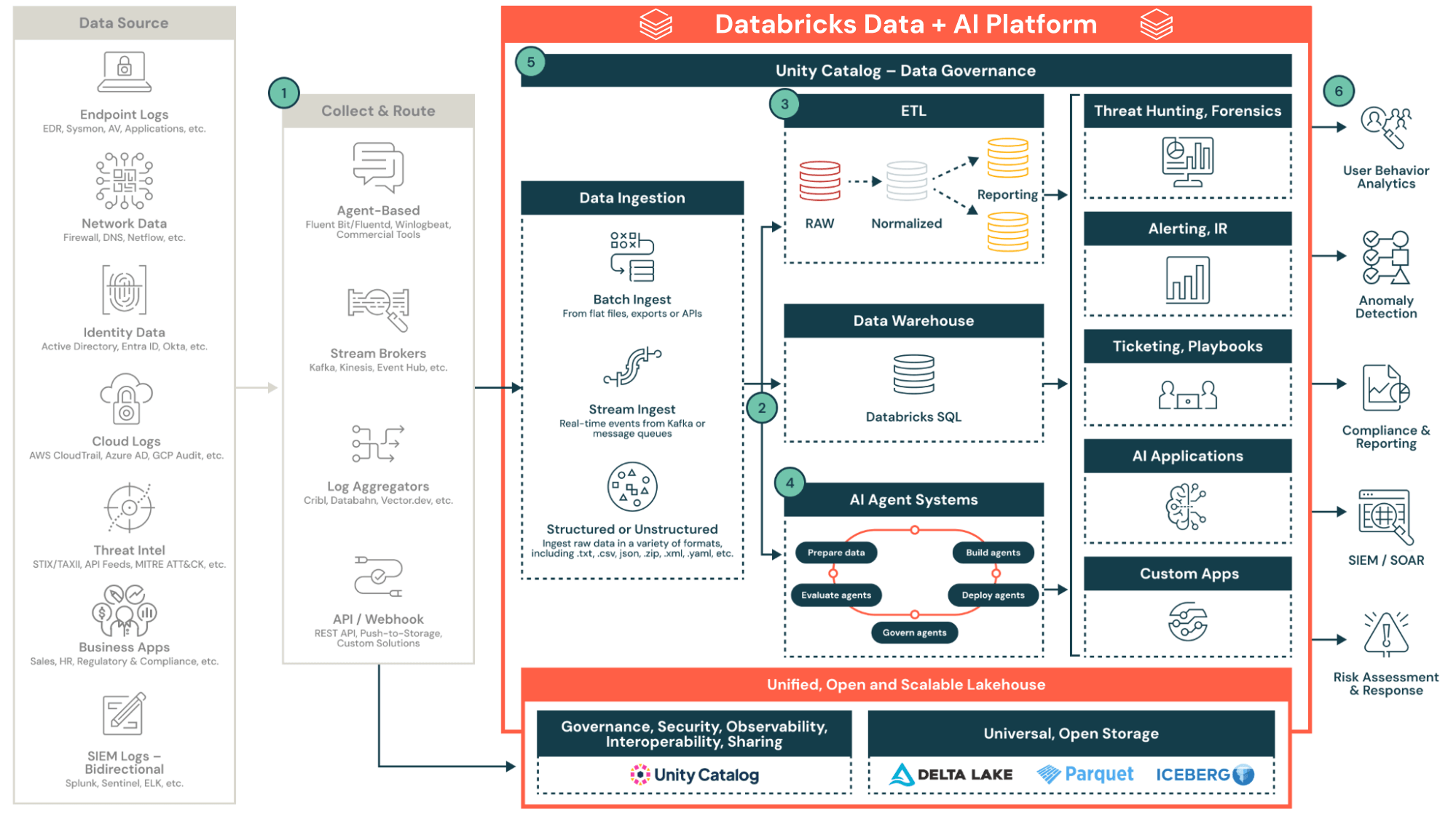
Databricks Lakehouse Architecture for Energy & Utilities Cybersecurity
The Databricks Data + AI Platform 14 provides a unified architecture that addresses the unique challenges facing energy and utility security teams:
Delta Lake Foundation: Open-format data storage with ACID transactions ensures data integrity and eliminates vendor lock-in. Security telemetry is stored in an optimized columnar format that supports both batch analytics and real-time streaming queries.
Unity Catalog Governance: Provides comprehensive data governance with fine-grained access controls, automated data lineage tracking for regulatory compliance, and consistent security policies across all data assets.
Real-Time Processing: Structured Streaming and Auto Loader enable continuous ingestion of security data from IT and OT sources, supporting sub-second detection scenarios and real-time dashboard updates.
Advanced Analytics and ML Capabilities
MLflow Integration: Manages the complete machine learning lifecycle for security use cases, from threat detection model development to deployment and monitoring. Pre-built models for anomaly detection, user behavior analytics, and threat classification can be customized for energy sector environments.
Lakehouse Monitoring 15: Monitors data quality and model performance to ensure detection accuracy remains high as threat landscapes evolve. Automated drift detection helps maintain model effectiveness over time.
Delta Live Tables: Simplifies the creation and management of data processing pipelines, ensuring security data flows from raw ingestion to analysis-ready formats with appropriate quality controls and lineage tracking.
Multicloud Flexibility and Integration
Bring-Your-Own Analytics: Organizations can retain existing SIEM/SOAR investments while leveraging Databricks for long-term data retention, advanced analytics, and ML-driven threat detection. This approach provides the best of both worlds—immediate detection capabilities and deep analytical power.
Cost-Effective Retention: Tiered storage options enable organizations to keep hot data readily accessible for real-time operations while archiving historical data cost-effectively for compliance and forensic purposes. This is particularly important for energy organizations that may need to retain security logs for 7-10 years.
Open Integration: Support for industry-standard APIs and data formats ensures seamless integration with existing security tools, from endpoint detection platforms to industrial control system monitoring solutions.
Why Databricks Differentiates
Open Standards: Unlike cloud-native solutions that lock data into proprietary formats, Databricks uses open standards like Delta Lake and Apache Parquet, ensuring organizations maintain control over their data and can adapt to changing requirements.
True Multicloud: While competitors focus primarily on their native cloud environments, Databricks provides consistent functionality across AWS, Azure, and Google Cloud, enabling organizations to implement unified security analytics regardless of their cloud strategy.
ML/AI Leadership: The combination of MLflow for model lifecycle management and Unity Catalog for data governance provides unmatched capabilities for deploying and managing ML-driven security use cases at enterprise scale.
Cost Optimization: Intelligent data tiering and optimization features like Photon and Delta Engine provide superior price-performance for large-scale security analytics workloads, often reducing total cost of ownership by 40-60% compared to traditional data warehouse approaches.
Customer-Ready Outcomes & Next Steps
90-Day Pilot Plan
Phase 1 (Days 1-30): Foundation Setup
- Deploy Databricks workspace with Unity Catalog governance
- Configure data ingestion from 3-5 priority log sources (Windows, firewall, cloud audit logs)
- Establish bronze/silver/gold data architecture with basic quality controls
Phase 2 (Days 31-60): Detection & Analytics
- Implement 5 core detection use cases (e.g., lateral movement, privilege escalation, anomalous network activity)
- Deploy 2 threat hunting playbooks focused on IT-to-OT attack paths
- Create executive dashboard showing security posture metrics
Phase 3 (Days 61-90): Compliance & Optimization
- Build automated compliance reporting for primary regulatory framework (NERC CIP or TSA)
- Calculate retention cost savings vs. existing SIEM (typically 50-70% reduction)
- Establish success metrics and business case for full deployment
Expected Outcomes
Operational Improvements:
- 60% reduction in time to detect sophisticated threats
- 80% faster forensic investigations through unified data access
- 90% automation of regulatory compliance reporting
Cost Benefits:
- 50-70% reduction in long-term data retention costs
- Elimination of SIEM data volume limits and associated overage charges
- Reduced need for specialized forensic tools through unified platform approach
Strategic Advantages:
- Future-proof architecture that scales with growing data volumes
- Vendor independence through open data formats
- Enhanced ability to attract and retain skilled security analysts through modern tooling
Call to Action
The cybersecurity challenges facing the Energy & Utilities sector will only intensify as IT/OT convergence accelerates and threat actors become more sophisticated. Organizations that act now to modernize their security analytics platforms will be better positioned to defend against emerging threats while meeting evolving regulatory requirements.
Ready to transform your cybersecurity operations? Schedule a Databricks cybersecurity workshop to explore how the lakehouse platform can address your specific security challenges.
Cybersecurity and Energy
Get the latest posts in your inbox
Subscribe to our blog and get the latest posts delivered to your inbox.