How AI Is Transforming Data Analytics
- AI automates data preparation, enables natural language querying, and delivers real-time insights that replace static reporting across analytics workflows.
- AI accelerates analysis, detects patterns humans miss, and democratizes access to insights, but organizations must address risks like bias, data quality issues, and over-reliance on automation.
- AI handles routine tasks like data cleaning and report generation, freeing analysts to focus on judgment-intensive work, business context, and model oversight.
What AI for Data Analytics Means Today
As AI becomes increasingly integral to how organizations work with data, more teams are adopting AI-based tools to move faster and make better decisions. Instead of relying solely on manual queries, dashboards and human‑driven interpretation, modern analytics can now incorporate AI/ML, natural language processing (NLP) interfaces and automated workflows that augment human workflows.
For example, generative AI makes analytics more accessible by allowing people to ask questions in everyday language instead of writing SQL queries or using complex BI tools. Automation reduces the manual effort required to clean data, generate features and run models, freeing analysts to focus on higher‑value tasks.
Compared with traditional analytics, where teams manually prepare data and build reports, AI can now perform many of the more routine and repetitive tasks.. Analysts still guide the process, but by incorporating AI, analytics teams can prepare data more reliably, generate insights faster and make predictions part of everyday decision‑making.
At Databricks, we don't consider AI to be a separate add‑on, but rather an integrated capability that enhances every step of the data lifecycle when built on a unified, well‑governed foundation.
Getting Started with AI for Data Analytics
AI supports common analytics tasks such as classifying data, identifying trends, answering natural‑language questions and recommending next-best actions, although organizations must still manage risks like biased outputs, poor data quality and governance issues. To get started, analysts need foundational data literacy, comfort with basic ML concepts and the ability to validate results.
Most teams begin by establishing a unified data foundation and piloting small, high‑value use cases, but whether it’s forecasting demand or helping business users explore data conversationally, AI extends what analytics teams can accomplish and makes insights more widely available.
How AI Enhances Each Stage of the Data Analytics Workflow
In data analytics, workflows typically move through the following stages:
- Data collection
- Preparation
- Analysis
- Visualization
- Decision‑making
Each step has its own challenges, but AI can play a meaningful role that is specific to each.
Data Collection
In this stage, AI helps teams gather information from a variety of sources without the need to build custom pipelines for each one. Automated systems are able to pull data from applications, documents, sensors and APIs, then classify it for analysis. AI also deals with large datasets more efficiently than traditional tools, which is especially valuable when organizations collect data from multiple business units or real‑time streams.
Preparation
During the data cleaning and preparation stage, AI can identify anomalies, missing values and inconsistencies that would take an analyst much longer to find. It can also automate repetitive tasks like formatting fields, standardizing labels and joining datasets. This reduces the time employees have to spend on manual prep work and improves the quality of downstream analysis by basing it on higher‑quality data.
Analysis
This stage is where AI can help recognize patterns, predict outcomes and detect unusual behavior. AI-driven models are able to run continuously, which makes real‑time analysis and forecasting possible. Instead of waiting for scheduled reports, teams can see changes as they happen and respond immediately.
Visualization
AI tools can easily create charts, dashboards and summaries based on the underlying data. NLP technologies also enable users to ask questions in a conversational way and receive clear explanations in return. This makes complex analysis easier to understand and helps nontechnical users explore data without needing advanced skills.
Decision-making
AI elevates this stage by moving teams from decisions based on historical reports to forward‑looking strategies. Modern AI solutions can surface anomalies, forecast emerging risks and opportunities and distill unstructured signals such as customer sentiment into patterns that leaders can act on. Combining this with Natural Language Querying reduces data preparation time while providing analysts with insights based on real-time, “what-if” scenarios that drive timely action.
Practical Examples of AI-powered Analytics in Action
As organizations mature in their use of AI for data analytics, and while there is certainly plenty of room for further development, it makes sense to look at some of the ways AI is currently being used successfully in the following categories:
- Scenario-based workflows
- Real-time analytics
- Natural language querying
- Accelerating time-to-insight
Scenario-based Workflows
One common scenario-based example is sentiment analysis, where AI analyzes customer feedback, social posts or support tickets to determine whether customers feel positive, neutral or negative about a product or service. This helps teams understand trends in customer experience without having to read thousands of individual comments.
Predictive analytics is another widely used workflow, where AI models provide forward‑looking insights, such as forecasting demand, estimating churn or predicting which sales leads are most likely to convert.
Anomaly detection can flag unusual patterns in transactions, sensor readings or system logs so teams can investigate issues before they escalate.
For organizations with large datasets, AI can also generate quick summaries that highlight key themes or changes, saving hours of manual review.
Real-time Analytics
By conducting AI‑powered real-time analysis, retailers can forecast sales for specific days and adjust staffing or inventory levels. Manufacturers can identify operational issues as they happen by monitoring equipment data. Logistics teams can track delivery performance and anticipate delays. Real‑time insights like these help organizations reduce the lag between data collection and action.
Natural Language Querying
Natural language querying makes analytics more accessible. Instead of writing SQL queries or navigating dashboards, users can ask questions like “What were our top‑selling products last quarter” or “Show me regions with rising support volume.” AI interprets the question, runs the analysis and returns a clear answer, lowering the barrier for nontechnical users of business data.
Tools and Platforms Enabling AI for Data Analytics
AI‑driven BI tools increasingly feature core capabilities to support key data analytics workflows. Predictive features support trend forecasting and risk identification. Generative AI can summarize datasets or translate technical findings into plain language. Natural language querying makes exploration more intuitive, while AI‑assisted visualization and workflow automation reduce the manual effort behind dashboards, data prep and routine reporting.
The right tool still depends on the problem you’re solving. Forecasting requires strong predictive models, dashboard automation benefits from AI‑driven visualization and spreadsheet augmentation is far easier with natural‑language features that cut down on complex formulas. At the moment, some tools are better at some capabilities than others, although the trend is clear. The modern BI stack is converging toward a unified suite that includes all of them. Databricks AI/BI brings these capabilities together in one platform, pairing governed data with AI‑assisted analytics for faster, more reliable insights.
Benefits of Using AI in Data Analytics
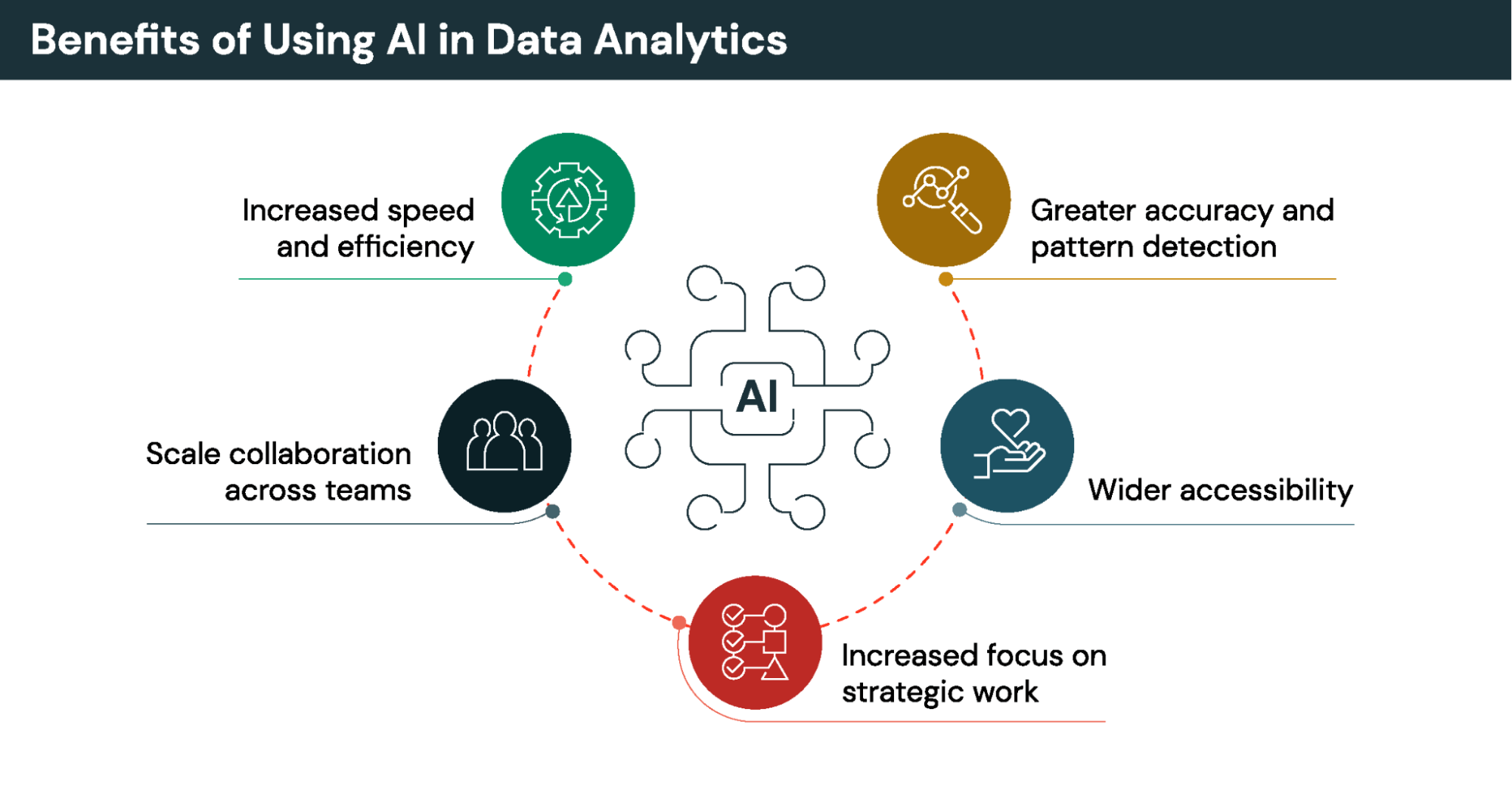
The benefits of using AI for data analytics generally center around productivity, efficiency, accuracy, accessibility and scalability. Specific benefits include:
- Faster real‑time analysis: AI processes large datasets quickly and updates insights continuously, enabling a shift from static reports to always‑current intelligence.
- Improved accuracy and pattern detection: ML models uncover subtle trends, anomalies and relationships that humans often miss, reducing error and strengthening analytical rigor.
- Democratized analytics across technical and business users: Natural language interfaces let anyone explore data in everyday language, lowering barriers and broadening participation.
- Scalable insight generation: Automated workflows, shared models and unified platforms deliver consistent insights across teams, freeing analysts for higher‑value strategic work.
Limitations, Risks and Ethical Considerations
While incorporating AI into analytics can significantly improve data intelligence, it also introduces risks. These risks shouldn’t prevent adoption, but they do highlight the need for a strong data foundation and responsible practices. The following are some key areas to consider.
Bias, interpretability and Data Quality
AI outputs depend heavily on the data they learn from. If the data is incomplete or biased, the results may be as well. Interpretability is another challenge. Some models act like black boxes, making it hard to understand how they reach conclusions. When internal reasoning isn’t visible, it is even more important to maintain trust in AI outputs by ensuring the data is clean, accurate and well‑documented.
Human Oversight and Governance
AI can generate insights quickly and confidently, which may lead users to over‑rely on automated results without validating them. AI is powerful, but it’s not infallible. Analysts remain essential for reviewing outputs, validating assumptions and ensuring insights align with real‑world context.
That’s partly why governance is also important. Organizations must manage version control, maintain reproducible workflows and support audit trails to track how models were built and how results were generated. Without these controls, troubleshooting becomes difficult and compliance risks increase.
Privacy and other Challenges to Consider
AI systems often work with sensitive data, which may raise privacy and ethical concerns. Organizations must ensure that data is collected and used responsibly, with proper safeguards and access controls in place.
One question to consider is the ethical impact of using AI for analytics. Companies must handle data responsibly and help customers understand how their information will be used. Transparency is also essential. Organizations should be able to explain how AI models work, what data they rely on and how they inform decisions. Ethical use also requires human oversight to ensure AI supports decision‑making rather than replacing judgment or accountability.
Another common question is whether it’s okay to rely solely only on AI for data analysis. It is not. AI can speed up analysis and generate insights, but it cannot replace human expertise, domain knowledge or ethical judgment. The strongest analytics workflows combine AI‑driven automation with thoughtful human oversight to ensure accuracy and accountability.
How AI is Changing the Role of Data Analysts
AI is already reshaping the day‑to‑day work of data analysts by shifting the balance of responsibilities away from manual tasks and toward more complex, judgment-oriented activities. Analysts can now rely on AI to automate things like cleaning data, building routine reports or writing repetitive queries, as well as preparing datasets, generating summaries, creating visualizations and identifying patterns much faster than they could do manually.
However, there are things analysts can do that AI can't, or not as well, such as evaluate tradeoffs or decide which insights matter most to their team. Analysts provide the judgment, domain knowledge and critical thinking needed to interpret results and guide decisions. They also validate AI‑generated outputs to ensure the logic is sound and the conclusions are verifiable.
One other change is that many analysts now spend more time on crafting effective prompts for AI responses, or choosing the right combination of models, queries and workflows to answer a business question. Oversight is another growing responsibility. Analysts may find they spend more time monitoring data quality, checking for bias and ensuring that automated insights are accurate and trustworthy.
These changes connect directly to a common question: Will AI replace data analysts? The answer is that while AI can automate tasks, it can't replace the strategic thinking, contextual understanding and ethical judgment that analysts bring. AI elevates the analyst role, allowing analysts to focus on discovering deeper insights and more impactful decision support.
Skills and Getting Started with AI in Analytics
While AI is creating new opportunities and changing responsibilities for analysts, people in those roles should still strive to stay competitive by developing relevant skills. =Emerging skills like prompt design will help you get better results from AI-powered BI tools.
Many teams begin with low‑barrier experiments that use sample projects, accessible tools and sandbox datasets. Many platforms offer guided notebooks or built‑in examples that walk users through common workflows. These small use cases help analysts build confidence while they learn how AI fits into their existing processes.
At the team level, a simple workflow is a great way to learn. Analysts can build a basic predictive model that forecasts a single metric, such as weekly demand or customer churn. Or they might try running sentiment analysis on customer reviews to see how AI classifies positive and negative feedback.
By developing these skills and experimenting with entry-level tools, analysts can begin using AI in meaningful ways and prepare for more advanced applications.
The Future of Data Analytics with AI
The future of data analytics is almost certain to be influenced significantly by the trajectory of advances in generative AI and automation. As generative AI is expanding what teams can automate, it is also making data more accessible. As predictive modeling matures we should expect it to become more accurate and more adaptive as the models learn from new data. Autonomous data exploration is also likely to increase, thanks to systems that can scan datasets, detect patterns and surface insights without being prompted.
Another major shift to keep an eye on is the rise of AI agents that support or augment analysts. Acting as intelligent partners, these agents will be able to help run queries, monitor data quality, recommend models and flag anomalies, thus extending an analyst’s reach and accelerating their decision‑making.
Conclusion
AI is reshaping data analytics in meaningful ways by speeding up routine tasks, improving accuracy and making insights easier for more people to access. From data preparation to visualization, AI is opening the door to new levels of automation and exploration.
If you'd like your company to start using AI with data analytics, the best way to begin is choosing one workflow area to pilot an AI‑driven improvement. This could be automating a recurring report, summarizing a dataset with NLP tools or testing a simple predictive model. Small, focused experiments help teams learn what works and build confidence before they take on more complex initiatives.
Whether you're just starting out or well on your way, the message is simple: AI expands what is possible with data analytics, but human judgment remains essential. When AI and human expertise work together, organizations can use AI to unlock faster insights and make better decisions based on their data.
To learn more about how AI-powered data intelligence powers business intelligence, compound AI systems or the new Databricks offering AI/BI Genie that helps you converse with your data through natural language, get your copy of our eBook Business Intelligence Meets AI.
Get the latest posts in your inbox
Subscribe to our blog and get the latest posts delivered to your inbox.