MosaicML Delivers Leading NLP Performance in MLPerf v2.1
by Daya Khudia, Nikhil Sardana, Sam Havens, Alex Trott and Erica Ji Yuen
MosaicML leads the MLPerf NLP results, delivering a score of 7.9 minutes on 8x NVIDIA A100 GPUs in the Open Division, thanks to algorithmic and systems optimizations delivered through our platform.
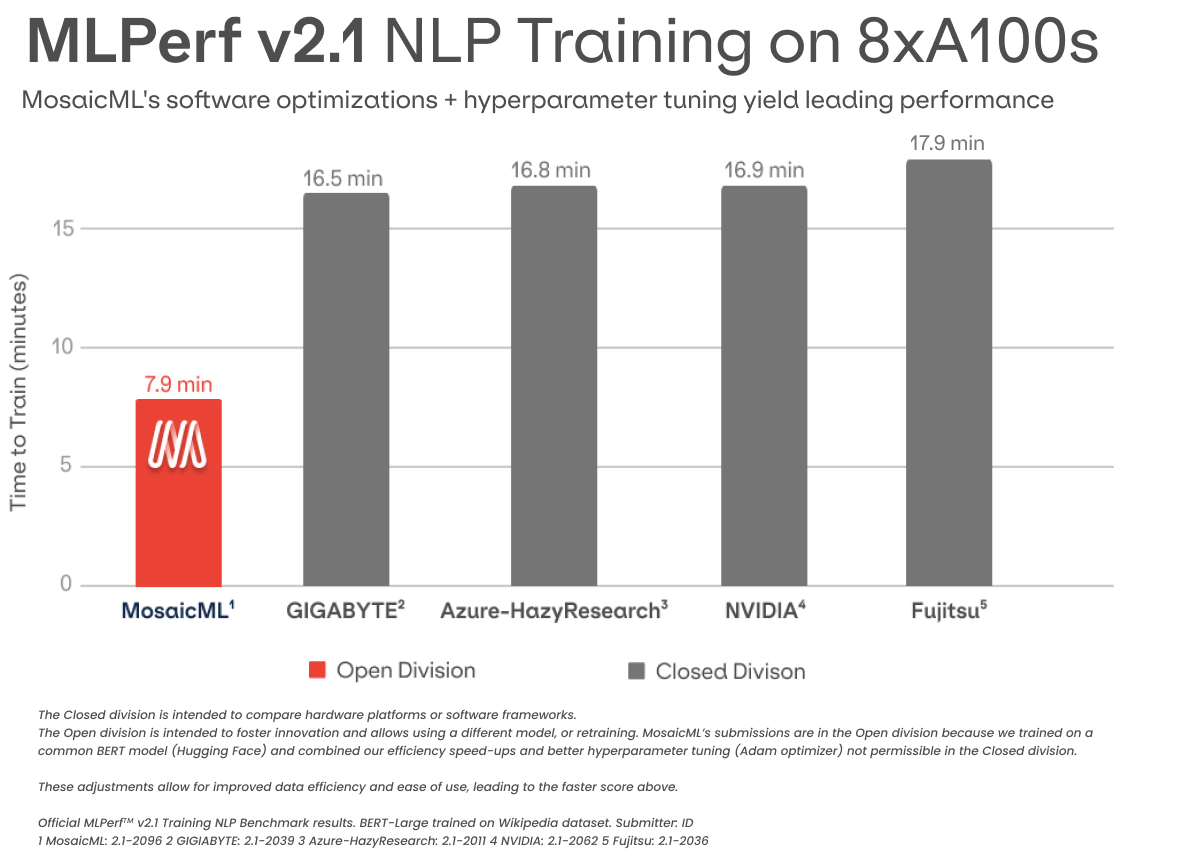
A common perception in machine learning is that it's too hard - and too expensive - to train NLP models from scratch. Instead, most companies are fine-tuning existing models that are pre-trained on generic text data such as all of Wikipedia.
We're on a mission to change that narrative so that anyone can train NLP models from scratch on domain-specific data that's relevant to their industry. Our ultimate goal: lower the cost and time of training, and give companies the ability to unlock new capabilities and better differentiate their products.
That's why we're excited to announce that in today's MLPerf results, MosaicML achieved leading NLP performance. We accelerated the training of a Hugging Face BERT model by 2.7x1 with our software and algorithmic optimizations, which can be automatically enabled in our MosaicML platform.
MosaicML results in MLPerf Training v2.1
Our submission uses our open source library Composer, built on top of PyTorch, to easily plug in and test different optimizations. We submitted two configurations to the NLP benchmark in the Open division:
- Baseline: We used the popular BERT-Large model from Hugging Face, and set a strong baseline by applying mixed precision and tuning the hyperparameters. Notably, the Adam optimization converged much faster than the closed division's mandated LAMB optimizer.
- Optimized: To speed up the training, we added several optimizations to the Baseline: Unpadding, Flash Attention, FusedLayerNorm, FusedDropoutAddLayerNorm, and FusedDenseGeLuDense.
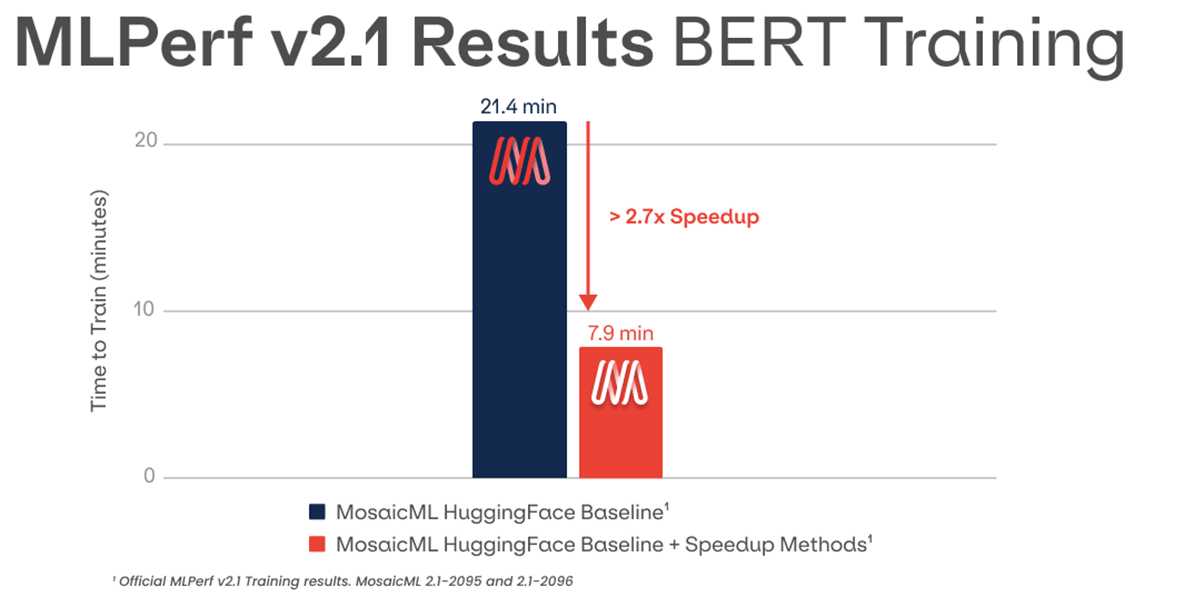
Our system and algorithmic optimizations achieve a 2.7x speed-up on training the NLP benchmark compared to a Hugging Face baseline1 (Figure 2). Importantly, both the baseline and the optimized submissions used the same hyperparameters, for a fair comparison.
How MosaicML achieved leading NLP training performance
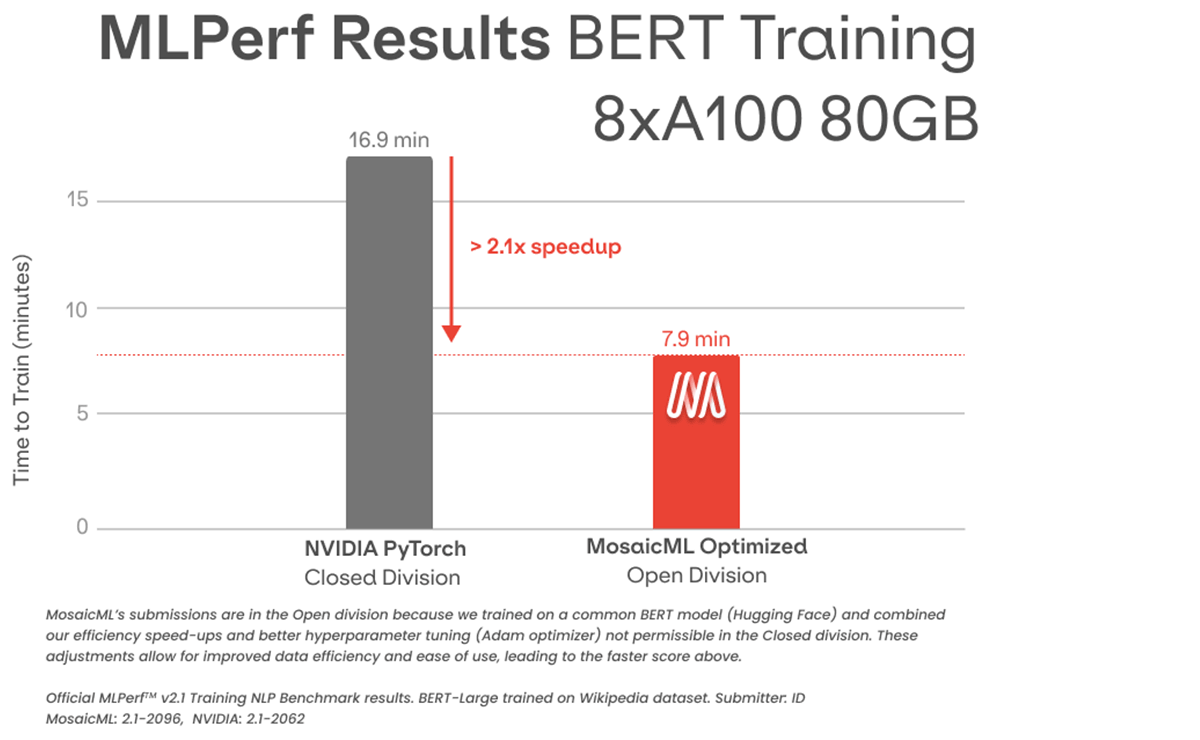
In comparison, NVIDIA's submission on similar hardware in the Closed division reaches the same accuracy in 16.9 minutes. Our Open division submission is 2.1x faster (Figure 3).
However, there are several important differences between our submissions:
- Ease of use over speed. Our codebase sacrifices some raw speed in favor of code that is easier to use and modify through the implementation of a generic Trainer, instead of a bespoke training loop with custom optimizations. On a samples-per-second basis, our submission is 1.7x slower than NVIDIA's submission.
- Better data efficiency. We found that when using a different optimizer (Decoupled Adam) that is permissible in the open division and widely used with our customers, our training takes 3.5x fewer samples to reach the same accuracy.
To sum up: our submission achieved leading NLP performance with a customizable codebase that is easy to use with your own data.
How to get MLPerf-level training speed with MosaicML
Knowing when - and how - to use which optimization methods with what models is difficult - and can change based on your hardware and system configurations! To save our customers' valuable time, we built the MosaicML Platform, which was used for our MLPerf submission. The MosaicML platform is an optimized infrastructure and software stack for training deep learning models.
Enabling MLPerf-level speed is easy: you can engage our automatic optimization feature that profiles your code and automatically applies the right speed-up recipes with just a single command-line flag ("-o1")!
Our customers want to focus on modeling, and not spend time dealing with performance optimization. Leave that to our automated software built by our team of efficiency experts and researchers.
Ready to build the best models in the shortest time at the lowest cost? Get started by signing up for a free trial!
1 Official MLPerf v2.1 Training results. MosaicML HuggingFace Baseline: 2.1-2095; MosaicML HuggingFace Baseline + Speedup Methods 2.1-2096
2 The MLPerf NLP score measures time to train of BERT-Large to 0.72 Masked LM Accuracy on Wikipedia dataset.
Frequently asked questions
What result did MosaicML achieve in the MLPerf v2.1 NLP benchmark?
MosaicML achieved a score of 7.9 minutes to train BERT-Large to 0.72 Masked LM Accuracy on 8x NVIDIA A100 GPUs in the Open Division of MLPerf v2.1. The submission used the open source Composer library, built on PyTorch, to test different optimizations. Two configurations were submitted, a Baseline and an Optimized version, with the Optimized version delivering the leading score.
What specific optimizations enabled the 2.7x speedup over the Hugging Face baseline?
The Optimized submission added Unpadding, Flash Attention, FusedLayerNorm, FusedDropoutAddLayerNorm, and FusedDenseGeLuDense on top of the Baseline configuration. Both the baseline and optimized submissions used the same hyperparameters to keep the comparison fair. Applying these five techniques together let the optimized run reach the target accuracy 2.7x faster than the Hugging Face baseline.
How does the Baseline submission differ from the Optimized submission?
The Baseline submission used the popular BERT-Large model from Hugging Face with mixed precision and tuned hyperparameters, and it used the Adam optimizer rather than the Closed division's mandated LAMB optimizer. The Optimized submission started from this same baseline and layered on the five additional software optimizations described above. Because both submissions shared identical hyperparameters, the resulting 2.7x speedup can be attributed to those added optimizations.
Why did MosaicML submit to the Open Division rather than the Closed Division?
The Open Division allowed MosaicML to use the Decoupled Adam optimizer, which is not permitted in the Closed division's mandated LAMB setup and is widely used with MosaicML's customers. Using this optimizer let the training reach the same accuracy target with 3.5x fewer samples. MosaicML's codebase also favors a generic Trainer for ease of use over NVIDIA's bespoke training loop, making it 1.7x slower on a samples-per-second basis, yet the Open Division submission still reached the accuracy target 2.1x faster in wall-clock time than NVIDIA's Closed Division result on similar hardware.
How can I apply these MLPerf-level optimizations to my own model training?
These optimizations can be automatically enabled on the MosaicML platform, the same infrastructure used for the MLPerf submission, by turning on the automatic optimization feature with a single command-line flag ("-o1"). This feature profiles your code and automatically applies the appropriate speed-up recipes so you don't have to manually tune performance settings. You can start using it by signing up for a free trial.
Get the latest posts in your inbox
Subscribe to our blog and get the latest posts delivered to your inbox.