The Rise of Sports Intelligence: How the Lakehouse Turns Tracking Data into Competitive Advantage
A modern data and AI foundation that connects player tracking, biomechanics, and operations to on-court and front-office decisions
by Corey Abshire, Kush Patel and Nick Ragonese
- Show how pro teams turn exploding tracking and biomechanical data (like NBA Hawk‑Eye SkeleTRACK) into sports intelligence that actually changes decisions on the court, in the training room, and in the front office.
- Use the Databricks Data + AI Platform as the governed “sports brain” where tracking, medical, wearable, video, scouting, and fan data land in one lakehouse, then apply Lakeflow, Unity Catalog, ML, AI Search, and sub‑second apps to power real-time workflows.
- Highlights concrete outcomes: proactive injury and workload management, real-time coaching insights on matchups and mechanics, and next‑gen fan and broadcast experiences like biomechanical overlays and interactive, data‑driven replays.
Every second of a professional basketball game now generates more than 20,000 data points from Hawk-Eye cameras. Across a 48-minute game, that adds up to tens of millions of positional measurements. Somewhere inside that stream are the answers to the questions teams obsess over: how to prevent injuries, scout more precisely, dissect plays, optimize lineups, and even fine-tune shooting mechanics. The hard part is building the data platforms and AI models that answer those questions reliably at scale. These systems need to be fast enough to change what happens on the floor, in the locker room, and in the office.
Across professional sports, the volume of biomechanical and tracking data has never been higher. However, the capacity of most organizations to actually use this data to solve their key use cases has barely moved. Databricks Data + AI Platform helps sports data teams fill this gap, creating an opportunity for teams to create new Sports Intelligence capabilities for their players and coaches that lets them finally unlock the value in this massive amount of data. Databricks helps teams keep players healthier, win more games, boost performance, and run more efficiently across their entire ecosystem.
The Data Explosion
In March 2023, the NBA replaced Second Spectrum's center-of-mass player tracking with Sony Hawk-Eye's SkeleTRACK system across all 29 arenas. The new feed captures 29 skeletal joints on every player and referee, 13 people on the floor at any moment, sampled 60 times per second. That works out to roughly 22,620 positional updates per second, on the order of 65 million records per 48-minute game, and approximately 80 billion records across an 82-game regular season before counting the playoffs or practice.
This is a generational leap, with SkeleTRACK data is roughly two orders of magnitude richer and for the first time capturing full 3D pose in real-time. What the data unlocks is not "object detection" or "computer vision." Those are the means. The actual outcomes are the things teams care about:
- Understanding how a shooter's mechanics shift late game as fatigue alters elbow angle and release height.
- Detecting subtle changes in movement patterns that precede ACL and Achilles injuries.
- Quantifying how defensive schemes, defender proximity, and the specific play being run alter shot accuracy.
- Comparing biomechanical load across games to optimize rest decisions and reduce injuries.
- Personalizing skill development by mapping each athlete’s unique mechanics to their make/miss outcomes instead of forcing a generic training model.
- Designing role and position specific movement profiles movement profiles so teams can draft, trade for, and develop players whose biomechanics fit their system.
The tracking layer is also consolidating across sports. Hawk-Eye is already deployed in the Premier League, all four tennis Grand Slams, Cricket's DRS, MLB's Statcast, NASCAR, and Formula 1. The NHL has expanded its puck and player tracking partnership with biomechanical extension being the obvious next step, and the NFL is closely following in lockstep. Whatever foundation a sports organization builds for Hawk-Eye in one sport will serve it across every sport it plays in.
Hawk-Eye gives the teams the feed. It does not give the teams the answers. The question is: what do you do with it?
The Integration Gap
Within a modern professional sports organization, the analytics stack is often distributed across components from multiple providers. Tracking data lives with one vendor, wearables with another, video somewhere else, opponent scouting and event labels with a different provider, and injury analytics with yet another. When combined with the scale of the data involved, this can lead to multiple challenges across the industry.
- Silos of "truth." The performance team, the medical staff, and the coaching staff each work off their own (often conflicting) “version” of the same player data with reconciliation taking weeks.
- Latency that compounds. Each step between vendors introduces delay. Some questions need real-time answers on the bench, others just need to be there by morning at a reasonable cost, but most teams struggle to hit either reliably.
- No governance and no trusted labels. Who has access to what? Can you trace a prediction back to the medical record, the wearable file, and the camera frame that generated it? Can you trust an event label from an outside vendor when you know it is wrong some of the time? Most teams keep using those labels anyway, fully aware of the problems but constrained by the tools they have today.
- Arena reconciliation. Camera positions, court geometry, and calibration drift differ between venues. Even raw Hawk-Eye output requires normalization before it is comparable game to game.
- Compute that does not scale. 953,000 frames per game push traditional data warehouse tables past the edge of practicality. Sports data science teams routinely fall back to local Python on a laptop, downloading samples and hoping the sample is representative.
These are not problems another point solution will fix. The cost of fragmentation shows up as missed injury signals, slower in-game decisions, and an inability to run true cross-domain analysis that combines tracking data with medical history, workload, and opponent tendencies. The missing piece is not another tool. What teams need is a governed data and AI platform where all of those tools and data streams can converge.
Sports Intelligence on the Lakehouse
The Databricks Data + AI Platform is the composable center where an organization's tracking, wearable, video, scouting, medical, operational, and fan engagement systems come together into a single governed estate. It gives a team the foundation to turn the outputs of those systems into something usable by a coach in a timeout, a biomechanist in a lab, and a GM at the trade deadline.
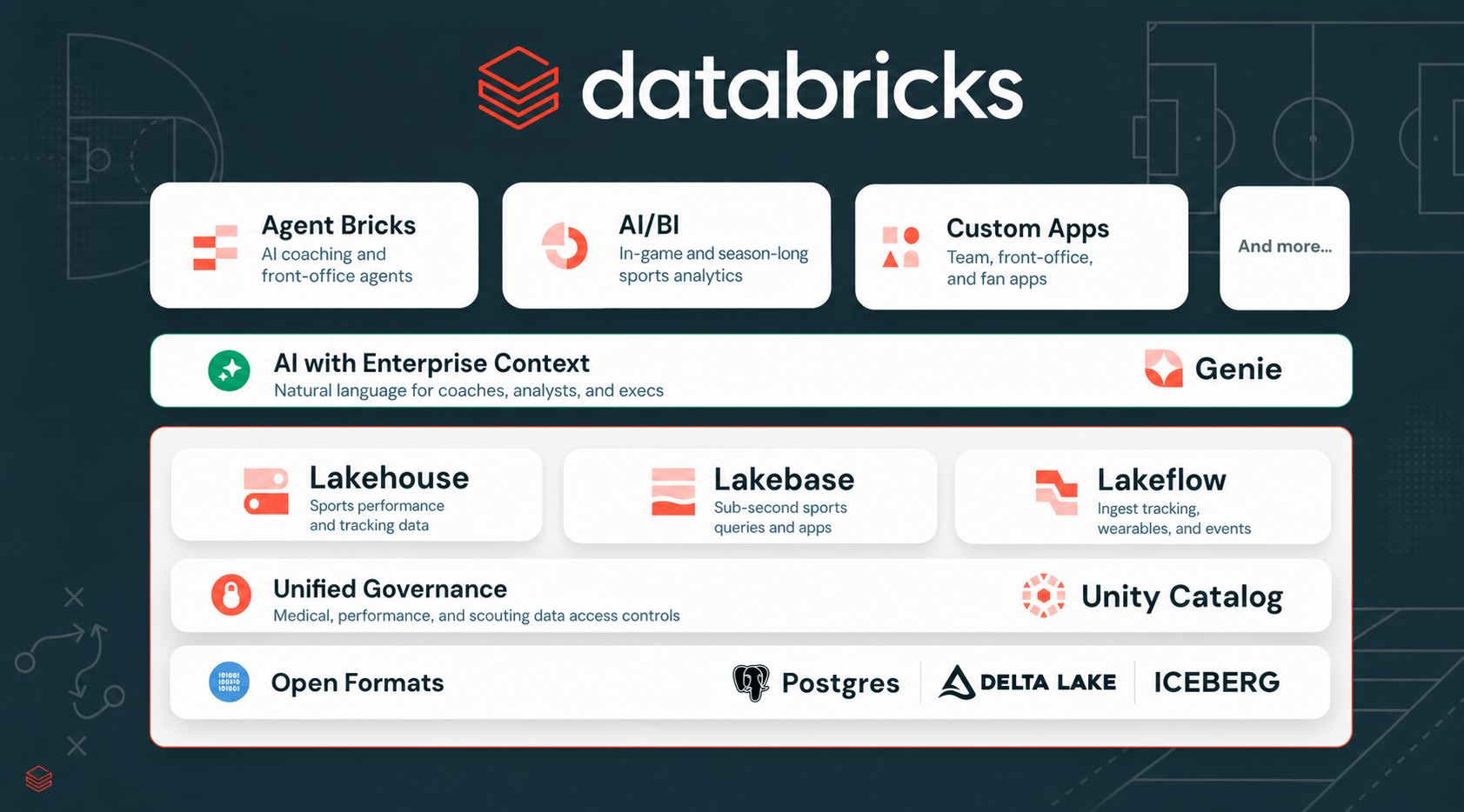
High Level Overview:
Ingest. Lakeflow handles streaming ingestion of Hawk-Eye, wearable, and event feeds at game velocity. Auto Loader and declarative pipelines enable teams to stand up production ingestion without writing custom Spark by hand. That matters in an industry where the analytics organization is often a handful of people.
Organize. A medallion architecture progressively refines raw data into usable insights. Bronze captures continuous 60 Hz frames. Silver is the event catalog: possessions, shots, screens, defensive matchups, with frame ranges correlated to camera output and arena calibration applied. Gold is the analytics-ready feature layer that drives the models and dashboards.
Govern. Unity Catalog provides lineage, access control, and auditability across the entire data + AI estate. That matters when medical data sits next to performance data. Equally important is data quality and trust. Lineage and quality monitoring let a team prove which event labels they trust, which arena's calibration drifted, and which downstream model was trained on which feed. That kind of provenance is the precondition for staking real decisions on the data, and most teams do not have it today.
Analyze. ML models like shot probability, injury risk, and fatigue index train inside the same platform. Model Serving deploys them. AI Search makes the video catalog queryable by similarity, so a coach can find every contested 3 in the fourth quarter against a switching defense without manually scrubbing tape. Through a single interface, a team can also reach any external foundation model for vision-language tasks like injury detection from broadcast footage or swap in their own custom or open source models, a workflow already in use by analytics leaders across professional sports.
Serve. Lakebase brings sub-second query latency to the interactive layer, so analyst-facing applications and courtside dashboards are not waiting on a warehouse. Databricks Apps hosts custom analytics applications needed by sophisticated sports teams: the 3D biomechanical viewer, the bench-side iPad app, the front-office evaluation tool. They run on the same governed platform that produces the data, without a separate hosting stack.
Democratize. Databricks Genie lets coaches, trainers, and front-office staff ask questions in natural language ("How have my starting five's third-quarter shot mechanics changed against zone defense over the last ten games?") and get an “in-the-moment” answer. AI agents handle the multi-step workflows behind those questions, executing the joins and rollups that used to require an analyst on call.
The point is composability, not replacement. A team that already has Hawk-Eye keeps Hawk-Eye. A team that already has Catapult keeps Catapult. The lakehouse makes the outputs of those investments interoperable, governed, and fast enough to use.
What Becomes Possible
Three outcomes worth reflecting on. There are more, but these are the ones we hear most often.
1. Injury Prevention and Load Management
Player availability is a top priority across all major sports leagues, with injuries to high profile players making headlines as much as dominant performances. Today, most teams react. A star gets banged up on a play, the medical staff diagnoses, the player misses time. The data to predict (biomechanical asymmetries, landing-load deltas, cumulative workload) exists in the feed. The platform to combine it across vendors does not, in most organizations.
With Hawk-Eye skeletal data unified with workload, medical history, and play-by-play context in one governed platform, teams can see warning signs that no single system catches on its own. Movement-pattern anomalies in the days before an ACL tear. Bilateral asymmetries that track with Achilles risk. A cumulative high-intensity load that crosses the player-specific threshold the medical staff cares about. The shift is from reactive to proactive, and that is the conversation training staff can take to a head coach and a GM with confidence.
2. Real-Time Coaching Intelligence
During a timeout, an assistant pulls up an iPad with the current matchup analysis. Which lineups are producing efficient shots against the opponent's switch coverage? How is defender proximity affecting our shooters' release point? Which plays we are running tonight are getting cleanly executed mechanically, and which are degrading by the fourth quarter? How much is one specific defender disrupting our offense's mechanics, beyond what the box score shows?
That capability sits on top of sub-second serving and custom apps, and it requires data governed and clean enough that coaches and trainers can trust what they see. Most coaches and trainers do not write SQL. Genie makes the interface natural language. Apps make the experience purpose-built. Unity Catalog makes the answers traceable. AI-powered insight becomes available to every staff member who needs it, while still giving the analytics team the tools to confidently ensure those answers are trustworthy and reliably available.
3. Enhanced Fan and Broadcast Experiences
The NBA's Christmas Day 2024 game was the league's first fully animated broadcast built on SkeleTRACK data. That was the proof of concept. The platform makes the production model real. Broadcasters can render real-time biomechanical overlays during live games. Fantasy and betting partners can consume governed, enriched feeds via Delta Sharing. New formats (3D replays with biomechanical context, AI-generated highlight packages, interactive second-screen experiences) become a question of design rather than infrastructure.
The lakehouse that runs the injury risk model is the same lakehouse that produces the broadcast feed. That is the platform's job, and a sports organization should expect theirs to do both from one estate.
Basketball and Beyond
The pattern generalizes across every tracking-rich sport. Hawk-Eye in soccer powers VAR, semi-automated offside, and tactical analysis. KinaTrax pitching biomechanics in MLB drives UCL injury prevention, a billion-dollar problem on its own. Tennis serve mechanics, cricket bowling actions, and the next wave of skeletal tracking arriving in the NFL all share the same shape: high-frequency spatial data, plus video, plus medical, plus context, unified, governed, and served fast.
The same patterns extend outside sports entirely. Healthcare motion capture, manufacturing robotics, autonomous vehicle perception. Anywhere a team has multi-modal high-frequency data, the lakehouse provides the same robust, composable solution.
What’s Next?
For leaders in data science, analytics, and performance, skeletal tracking isn’t a hypothetical anymore; it’s either already here or on the way. The only question is whether your platform is ready for it.
Learn more about Databricks for Media & Entertainment, or request a demo to see how your organization can drive competitive insights.
Get the latest posts in your inbox
Subscribe to our blog and get the latest posts delivered to your inbox.