What is Tensorflow Estimator API?
TensorFlow's high-level API for model training, evaluation, and prediction, simplifying distributed ML without managing computational graphs or sessions
- The TensorFlow Estimator API is a high level interface that represents a complete model and provides simple methods to train, evaluate and generate predictions.
- Estimators support both pre made models and custom models, and they can run on local machines or distributed environments across CPUs, GPUs and TPUs without changing your model code.
- The API handles many training details for you, such as checkpointing, recovering from failures and creating TensorBoard summaries, so teams can share implementations and focus more on model design.
What is the TensorFlow Estimator API?
Estimators represent a complete model but also look intuitive enough to less user. The Estimator API provides methods to train the model, to judge the model’s accuracy, and to generate predictions. TensorFlow provides a programming stack consisting of multiple API layers like in the below image:
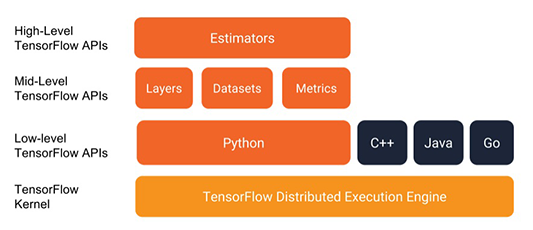
There are two types of estimators; you can either choose the pre-made Estimators, alternatively, you can write your own custom Estimators. Estimators-based models can be run on local hosts as well as on distributed multi-server environment without changing your model. In addition, you can run Estimators-based models on CPUs, GPUs, or TPUs without having to record your model.
What are the four main features of TensorFlow Estimators?
- Training- they will train a model on a given input for a fixed number of steps
- Evaluation- they will evaluate the model based on a test set.
- Prediction- estimators will run inference using the trained model.
- Export your model for serving.
On top of that, the Estimator includes default behavior common to training jobs, such as saving and restoring checkpoints, creating summaries, etc. An Estimator will require you to write a model_fn and an input_fn that correspond to the model and input portions of your TensorFlow graph.
The agentic AI playbook for the enterprise

What are the benefits of TensorFlow Estimators?
- Estimators simplify sharing implementations between model developers.
- You can develop a great model with high-level intuitive code, as they usually are easier to use if you need to create models compared to the low-level TensorFlow APIs.
- Estimators are themselves built on tf.keras.layers, that makes customization a lot easier.
- Estimators will make your life easier by building the graph for you.
- Estimators provide a safely distributed training loop that controls how and when to:
- build the graph
- initialize variables
- load data
- handle exceptions
- create checkpoint files and recover from failures
- save summaries for TensorBoard
Additional resources on the TensorFlow Estimator API
Frequently asked questions
What's the difference between pre-made and custom Estimators?
TensorFlow's Estimator API offers two types of Estimators: pre-made Estimators that come ready to use, and custom Estimators that you write yourself. Both types represent a complete model and can be run on local hosts or in a distributed multi-server environment without changing the underlying model. This flexibility lets you choose a ready-made solution for common tasks or build a custom Estimator when your use case requires it.
What do I need to write to build an Estimator?
An Estimator requires you to write a model_fn and an input_fn that correspond to the model and input portions of your TensorFlow graph. The model_fn defines the model itself, while the input_fn handles the data that feeds into it. Estimators are themselves built on tf.keras.layers, which makes customizing these functions easier.
Can Estimator-based models run on different hardware without modification?
Yes, Estimator-based models can run on CPUs, GPUs, or TPUs without having to rewrite your model. They can also move between a local host and a distributed multi-server environment without changing the model itself. This portability is one of the core design goals of the Estimator API.
What actions can an Estimator perform once it's built?
Estimators encapsulate four main features: training, evaluation, prediction, and exporting your model for serving. Training runs the model on a given input for a fixed number of steps, evaluation checks the model against a test set, and prediction runs inference using the trained model. On top of these features, the Estimator includes default behavior common to training jobs, such as saving and restoring checkpoints and creating summaries.
Why choose Estimators over low-level TensorFlow APIs?
Estimators are generally easier to use than low-level TensorFlow APIs because they let you develop a model with high-level, intuitive code while the Estimator builds the graph for you. They also simplify sharing implementations between model developers. In addition, Estimators provide a safely distributed training loop that controls building the graph, initializing variables, loading data, handling exceptions, creating checkpoint files, recovering from failures, and saving summaries for TensorBoard.
Get the latest posts in your inbox
Subscribe to our blog and get the latest posts delivered to your inbox.